
Coffee has moved beyond a daily beverage in India; it has become a lifestyle, and brands like Starbucks are leading this transformation. The Starbucks Franchise Cost in India is a major interest among entrepreneurs who want to enter the premium café business and build a brand-driven venture. With Starbucks serving millions of customers worldwide and operating 38,000+ stores globally, the company has created a strong identity around quality coffee, modern spaces, and customer experience.
However, Starbucks follows a different expansion strategy in India compared to many other food and beverage brands. Instead of offering regular franchise opportunities, Starbucks operates through a partnership model with Tata Consumer Products. This makes understanding its investment structure, business model, and market approach essential for aspiring café owners.
As India’s café market continues to expand with rising demand for premium dining experiences, Starbucks remains an inspiring example for entrepreneurs exploring opportunities in the coffee industry.
Starbucks in India – Brand Overview
Starbucks Corporation entered the Indian market in 2012 through a joint venture with Tata Consumer Products, operating under the name Tata Starbucks Private Limited. Since its launch, Starbucks has established itself as one of India’s leading premium coffeehouse brands, catering to urban consumers seeking high-quality coffee and a comfortable café experience.
The company offers a diverse menu that includes handcrafted beverages, espresso-based drinks, teas, snacks, desserts, and locally inspired food options tailored to Indian tastes. Starbucks has expanded steadily across major cities such as Delhi, Mumbai, Bangalore, Hyderabad, Pune, and Chennai, opening outlets in malls, business districts, airports, and high-footfall commercial locations.
The brand is known for its premium positioning, strong customer loyalty, sustainable sourcing practices, and modern store designs. With India’s growing café culture and increasing demand for specialty coffee, Starbucks continues to strengthen its presence and expand its footprint across the country.
Starbucks India Business Models & Ownership Structure
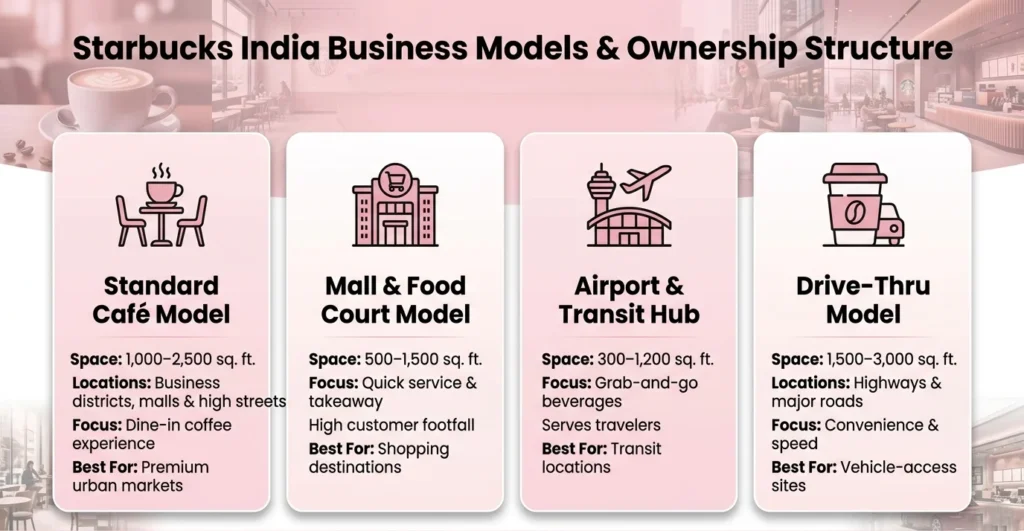
Starbucks operates differently from many traditional food franchise brands in India. Instead of offering direct franchises to individual investors, the company primarily follows a licensing and company-operated business model through its partnership with Tata Consumer Products. Depending on location type and customer demand, Starbucks outlets may be established in different formats such as premium cafés, mall stores, airport outlets, and drive-thru locations.
1. Standard Café Model – Most Common Starbucks Format
This is the most widely used Starbucks outlet format in India. These stores offer the complete Starbucks experience with dine-in seating, premium coffee beverages, snacks, desserts, and workspace-friendly environments.
- Space: 1,000–2,500 sq. ft.
- Investment: ₹1.5 Crores – ₹4 Crores+
- Menu: Coffee beverages, teas, sandwiches, desserts, bakery products, snacks
- Profit Potential: High in premium urban locations
- Best Locations: Business districts, malls, high streets, commercial hubs
- Best For: Large-scale investors and licensing partners
This model focuses on customer experience, longer visits, and premium brand positioning.
2. Mall & Food Court Model – High Footfall Format
These Starbucks outlets are located inside shopping malls and food courts where customer traffic remains consistently high throughout the year.
- Space: 500–1,500 sq. ft.
- Investment: ₹1 Crore – ₹3 Crores+
- Menu: Core Starbucks beverages, quick snacks, takeaway items
- Profit Potential: Strong due to steady mall traffic
- Best Locations: Premium malls and shopping centers
- Best For: Locations with heavy daily customer movement
The format emphasises quick service while maintaining Starbucks’ premium customer experience.
3. Airport & Transit Hub Model – Premium Revenue Format
Starbucks operates stores in airports, railway terminals, and major transit locations where travelers seek premium beverages and food options.
- Space: 300–1,200 sq. ft.
- Investment: ₹2 Crores – ₹5 Crores+
- Menu: Coffee, beverages, packaged snacks, ready-to-eat items
- Profit Potential: Very High due to premium pricing opportunities
- Best Locations: Airports, metro stations, transportation hubs
- Best For: Strategic high-footfall travel locations
These outlets often benefit from continuous customer flow and higher average spending per customer.
4. Drive-Thru Model – Fast-Growing Format
Drive-thru Starbucks stores are becoming increasingly popular as convenience-focused coffee consumption grows in India.
- Space: 1,500–3,000 sq. ft. including parking access
- Investment: ₹2 Crores – ₹6 Crores+
- Menu: Full Starbucks menu with quick-order service
- Profit Potential: High in automobile-heavy markets
- Best Locations: Highways, major roads, suburban commercial zones
- Best For: Long-term investors with access to large commercial spaces
This format combines convenience with premium coffee service and has strong growth potential.
Does Starbucks offer a franchise in India
No, Starbucks does not offer a traditional franchise model in India. Unlike many food and beverage brands that allow individual entrepreneurs to purchase and operate franchise outlets, Starbucks follows a different business strategy in the Indian market. The company entered India in 2012 through a 50:50 joint venture between Starbucks Corporation and Tata Consumer Products, operating under the name Tata Starbucks Private Limited.
All Starbucks stores in India are generally company-operated or managed through approved licensing arrangements under this partnership. As a result, independent investors cannot directly apply for a standard Starbucks franchise in the same way they can with many other restaurant or café chains. Starbucks maintains strict control over store operations, product quality, customer experience, employee training, and brand standards to ensure consistency across all locations.
Although direct franchising is not available, large-scale commercial partnerships or licensing opportunities may occasionally be considered through the company’s official business channels. Investors interested in the Starbucks business model should understand that ownership opportunities are significantly more restricted compared to traditional franchise brands operating in India.
Starbucks Franchise vs Licensing Model vs Join Venture Model
Many investors use the terms franchise, licensing, and joint venture interchangeably, but these business models are very different. Starbucks primarily uses licensing and joint venture arrangements rather than traditional franchising in many international markets, including India.
| Factors | Starbucks Franchise | Licensing Model | Joint Venture Model |
| Ownership | Independent franchise owner | License holder operates under brand approval | Two companies jointly own and operate business |
| Brand Control | Moderate | High | Very High |
| Investment by Local Partner | High | High | Shared between partners |
| Operational Freedom | Relatively Flexi6 | Limited Flexibility | Controlled jointly |
| Profit Sharing | Franchisee keeps profits after fees | Licensee pays licensing fees | Profits shared between partners |
| Training & Standards | Brand provides guidelines | Strict Brand Standards | Joint management system |
| Common in India for Starbucks? | No | Limited | Yes |
| Risk Level | Franchise owner bears most risk | License holder bears operational risk | Risks shared by both partners |
Entrepreneurs cannot directly buy a Starbucks franchise in India. Starbucks primarily operates through its joint venture with Tata, making the Indian business modlel very different from standard food franchise opportunities.
Starbucks Franchise Cost in India – Complete Investment Breakdown
Since Starbucks does not offer a traditional franchise in India, there is no officially published franchise fee for individual investors. However, for educational and business planning purposes, investors often estimate the capital required to establish a Starbucks-style licensed or premium café outlet. The actual investment can vary significantly depending on location, outlet size, city, rental costs, and licensing arrangements.
Estimated Starbucks Outlet Investment Breakdown
| Expense Category | Estimated Cost |
| Licensing / Partnership Cost | Case-by-case basis |
| Commercial Space Deposit | ₹20 Lakhs – ₹1 Crores+ |
| Interior Design & Store Fit-Out | ₹40 Lakhs – ₹1.5 Crores |
| Furniture & Seating | ₹10 Lakhs – ₹40 Lakhs |
| Coffee Machines & Equipment | ₹25 Lakhs – ₹1 Crores |
| Kitchen Equipment & Appliances | ₹10 Lakhs – ₹50 Lakhs |
| Initial Inventory & Supplies | ₹5 Lakhs – ₹20 Lakhs |
| Technology & POS Systems | ₹3 Lakhs – ₹15 Lakhs |
| Staff Recruitment & Training | ₹5 Lakhs – ₹20 Lakhs |
| Licenses & Regulatory Approvals | ₹1 Lakh – ₹10 Lakhs |
| Initial Marketing & Launch Activities | ₹5 Lakhs – ₹25 Lakhs |
| Working Capital Reserve (6–12 Months) | ₹20 Lakhs – ₹1 Crores+ |
Estimated Total Investment by Outlet Type
| Outlet Format | Approximate Investment |
| Small Café Format | ₹1.5 Crores – ₹3 Crores |
| Standard Starbucks Café | ₹3 Crores – ₹6 Crores |
| Premium High-Street Outlet | ₹5 Crores – ₹10 Crores+ |
| Airport / Transit Hub Store | ₹7 Crores – ₹15 Crores+ |
| Large Flagship Store | ₹10 Crores – ₹20 Crores+ |
Because Starbucks India operates through Tata Starbucks Private Limited and not through a traditional franchise system, these figures should be considered estimated business planning costs rather than official franchise fees. Any partnership, licensing, or expansion opportunity would typically be evaluated individually by Starbucks and its Indian partner, Tata Consumer Products.
Starbucks Franchise Profit in India
Although Starbucks does not offer a traditional franchise in India, many investors are interested in understanding the profit potential of a Starbucks-style licensed or company-operated café. Profitability depends heavily on factors such as location quality, daily customer footfall, average order value, rental costs, operational efficiency, and local market demand.
Premium Starbucks outlets located in malls, business districts, airports, and high-street commercial areas generally benefit from strong brand recognition and higher customer spending. Because Starbucks is positioned as a premium coffee brand, its average transaction value is usually higher than that of many local cafés and quick-service restaurants.
Estimated Revenue & Profit Potential
| Metric | Estimated Range |
| Average Monthly Revenue | ₹15 Lakhs – ₹80 Lakhs+ |
| Premium Location Revenue | ₹50 Lakhs – ₹1 Crore+ per month |
| Gross Profit Margin | 55% – 70% |
| Net Profit Margin | 10% – 25% |
| Average Customer Spend | ₹250 – ₹700+ |
| Break-even Period | 3 – 7 Years |
Key Factors Affecting Profitability
- Location Quality: Premium locations with strong footfall often generate significantly higher revenue.
- Customer Volume: Daily customer traffic directly impacts beverage and food sales.
- Rental Costs: High rentals in malls and commercial districts can reduce profit margins.
- Operational Efficiency: Effective inventory management and staff productivity improve profitability.
- Brand Loyalty: Starbucks benefits from a loyal customer base and repeat visits.
- Delivery & Online Orders: Partnerships with delivery platforms can provide additional revenue streams.
Seasonal Revenue Opportunities
Starbucks outlets often experience higher sales during:
- Festive seasons
- Holiday periods
- Winter months
- Corporate events
- Student examination seasons
- Weekend and holiday traffic peaks
Return on Investment (ROI)
| Outlet Type | Expected ROI Timeline |
| Small Premium Café | 3 – 5 Years |
| Standard Starbucks Outlet | 4 – 6 Years |
| Airport / Transit Location | 5 – 7 Years |
| Flagship Store | 5 – 8 Years |
Overall, Starbucks remains one of the strongest premium café brands in India. While investment requirements are substantial, the combination of strong brand value, growing coffee consumption, premium pricing, and customer loyalty can create attractive long-term profit potential when operated in the right location with efficient management.
Requirements & Eligibility Criteria for a Starbucks Franchise in India
Since Starbucks does not offer a traditional franchise model in India, there are no publicly disclosed franchise eligibility requirements for individual investors. However, businesses interested in potential licensing, partnership, or large-scale commercial opportunities should generally meet strict financial, operational, and location-related criteria. Starbucks places significant emphasis on brand consistency, customer experience, and operational excellence.
Financial Requirements
Starbucks outlets require substantial investment due to premium store design, high-quality equipment, and prime commercial locations.
| Requirement | Estimated Criteria |
| Minimum Investment Capacity | ₹1.5 Crores – ₹10 Crores+ |
| Working Capital Reserve | 6–12 Months Operating Expenses |
| Business Financial Stability | Strong Financial Background Preferred |
| Creditworthiness | Good Financial Standing |
Investors should be capable of handling setup costs, staff salaries, inventory expenses, rent, and ongoing operational requirements.
Space Requirements
Location plays a major role in Starbucks’ business success.
| Outlet Format | Space Requirement |
| Small Café | 800–1,500 sq. ft. |
| Standard Starbucks Store | 1,500–3,000 sq. ft. |
| Premium Flagship Store | 3,000–6,000+ sq. ft. |
| Drive-Thru Store | 2,000–5,000+ sq. ft. |
Preferred Locations:
- Premium shopping malls
- Business districts
- High-street commercial markets
- Airports
- IT parks
- Universities and educational hubs
Business Experience Requirements
Starbucks generally prefers partners with experience in:
- Food and beverage operations
- Retail business management
- Hospitality industry
- Multi-unit business operations
- Customer service management
Prior experience managing premium consumer-facing businesses can be a significant advantage.
Operational Requirements
- Potential partners should be prepared to maintain:
- Starbucks brand standards
- Premium customer experience
- Food safety and hygiene compliance
- Employee training standards
- Inventory management systems
- Technology and POS infrastructure
Because Starbucks India operates through Tata Starbucks Private Limited, direct franchise opportunities for individual investors are generally not available. Any licensing or partnership opportunity would typically be evaluated on a case-by-case basis by Starbucks Corporation and Tata Consumer Products based on financial capability, operational expertise, and strategic business fit.
Documents Required for Starbucks Partnership
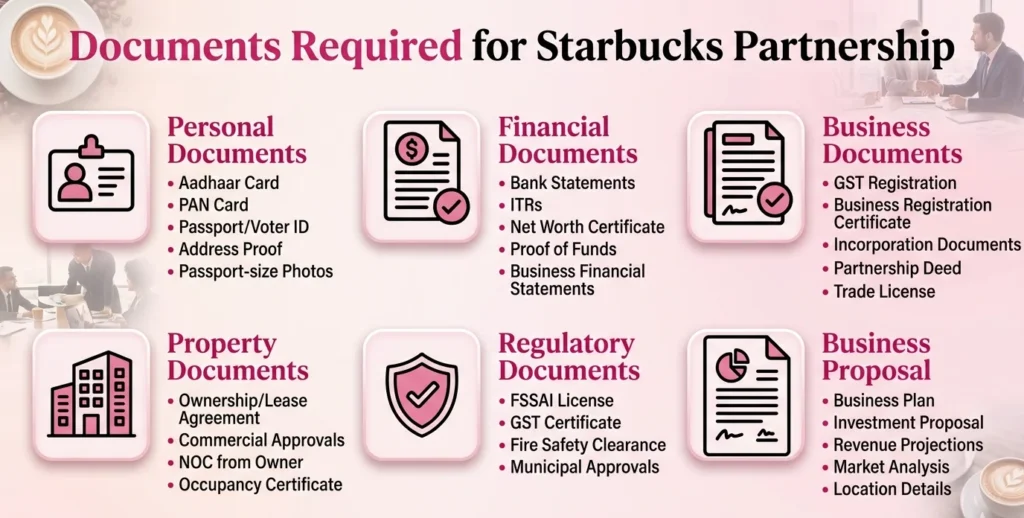
Since Starbucks does not offer a traditional franchise in India and primarily operates through Tata Starbucks Private Limited, understanding the Starbucks franchise cost and business model is important for interested entrepreneurs. Any potential licensing or partnership opportunity typically requires extensive documentation for financial, legal, and operational verification. Proper documentation helps assess the applicant’s financial strength, business experience, and suitability for managing a premium global brand.
Personal Identity Documents
Applicants are generally required to provide valid identity and address proof documents. These may include:
- Aadhaar Card
- PAN Card
- Passport
- Voter ID Card
- Passport-size photographs
- Address proof documents
Financial Documents
Since Starbucks outlets require significant capital investment, applicants must demonstrate strong financial capability through:
- Bank statements
- Income Tax Returns (ITR)
- Net worth certificates
- Proof of funds
- Business financial statements
- Audited balance sheets (for existing businesses)
Business Documents
If the applicant already owns a business entity, additional documentation may be required, including:
- Business registration certificate
- GST registration certificate
- Company incorporation documents
- Partnership deed (if applicable)
- Memorandum and Articles of Association (for companies)
- Trade license
Property Documents
Location plays a major role in Starbucks’ approval process. Applicants may need to submit:
- Property ownership documents
- Lease or rental agreement
- Commercial property approvals
- Building plan approvals
- No Objection Certificate (NOC) from the property owner
- Occupancy certificate (if applicable)
Legal & Regulatory Documents
To comply with Indian regulations and food service requirements, applicants may also need:
- FSSAI license
- GST registration
- Fire safety clearance
- Municipal approvals
- Health and sanitation permits
- Environmental clearances (where required)
Business Proposal Documents
For large-scale licensing or partnership discussions, Starbucks may request:
- Detailed business plan
- Investment proposal
- Market analysis report
- Revenue projections
- Operational strategy
- Proposed store location details
Having complete and accurate documentation can significantly improve the evaluation process and demonstrate an applicant’s readiness to manage a premium coffee retail business under Starbucks’ strict operational and brand standards.
Explore more franchise options in India:
- Amul Franchise Cost in India
- Chai Sutta Bar Franchise Cost
- McDonald’s Franchise Cost in India
- Burger King Franchise Cost in India
Starbucks Franchise Application Process – Step by Step
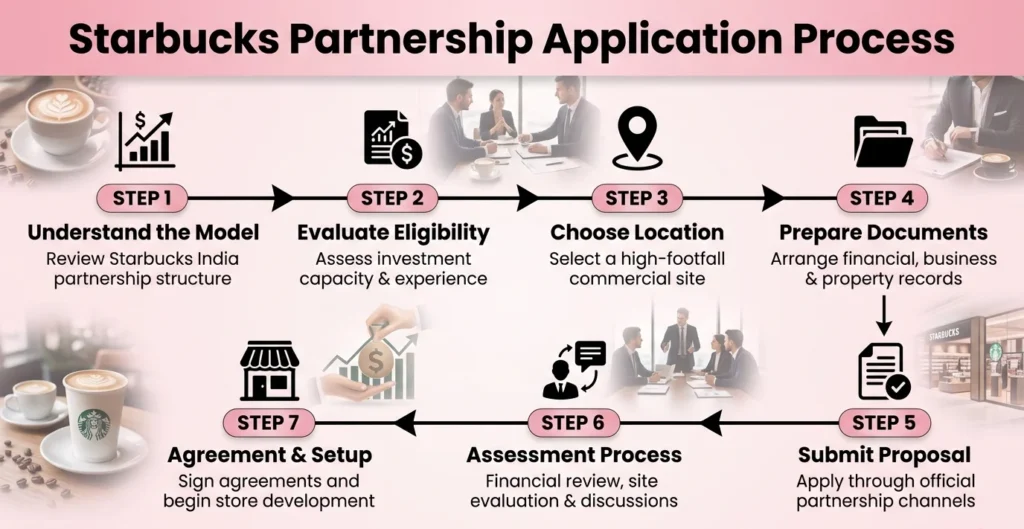
Since Starbucks does not offer a traditional franchise model in India, there is no standard franchise application process available for individual investors. However, businesses interested in potential licensing, commercial partnerships, or large-scale retail collaborations can follow a general evaluation and partnership process.
- Step 1: Research Starbucks’ business model in India and understand that the brand operates through Tata Starbucks Private Limited rather than a direct franchise system.
- Step 2: Assess your financial readiness, business experience, and ability to invest in a premium café business. Starbucks generally prefers financially strong partners capable of managing large-scale operations.
- Step 3: Identify a suitable commercial location in a high-footfall area such as a premium mall, business district, airport, or major urban market.
- Step 4: Prepare all required documents, including identity proof, financial records, property documents, business registrations, and investment details for evaluation.
- Step 5: Contact Starbucks or its Indian operating entity through official corporate business channels and submit your partnership or licensing proposal for review.
- Step 6: If the proposal meets business requirements, the company may conduct financial assessments, location inspections, and partnership discussions before considering any formal agreement.
- Step 7: Upon approval, commercial agreements are finalised, outlet planning begins, and the store is developed according to Starbucks’ global branding and operational standards.
Because Starbucks follows a highly selective expansion strategy in India, partnership opportunities are typically evaluated individually rather than through a standard franchise application process.
What Starbucks Provides – Support & Benefits
Although Starbucks does not offer a traditional franchise in India, any approved licensing or partnership arrangement typically benefits from the company’s globally recognised brand standards, operational expertise, and strong customer loyalty. Starbucks focuses heavily on maintaining a consistent customer experience across all locations, which is supported through extensive operational systems and brand resources.
- Brand Recognition: Starbucks is one of the world’s most recognised coffee brands, attracting customers through its premium positioning, strong reputation, and loyal consumer base. Partners benefit from immediate brand visibility and customer trust.
- Store Design & Branding Support: Starbucks provides standardised store concepts, interior design guidelines, branding elements, and customer experience frameworks to maintain consistency across locations.
- Staff Training Programs: Comprehensive training is provided for store managers, baristas, and operational teams. Training generally covers beverage preparation, customer service, food safety, operational procedures, and brand standards.
- Product Development & Menu Innovation: Partners gain access to Starbucks’ globally developed beverage recipes, seasonal offerings, food products, and menu innovations designed to enhance customer engagement and sales.
- Operational Support: Starbucks maintains detailed operating procedures covering inventory management, store operations, quality control, customer experience, and day-to-day business management.
- Supply Chain & Procurement Assistance: The company supports product consistency through approved suppliers, sourcing systems, coffee procurement standards, and quality assurance processes.
- Marketing & Brand Campaigns: National and regional marketing initiatives, product launches, seasonal promotions, and brand-building campaigns help drive customer traffic and strengthen brand awareness.
- Technology & Digital Ecosystem: Starbucks benefits from advanced digital systems including mobile ordering, loyalty programs, payment integration, customer analytics, and operational management tools.
- Quality Control Standards: Strict quality assurance procedures help maintain consistent product quality, hygiene standards, customer satisfaction, and brand reputation across all locations.
- Long-Term Growth Potential: With India’s growing café culture and increasing demand for premium coffee experiences, Starbucks offers strong long-term business potential backed by the expertise of Starbucks Corporation and Tata Consumer Products.
Overall, Starbucks’ support system focuses on brand strength, operational excellence, employee training, product quality, and customer experience, helping maintain the premium standards that have made the brand successful worldwide.
Alternatives to the Starbucks Franchise in India
Since Starbucks does not offer a direct franchise model in India, investors looking to enter the premium café and coffee business can consider several established franchise opportunities. These brands offer varying investment levels, operational models, and growth potential depending on business goals and budget.
| Brand | Approximate Investment | Royalty Fee | Break-Even Period | Best For |
| Café Coffee Day | ₹10 Lakhs – ₹50 Lakhs+ | 4% – 8% | 2 – 4 Years | First-time café entrepreneurs |
| Barista | ₹15 Lakhs – ₹1 Crore+ | 5% – 8% | 2 – 5 Years | Premium coffee café operators |
| Costa Coffee | ₹50 Lakhs – ₹2 Crore+ | Varies | 3 – 6 Years | Premium international café investors |
| The Coffee Bean & Tea Leaf | ₹50 Lakhs – ₹2 Crore+ | Varies | 3 – 6 Years | Urban premium café markets |
| Tea Time | ₹5 Lakhs – ₹15 Lakhs | Low | 1 – 2 Years | Low-investment beverage businesses |
| Chai Sutta Bar | ₹8 Lakhs – ₹25 Lakhs | 2% – 5% | 1 – 3 Years | Youth-focused café concepts |
| Chaayos | ₹30 Lakhs – ₹1 Crore+ | Varies | 2 – 5 Years | Premium tea café investors |
| Baskin Robbins | ₹10 Lakhs – ₹30 Lakhs | 4% – 8% | 1.5 – 3 Years | Dessert and beverage businesses |
| Belgian Waffle Co. | ₹15 Lakhs – ₹35 Lakhs | 5% – 8% | 1.5 – 3 Years | Café and dessert entrepreneurs |
| Brewbakes | ₹20 Lakhs – ₹60 Lakhs | 5% – 7% | 2 – 4 Years | Full-service café investors |
For investors specifically seeking a Starbucks-like premium café experience, Barista and Costa Coffee are often considered the closest alternatives available through franchise or expansion opportunities in India. However, the ideal choice depends on your investment budget, target customers, and preferred business model.
Conclusion
In conclusion, Starbucks remains one of the world’s most recognisable coffee brands, but it is important to understand that the company does not offer a traditional franchise model in India. While many entrepreneurs search for Starbucks franchise cost details, Starbucks operates through its partnership with Tata Consumer Products under a licensing structure.
While the investment requirements for a Starbucks outlet can be substantial, the brand’s strong reputation, premium customer experience, and growing coffee culture in India make it an attractive business opportunity. Investors should carefully evaluate financial requirements, location potential, operational commitments, and partnership eligibility before pursuing any Starbucks-related business opportunity in India.
