
Food franchising is an excellent way to get into the fast food industry with lower risk and a great brand. Burger King is one of the most popular and internationally available QSRs, known for its iconic flame-grilled burgers, huge customer base, and wide availability. For entrepreneurs researching the Burger King Franchise Cost in India, owning a Burger King franchise offers a chance to join a brand that is well recognized and in high demand among customers. Whether in India or around the world, it provides an opportunity to be part of a successful and established fast-food network.
The brand caters to both seasoned and first-time investors with its structured operations, robust marketing support, and scalable business model. Whether you are interested in the brand, eligibility requirements, or documentation, training, challenges, and FAQs, this guide covers all of the bases.
About Burger King

Burger King is one of the world’s leading quick-service restaurant brands, known for its flame-grilled Whopper and customizable menu options. It was established in 1954 and has since expanded to become a global brand with thousands of locations worldwide. Burger King focuses on quality ingredients, bold flavors, and consistent customer experience, making it a strong competitor in the fast-food market.
The brand has localized its menu to suit the Indian palate but still retains its international identity in India. The focus on operational efficiency, innovation, and aggressive marketing campaigns has contributed to Burger King’s loyal customer base. This international recognition for franchise partners means instant trust, continuous traffic, and a proven business model.
Why Consider a Burger King Franchise?
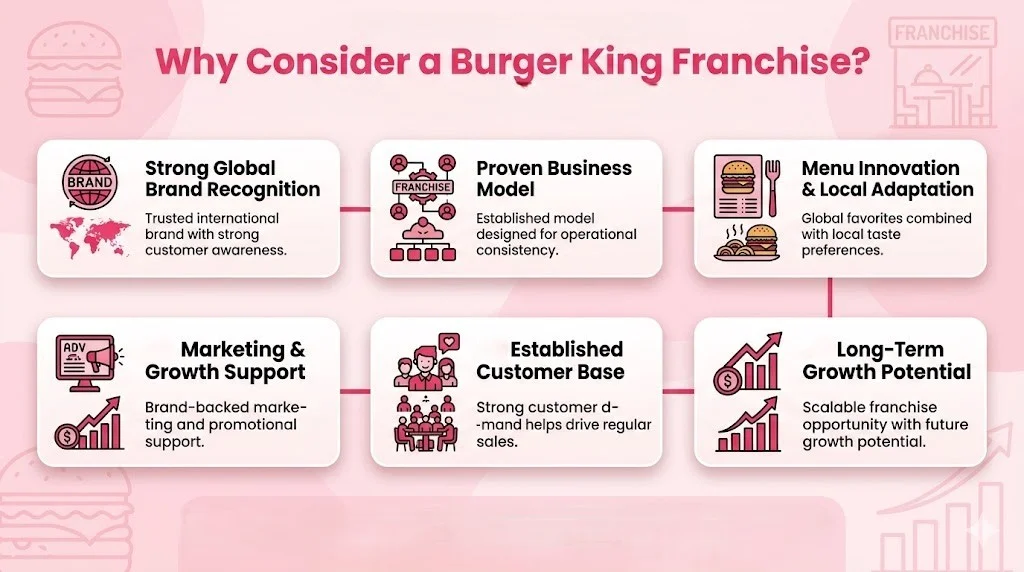
Burger King franchisees are not only entering into a partnership with a trusted QSR brand, but they are also investing in a proven operational system.
- Strong Global Brand Recognition: The worldwide presence of Burger King lets customers know that they will be served with instant trust. The brand’s iconic products and aggressive marketing drive consistent footfall, reducing the time and cost needed to build brand awareness from scratch.
- Proven Business Model: Franchisees benefit from having a standardized operating system that has been fine-tuned over decades. This reduces the chances of trial and error and ensures uniformity of quality, service, and profitability between sites.
- Menu Innovation & Local Adaptation: Burger King updates its menu regularly and customizes it to the local tastes and needs. This mix of innovation and localization helps retain customers and encourages them to return.
- Marketing & Growth Support: National campaigns, digital promotions, and launch support all drive quick customer acquisition and scale efficiently in competitive markets.
Burger King Store Formats in India
- Food Court Outlets: Food court outlets are mini-sized Burger King restaurants found in malls, airports, multiplexes, and large commercial buildings. The food court-style seating is primarily for takeout and fast service. This format can be useful at higher footfall or if the customers turnover quickly due to the reduced space and set-up requirements.
- High-Street / Inline Stores: Burger King outlets are found in the high street areas on busy commercial roads and marketplaces. These shops typically have dine-in, takeaway, and delivery options. The format is beneficial in urban settings, primarily because of the high visibility and direct customer access, and the frequent traffic from people all day long.
- Mall Full-Service Stores: Full-service Burger King restaurants are larger outlets that have specific seating areas. They are situated in high-end shopping malls and target young consumers, families, and shoppers. This format can accommodate increased sales volume because of the guaranteed mall traffic, weekend traffic, and extended hours.
- Drive-Thru Outlets: Burger King drive-through restaurants are intended for people who would prefer to not leave their car. These stores are usually located on the highways or in suburban areas and need more space. They are perfect for high-speed service, long hours, and travelers and commuters.
- Transit & Non-Traditional Stores: These are in the form of kiosks and express counters in airports, railway stations, colleges, IT parks, and hospitals. They offer simple menus and grab-and-go or snack foods. Smaller, they are subject to captive audiences and high daily footfall with small seating or space.
Burger King Franchise Cost in India
The total investment required to open a Burger King outlet in India varies widely based on location, store format, and size. Overall estimates range from about ₹5 crore to ₹10 crore+, particularly for high-street or standalone restaurants in metro or tier-1 cities.
Total Investment Breakdown
- Franchise Fee: A one-time franchise/brand fee is typically ₹40 lakhs – ₹50 lakhs, which allows you to use the Burger King brand, systems, and operational support.
- Setup Cost (Infrastructure & Construction): Setting up the outlet includes civil work, kitchen layout, electricals, plumbing, signage, and branding. It can cost approximately ₹2 crore – ₹4 crore.
- Interior & Equipment: Interior design, seating, furnishings, kitchen equipment, POS systems, and technology investments generally fall between ₹1.5 crore and ₹2.5 crore.
- Staff & Training: Recruiting and initial training expenses for staff and management typically require ₹20 lakhs – ₹40 lakhs, including wages during pre-opening training.
- Initial Inventory: The initial stock of raw materials, packaging, and consumables usually costs between ₹15 lakhs and ₹25 lakhs before opening day.
Space & Location Requirements
A Burger King outlet in India needs to choose the right space and location to ensure robust sales and profitability. Outlet space typically ranges from about 1,000 to 3,000 square feet, depending on the format: standalone dine-in restaurants, food court kiosks, or drive-through outlets.
High-visibility sites with consistent pedestrian traffic are preferred, such as shopping malls, high streets, commercial hubs, transport hubs, and even standalone highway sites for drive-through models. Frontage is crucial, as the visibility of the road/walkways will drive walk-in traffic and brand recall.
Different target audiences, including families, office workers, and students, visit the location, driving up sales every day. The overall success and revenue potential of the franchise are heavily influenced by how well the location attracts regular footfall and supports delivery services.
Profit Margin & ROI
The profit margin and ROI of a Burger King franchise in India rely on various factors, including location, sales volume, cost management, and efficiency. Net profit margin, typically 10% to 18%, is calculated by subtracting operating expenses such as rent, salaries, utilities, supplies, marketing contributions (usually 4%–4.5%), and royalty fees.
The monthly earnings vary depending on the site performance but are typically around ₹25 lakh to ₹75 lakh or higher in high-traffic zones. Many outlets make consistent profits and can pay off the initial investment within 3-5 years, depending on the specific location, lease rate, and daily sales.
Suggested Read:
Eligibility Criteria to Open Burger King Franchise
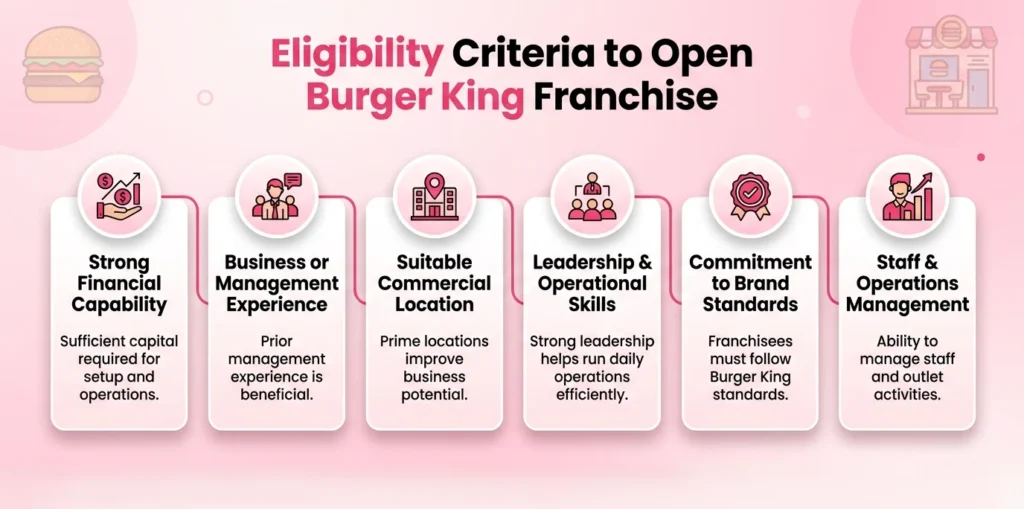
Before applying, potential franchisees must meet certain financial and operational requirements set by Burger King.
- Financial Capability: Applicants should possess good financial standing to invest in setup costs, working capital, and regular operating expenses without external financing.
- Business or Management Experience: Experience in QSR is a plus, but excellent business management and leadership skills are required to manage day-to-day operations, staffing, and customer service.
- Location & Infrastructure Readiness: A high-traffic, well-visible, and spacious site is needed for the franchise. Typically, these are located in malls, high streets, and commercial areas.
- Commitment to Brand Standards: To guarantee Burger King’s quality and service standards are met, franchisees have to adhere strictly to Burger King’s operational guidelines.
Documents Required For a Burger King Franchise
To apply for a Burger King franchise, applicants are generally required to submit the following documents during different stages of evaluation and approval. Since the Burger King franchise cost in India involves a significant investment, the company carefully reviews all required documents before granting franchise approval.
- Identity Proof – PAN Card, Aadhaar Card, Passport, or Voter ID
- Business Registration Documents – Certificate of Incorporation, Partnership Deed, or Proprietorship Proof
- Financial Documents – Net worth certificate, last 2–3 years ITRs, audited financial statements, bank statements
- Address Proof – Residential and business address proof
- Property Documents – Ownership papers or lease agreement for the proposed outlet location
- Site Layout & Floor Plan – Detailed drawings of the outlet space
- GST Registration Certificate
- Trade License / Shop & Establishment License
- Food Safety License (FSSAI)
- Company Profile / Business Background Summary
- Photographs of Applicant & Proposed Location
Steps to Open a Burger King Franchise
- Initial Inquiry & Application: Fill out a franchise inquiry or application outlining your financial ability, your business experience, and your desired Burger King location.
- Screening & Discussion: The brand will check your profile and might schedule meetings or interviews to evaluate your eligibility, investment potential, and commitment.
- Location Evaluation: Potential sites undergo assessment prior to approval, considering footfall, visibility, demographics, and commercial suitability.
- Franchise Agreement Signing: The franchise agreement is signed upon approval and specifies the investment, operating instructions, and brand requirements.
- Store Setup & Training: The construction of the outlets, installation of equipment, hiring of staff, and required training all start as directed by Burger King.
- Launch & Operations: Once the final inspection is complete, the outlet is opened with marketing support and continuous operational support from the brand.
Training & Support from Burger King
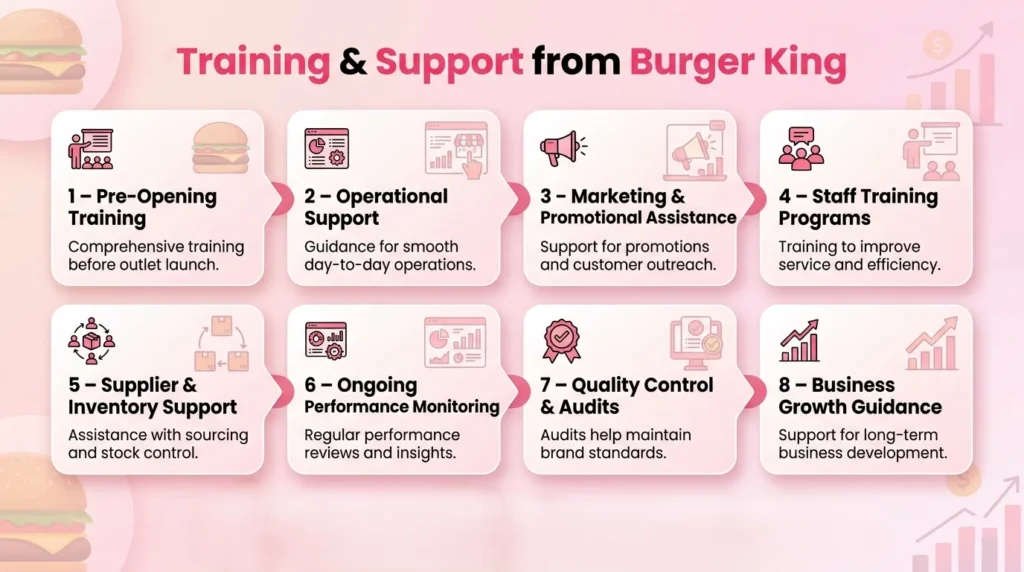
Burger King offers extensive support for the success of the franchise.
- Pre-Opening Training: Franchise owners and important team members are trained extensively before launch, providing them with a solid foundation of knowledge and skills for the restaurant industry, food preparation, hygiene and safety standards, and customer service.
- Operational Support: Burger King offers continuous operational support with its dedicated support teams that assist with inventory management, supplier coordination, staff scheduling, and problem-solving to ensure smooth, efficient, and standardized restaurant operations.
- Marketing & Promotions: The brand’s marketing campaigns are conducted across the country and in the region to increase awareness and customer foot traffic. Franchisees are also provided with strategic input for local promotions, Internet marketing, and launch campaigns to help ensure maximum reach and sales.
- Ongoing Performance Monitoring: The brand standards are maintained through regular quality audits, operational reviews, and performance evaluations. Regular monitoring and evaluation enable franchisees to pinpoint areas for improvement, optimize operations, and gradually boost their profit.
Challenges of Running a Burger King Franchise
With support from its brand, there are some challenges to being a franchise owner.
- High Initial Investment: The initial cost of starting a Burger King franchise includes franchise fees, construction, equipment, and working capital. This demands very robust financial planning, liquidity, and a long-term commitment to make sustainable returns.
- Strict Operational Guidelines: Consistent service, processes, and recipes must be followed by the franchise owners. This helps with consistency, but could make it harder to adjust prices, menus, or how the outlet is run on a day-to-day basis.
- Intense Competition: There are many global and local quick-service restaurant brands, and they’re all competitive. Franchisees are constantly required to provide the type of food, service, and experiences that draw customers in and ensure repeat business.
- Staff Management: Staff management is a huge problem in the food service industry because of high employee turnover. The quality and efficiency of services rely on ongoing recruitment, periodic training, performance checks, and motivation.
Conclusion
A Burger King franchise is a great opportunity to enter the fast food industry with the backing of a globally recognized brand. While evaluating the Burger King Franchise Cost in India, entrepreneurs also benefit from proven business systems, strong marketing support, comprehensive training, and efficient operational guidance. These advantages help reduce many of the risks typically associated with starting a new business from scratch.
But it’s all about matching the eligibility requirements, putting up enough money, picking the right location, and ensuring you follow all the brand requirements.
There are difficulties such as competition and investment, but if executed properly and managed actively, sustainable growth and profitability can be achieved. With preparation and strategic planning, a Burger King franchise can be a rewarding long-term business for entrepreneurs looking into a scalable and high-visibility enterprise in the QSR space.
