
Starting a business in India can be very much like a gamble with tremendous risks, but an Amul franchise presents a compelling case built on a solid foundation. Amul is a household name in India for generations, synonymous with quality milk products. Its cooperative model favoring millions of farmers supplying milk has accorded the brand an unmatched degree of credibility and recall across the nation.
India’s dairy industry is already thriving, with the value projected to grow to ₹30 trillion by 2028. Amul’s continuously diversifying portfolio of products ranging from milk and butter to ice creams and pizzas is, together with this growth spurt, making its franchise a very profitable and secure investment. Amul’s market position and financial strength are ensured, with an interim turnover of ₹72,000 crore in the last financial year. One of the biggest advantages of the Amul franchise model is that there is no royalty or revenue-sharing fee, so franchisees retain all their earnings, which makes the Amul franchise cost a lucrative and profitable business venture. Keep reading to learn if an Amul franchise business venture is suitable for you.
Overview of Amul’s Brand Strength and Cooperative Legacy
Amul is India’s most trusted and well-known brand, associated with dairy excellence. It was formed in 1946 by Tribhuvandas Patel with the help of Sardar Vallabhbhai Patel as a cooperative to empower farmers from the region against exploitative traders. Dr. Verghese Kurien, the “Father of the White Revolution,” has largely made the brand a success, turning Amul into the national power and world’s largest milk producer it is today.
Amul operates on a unique cooperative model, where farmers remain the owners, thereby offering a continuous supply of quality products. This strong support, coupled with a wide range of products including milk, butter, cheese, ice cream, and other food items, makes an Amul franchise a safe and lucrative business opportunity in India‘s growing dairy industry. The model is especially attractive because of its no-royalty fee option, which enables franchisees to keep all their earnings, making the Amul franchise a good investment.
| Feature | Description |
| Full Name | Anand Milk Union Limited |
| Managed By | Gujarat Cooperative Milk Marketing Federation Ltd. (GCMMF) |
| Founded | 1946 |
| Founder (Key Figure) | Tribhuvandas Kishibhai Patel, Dr. Verghese Kurien |
| Headquarters | Anand, Gujarat, India |
| Ownership Model | Cooperative |
| Number of Milk Producers | 3.6 million (approx.) |
| Product Categories | Milk, Butter, Cheese, Ice Cream, Ghee, Chocolates, Beverages, Dairy Whitener, Paneer, Sweets, and more |
| Brand Recognition | Iconic Indian brand with very high brand recall |
| Market Position | India’s largest food brand, World’s largest vegetarian cheese brand |
| Tagline | “The Taste of India” |
| Turnover (2024) | $7 billion (₹59,545 crore) |
| Distribution Network | Pan-India, extensive network reaching millions of outlets |
| Global Presence | Exporting to over 50 countries |
What is the Amul Franchise Model?
Amul has a simple business model with two major franchise types:
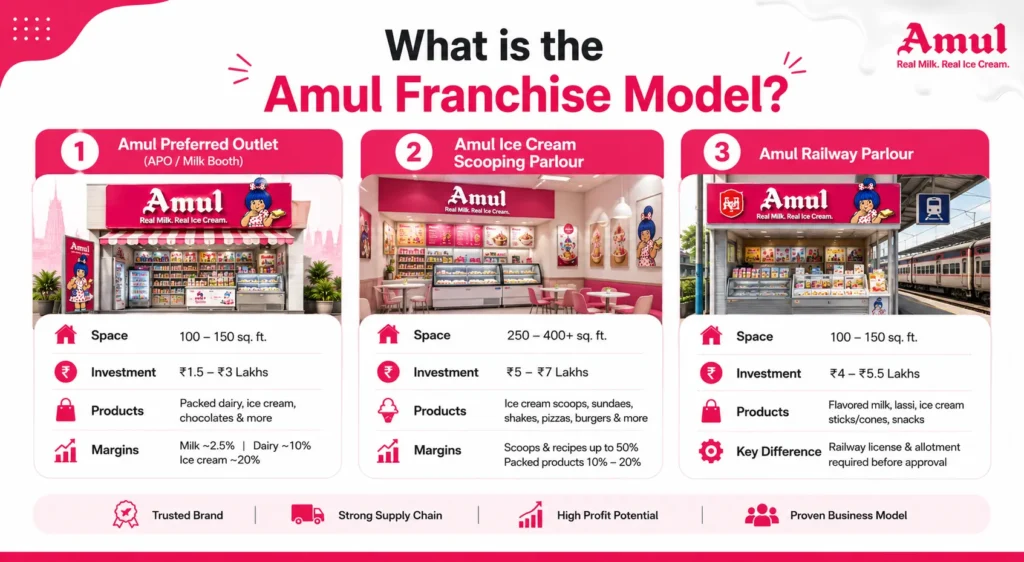
1. Amul Preferred Outlet (APO / Milk Booth)
This is the most common, small-scale model designed for high-footfall residential areas, local markets, or institutions. It focuses on high-volume, daily essential dairy products.
- Space Required: 100 to 150 sq. ft.
- Estimated Investment: ₹1.5 Lakhs to ₹3 Lakhs
- Product Scope: Complete packed retail range (Pouched milk, curd, paneer, butter, cheese, chocolates, and pre-packed ice creams).
- Average Margins: Pouched milk (~2.5%), Milk products (~10%), Pre-packed ice cream (~20%).
2. Amul Ice Cream Scooping Parlour
A premium, larger-format retail store focused heavily on the high-margin frozen dessert and live-counter snack segment.
- Space Required: 250 to 400+ sq. ft.
- Estimated Investment: ₹5 Lakhs to ₹7 Lakhs
- Product Scope: Recipe-based ice cream scoops, sundaes, shakes, floats, and live-cooked quick food items like Amul-branded pizzas, burgers, and sandwiches.
- Average Margins: Recipe-based items and scoops offer the highest profitability at up to 50%. Packed products remain at standard 10%–20% margins.
3. Amul Railway Parlour
A specialized variant of the kiosk format built specifically inside railway platforms or station transit hubs to target travelers and daily commuters.
- Space Required: 100 to 150 sq. ft. (allocated stall space).
- Estimated Investment: ₹4 Lakhs to ₹5.5 Lakhs (Higher due to specific railway kiosk fabrication and platform security compliance).
- Product Scope: Fast-moving, ready-to-consume items on the go (Flavored milk bottles, buttermilk/lassi packets, ice cream sticks/cones, and packaged snacks).
- Key Difference: You must first independently secure the allotment or license tender from Indian Railways/IRCTC before Amul approves and triggers the supply chain setup
Amul Franchise Cost in India – Breakdown Table (All 3 Models)
| Feature | Amul Preferred Outlet (APO) | Amul Ice-Cream Scooping Parlour (AISPP) | Railway Parlour |
| Space Required | 100-150 sq. ft. | 300+ sq. ft. | 100-150 sq. ft. |
| Brand Security (Non-Refundable) | ₹25,000 | ₹50,000 | ₹25,000 |
| Renovation & Interiors | ₹1,00,000 | ₹4,00,000 | ₹1,00,000 |
| Equipment Cost | ₹70,000 | ₹1,50,000 | ₹70,000 |
| Total Initial Investment | ₹2 Lakhs | ₹6 Lakhs | ₹2 Lakhs |
| Products Sold | Packaged products | Packaged + recipe-based | Packaged products |
| Profit Margins | 2.5% – 20% | Up to 50% on select items | 2.5% – 20% |
| Royalty Fee | None | None | None |
| Monthly Turnover (Est.) | ₹1.5L – ₹6L | ₹5L – ₹10L+ | ₹1L – ₹4L |
Amul Franchise Profitability: Costs vs. Returns
One of the most significant aspects of the viability of a business is its ability to make profits, and the Amul franchise business model can achieve high returns with no royalty fees.
Estimates of monthly sales turnover
An efficiently run Amul Preferred Outlet can obtain a monthly sales turnover of between ₹1.5 lakhs and ₹6 lakhs, and a Scooping Parlour can get a turnover of ₹5 lakhs to ₹10 lakhs a month or more, subject to location and footfalls.
Profit margins by product category
The profit margins are graded based on the product category:
- Pouch Milk: Low 2.5% margin
- Milk Products (Ghee, Butter, Cheese): Margin of about 10%
- Pre-packaged Ice Creams: Margin of about 20%
- Recipe-based Items: Highest margin of up to 50%, making the Ice-Cream Scooping Parlour highly profitable.
Estimated income & ROI
Without royalty fees, the franchisee keeps all the profit. A Preferred Outlet can achieve a net monthly return of ₹50,000 to ₹1.5 lakhs, while a Scooping Parlour can achieve ₹1.5 lakhs to ₹2.5 lakhs. Most franchisees are in a position to achieve a full ROI within 18 months or even 6 months, bearing witness to the efficiency of the business model.
How to Apply for an Amul Franchise: Step-by-Step Guide
Applying for an Amul franchise is a hassle-free, step-by-step process that can be initiated online. Here is a step-by-step guide:
1. Online Application: Start with the website of Amul and locate the “Amul Parlours” page. There will be an online application form where you need to enter your personal, financial, and proposed location details.
2. Document Submission: You will need to submit a number of documents to support your application. These usually are:
- Personal ID Proof: Aadhaar Card, PAN Card, Voter ID.
- Address Proof: Electricity bill or ration card.
- Property Documents: Sale deed, shop agreement, or a real rent agreement of the premises where the proposed outlet will be located.
- Business Documents: GST registration certificate and FSSAI license.
3. Verification and Site Inspection: After you’ve submitted your application, an Amul representative will review it. Assuming that you qualify on the initial criteria, they will arrange a visit to your proposed location to assess its potential based on foot traffic, commercial viability, and overall potential.
4. Franchise Agreement and Payment: Once your website is accredited, you will be required to sign a binding franchise agreement and pay the initial investment payment, like the non-refundable brand security deposit.
5. Training & Setup: Post-agreement, Amul provides thorough training in store operations, product handling, and customer service. They also facilitate the setup of the store design, branding, and equipment installation. Your franchise is now set to launch officially after this.
Amul Franchise Contact Number & Email
You can easily contact Amul before and after you have made your application for the franchise. On average, 2-3 working days are required for the Amul franchise cost in India helpdesk to respond to the queries received, which are more than 500+ per month.
For any kind of inquiries related to the Aqua products, please reach out to the Amul franchise team using the details given below:
- Phone: +9118002583333
- Email: estore@amul.coop
- Head Office: Anand, Gujarat, India
- Franchise Link: https://amul.com/about-amul-franchise
Documents Required for Amul Franchise
A clean document is required to get the Amul franchise investment sanctioned in India. Nearly 30% of applicants had applications delayed due to missing out on a core document in 2026.There are a minimum of 6 documents that Amul will ask for in 2026 and not submitting some of these is one of the common reasons for delayed application process.
- Identity Proof: provide valid Government issued identity proof (Aadhaar Card, PAN Card, Voter ID).
- Address proof: A valid address can be confirmed by a recent utility bill (Electricity / Water) or ration card of business / residential address.
- Property Documents: Sale Deed / Leave (Let Out) Agreement / Registered Rent Agreement of proposed outlet space.
- GST Registration: If you wish to go ahead with business transaction with the tax law legality then you will need GST background to make your outlet legally active for the business transactions.
- Food Safety and Standards Authority of India (FSSAI) Licence: All outlets that sell foods and/or milk products must get a Food Safety and Standards Authority of India (FSSAI) licence.
Amul Franchise Support & Contact Details
Amul offers robust backend support to its franchisees for a smooth operating experience.
Amul provides assistance in several forms, including signage branding, equipment purchase assistance, marketing material, and an extensive supply chain network. In the event that you want to get answers to any of your questions, you can call the office of the franchise desk on 022-68526666 or send an email to retail@amul.coop. The headquarters office is located at Gujarat Cooperative Milk Marketing Federation, PO Box 10, Amul Dairy Road, Anand 388 001, Gujarat, India.
Amul Franchise Review: Pros & Cons
An Amul franchise is a great business venture for the entrepreneur, but it’s important to weigh both the advantages and disadvantages before investing. The strong position of the company in the market and established business model are the biggest draws, but it can be overly dependent on factors like location and competition.
Pros:
- Brand Worth: You leverage decades of brand recall and trust. Amul is an India brand name, so you don’t need to spend time and money building customer credibility anew.
- No Royalty Fees: One very substantial economic advantage is that you get to keep 100% of your profit after expenses. This is a unique feature that sets the Amul franchise apart from most other franchise ideas.
- Low Investment: The up-front Amul franchise price is low, with models beginning at as low as ₹2 lakhs. This provides a wonderful launch pad into business ownership for budding entrepreneurs who have limited capital.
- High Demand: Milk and dairy products are a daily staple of most Indian families. This means a steady stream of customers and a year-round income stream, no matter the season.
- Complete Support: Amul offers complete support to its franchisees, ranging from assistance in store layout and design to provision of products and marketing assistance. This strong system reduces the risks of operation and enables you to manage the business effortlessly.
Cons:
- Location Dependency: Profitability is mostly tied to getting a high-traffic location. A poor location selection, even with the support of the Amul brand, leads to poor sales and inability to break even on working costs such as electricity and rent.
- Competition: You can have direct competition not only from other Amul stores in the neighboring areas but also from local super markets and milk shops. Even here, some planning and better-than-average customer service are required to differentiate oneself and achieve a loyal clientele.
- Fixed Pricing: As an Amul franchisee, you will be required to maintain the company’s fixed retail prices. This limits your price flexibility and can undermine your competition with local retailers who could be offering discounts.
- Low Margins on High-Grossing Products: While recipe products in scooping parlours have high margins, every day products like pouch milk are typified by very low margins. This means profitability is highly reliant on huge volumes of sales of the product to generate sufficient revenue.
- Limited Customization: The homogenized business model and brand do not provide much room for creativity or customizing of the business. You are required to follow the parameters established by Amul, which is a downside for businessmen who prefer to have more control over the image of their company.
Common Mistakes to Avoid When Starting Amul Franchise
Investors who are new to the field and want to buy an Amul franchise in India are unaware of these working considerations in calculating the cost of the Amul franchise. By 2026 it’s almost 1 out of 4 failing Amul outlets who say that they have failed to meet their monthly profit goals because they have given poor location or undercapitalisation priority.
- Poor Location Selection: If you are selecting a low foot-fall, your daily sales will be proportionately low, always choose the location of a Local Market, School, Hospital or any transit areas.
- Initial investment: The initial investment amount is for the setup while around ₹30,000-₹60,000 of buffer additional monthly investment is required for the monthly running costs including rent, electricity, stock replacement etc.
- FSSAI: If Amul does not have a food licence, the outlet might be closed, fined or even permanently banned from operating by the Amul franchise.
- Trained staff: Failure to staff with trained employees results in the spoilage of perishable dairy products, customer complaints, and a loss of profits.
- Improper Local Marketing: If you are not promoting in the local media as manifest in pamphlets, WhatsApp groups, Google etc, you are missing out on a lot of walk-in customers.
Amul Franchise vs Dairy Day vs Mother Dairy vs Vadilal (2026 Comparison)
| Feature | Amul | Dairy Day | Mother Dairy | Vadilal |
|---|---|---|---|---|
| Investment | ₹2–6 Lakh | ₹4–10 Lakh | ₹5–15 Lakh | ₹5–12 Lakh |
| Franchise Fee | No | Varies | Dealership Model | Varies |
| Royalty | No | Low | No | Low |
| Product Range | Dairy, Ice Cream, Beverages | Ice Cream | Dairy, Grocery | Ice Cream, Frozen Foods |
| Brand Reach | Pan India | South India | North India | Pan India |
| Profit Margin | 10–50% | 20–40% | 4–25% | 20–40% |
| Space Required | 100–300 sq ft | 150–400 sq ft | 150–500 sq ft | 150–400 sq ft |
| Break-even | 12–24 Months | 18–30 Months | 18–30 Months | 18–30 Months |
| Best For | Low-Investment Retail | Ice Cream Outlet | Dairy & Grocery Store | Premium Ice Cream Outlet |
| Overall Rating | 5/5 | 4/5 | 4/5 | 4/5 |
Conclusion: Is Investing in an Amul Franchise Worth It in 2025
Given the minimal initial investment, absence of royalty fees, and high brand value of Amul, franchising is a prudent business step for 2025. The in-built profitability of the business model and the comprehensive support system by Amul minimize risks to nil, making it an excellent choice for both new and seasoned business owners seeking a safe and profitable venture.
The brand’s immense faith and pan-India acceptability assure a steady flow of customers from day one, facilitating prompt return on investment. Having its product range diversified from day-to-day essentials like milk to high-margin ice cream scoops, an Amul franchise collects numerous streams of revenues that can support the business during any period of the year. Also, the brand’s penetration and growth to further geographies, such as tier-2 and tier-3 cities, are excellent long-term profit-making opportunities.
Discover More Franchise Opportunities:
FAQs
How much does an Amul franchise cost in India in 2026?
Royalty fee along with Amul franchise cost In India starts from ₹2 lakhs for a Preferred Outlet and can go up to ₹6 lakhs for an Ice-Cream Scooping Parlour.
How much profit does an Amul franchise make per month?
Depending on location and the volume of sales, monthly profits at the small town outlets range from ₹30,000 to ₹50,000 per month and at high foot value scooping parlours range from ₹1.5 lakh – ₹2.5 lakh per month.
How to apply for an Amul franchise in India?
Please visit the Amul’s official website and complete Amul Parlours application form and submit all documents, do a site inspection, sign the agreement and training on launch.
Does Amul franchise have any royalty or revenue sharing?
There is no Amul Reward or Amul royalty charges nor there is any Amul revenue trade fee. It is a high value low cost model as the franchisees keep 100% of their earnings after paying operating expenses.
What is the break-even period for an Amul franchise?
The investment amount recovered by most of the Amul franchisees range from 6-months to 18-months, depending on their outlets, the location of these outlets, their footfall and monthly sales.
Is Amul franchise profitable in small towns and villages?
Yes. The dairy industry has a daily need for product and a consistent demand. With lower overhead costs, profit from an Amul Preferred Outlet will be ₹30,000 to ₹50,000 per month in a Tier-3 zone as well.
