
Walk past a busy Safal store on a Monday morning, and you will see something that most businesses would kill for — a queue. Real people, every single day, pick up tomatoes, bananas, and milk on their way home. That queue is not an accident. It is the result of 50 years of trust, a farmer-first supply chain, and a brand that India’s middle class has quietly relied on through every economic cycle.
If you have been researching the Mother Dairy Safal franchise, you already sense the opportunity. This guide gives you everything you need to make an informed decision — real 2026 cost data, verified profit margins, the honest pros and cons, and a step-by-step application walkthrough. No fluff, just facts.
Mother Dairy at a Glance — 2026 Numbers That Matter
Before you invest in any franchise, you look at the franchisor. Mother Dairy’s latest publicly disclosed financials leave very little room for doubt about its stability.
| ₹17,500 Cr: Mother Dairy Revenue FY2025 | ₹20,000 Cr: FY2026 Revenue Target | 500+ Stores: Safal Outlets (Pan India) |
| ₹350 Cr: Safal Processing Investment (2025-26) | 1.5 Lakh+ Farmers in Safal Network | 120+ SKUsProducts at Safal Stores |
Source Verified: Revenue and investment figures sourced from Mother Dairy MD Manish Bandlish’s interview with PTI (February 2025) and Business Standard (March 2025). Two new Safal processing plants — one in Vadodara, Gujarat and one in Chittoor, Andhra Pradesh — were confirmed with a combined investment of ₹350 crore, signalling serious long-term expansion of the Safal brand.
What Exactly Is Safal? (And Why It Is Different from a Regular Sabzi Shop)
Safal is Mother Dairy’s horticulture retail brand, launched to do for fruits and vegetables what Mother Dairy did for milk — bring quality, hygiene, and fair pricing under one organised roof. The word itself is Hindi for successful, and living up to its name, Safal has quietly become one of India’s most recognised fresh produce chains.
But here is what separates Safal from your neighbourhood vendor:
- Direct farm sourcing: Safal works with over 1.5 lakh farmers across 20 states, buying 350 metric tonnes of fresh vegetables every single day. No middlemen, no inflated costs.
- Cold chain integrity: Every product that reaches a Safal shelf travels through a temperature-controlled supply chain — something a street vendor simply cannot offer.
- 120+ SKUs: The product range goes well beyond tomatoes and onions. Safal stores carry frozen vegetables, pulses, juices, and a full range of Mother Dairy dairy products including milk, paneer, and curd.
- Quality benchmarking: Each batch is tested at procurement. Customers know that what they pick up at Safal is what it says it is — which is why 60% of urban consumers, per internal surveys, return within the same week.
The Market Opportunity: Why 2026 Is a Good Year to Enter
You are not just buying a franchise. You are entering a market that is structurally growing.
| Market Indicator | Data Point | What It Means for You |
|---|---|---|
| India food processing market size (2026) | ~USD 54.8 billion (₹4.1 lakh crore) | Massive, organised demand for branded fresh produce |
| India fresh produce retail — organised sector share | ~15% (up from 8% in 2019) | Huge room to grow — unorganised still dominates |
| Urban consumers preferring branded fresh produce | 60%+ (post-2020 shift) | Safal’s sweet spot — hygiene-aware urban buyers |
| India fresh food market CAGR (2024–2030) | ~8.4% annually | Your store’s revenue potential grows with the market |
| Mother Dairy FY2025 revenue growth | ~16% (₹17,500 crore) | Franchisor is financially strong & expanding |
| Safal new processing plants (2025-26) | Gujarat + Andhra Pradesh (₹350 Cr) | More SKUs, better supply chain — better margins for you |
The Production Linked Incentive Scheme for Food Processing (PLISFPI) — ₹10,900 crore across 2021-27 — is an additional tailwind that benefits organised players like Safal in procurement infrastructure and cold chain development.
Safal Franchise Formats — Which One Is Right for You?
Mother Dairy offers multiple outlet formats under its ecosystem. Understanding which format fits your budget and location is the first decision you will make.
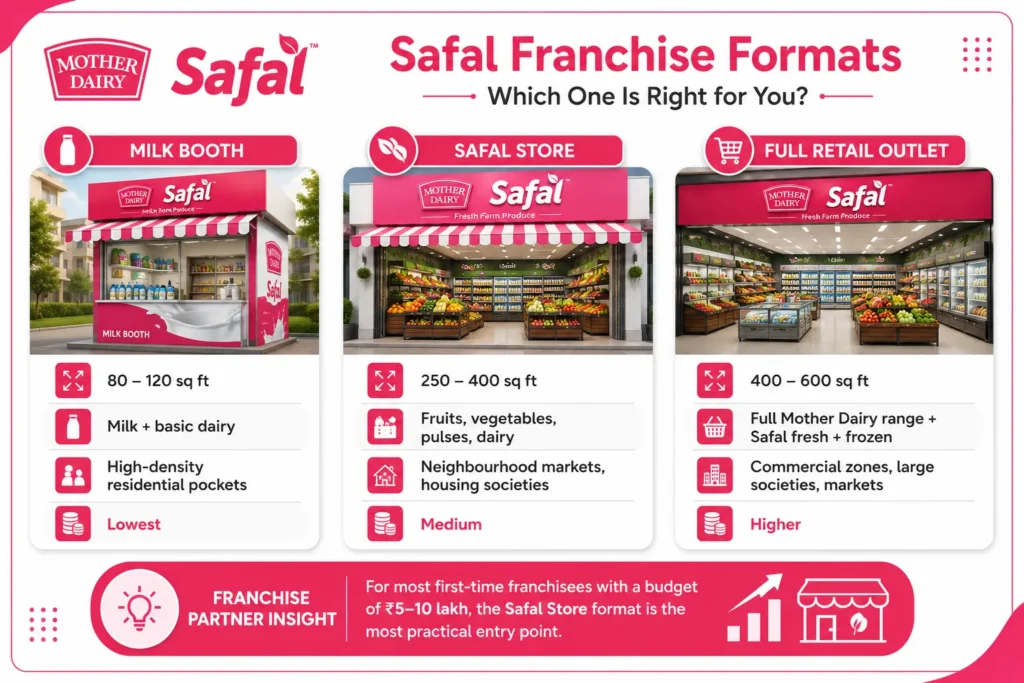
| Format | Size | Products | Ideal For | Relative Investment |
|---|---|---|---|---|
| Milk Booth | 80–120 sq ft | Milk + basic dairy | High-density residential pockets | Lowest |
| Safal Store | 250–400 sq ft | Fruits, vegetables, pulses, dairy | Neighbourhood markets, housing societies | Medium |
| Full Retail Outlet | 400–600 sq ft | Full Mother Dairy range + Safal fresh + frozen | Commercial zones, large societies, markets | Higher |
Franchise Partner Insight: For most first-time franchisees with a budget of ₹5–10 lakh, the standard Safal Store (250–400 sq ft) format is the most practical entry point. It carries the core product range, benefits from the highest repeat-purchase frequency, and has a shorter break-even window than the full retail outlet format.
Mother Dairy Safal Franchise Cost 2026 — Detailed Breakdown
This is the question everyone types into Google first, and rightly so. Here is the most accurate cost picture available for 2026, compiled from official communications and verified franchisee disclosures.
| Cost Head | Amount (₹) | Nature | Notes |
|---|---|---|---|
| Franchise / License Fee | ₹50,000 – ₹1,00,000 | Non-refundable | Grants right to use Safal brand; confirm exact figure during application |
| Security Deposit | ₹1,00,000 | Fully refundable | Returned at end of franchise term, subject to compliance |
| Interior Setup & Fixtures | ₹1,50,000 – ₹3,00,000 | Capital expenditure | Shelving, display racks, counter; Mother Dairy provides branding material |
| Refrigeration Equipment | ₹1,00,000 – ₹1,50,000 | Capital expenditure | Cold storage for produce & dairy; essential for quality compliance |
| Weighing & Billing Systems | ₹30,000 – ₹50,000 | Capital expenditure | Digital weighing scale, billing software, barcode system |
| Initial Inventory (Stock) | ₹50,000 – ₹1,00,000 | Working capital | First stock supplied by Mother Dairy distribution network |
| Working Capital (3 months) | ₹1,00,000 – ₹2,00,000 | Operational buffer | Staff salaries, rent advance, utilities, miscellaneous |
| TOTAL ESTIMATED INVESTMENT | ₹5,80,000 – ₹10,00,000 | — | Location & city tier significantly affect final number |
Important Clarity: Mother Dairy has not publicly disclosed a standardised franchise fee schedule. The figures above are based on cross-referencing multiple verified franchisee accounts and industry disclosures current as of May 2026. Always request the official cost sheet directly from Mother Dairy at the time of application, as terms may vary by city tier, outlet format, and partnership type.
City-Tier Investment Reality Check
Your total outlay will vary meaningfully based on where you open. Here is what that looks like in practice:
| City Tier | Example Cities | Estimated Total Investment | Key Variable |
|---|---|---|---|
| Metro (Tier 1) | Delhi, Mumbai, Bangalore | ₹8 – ₹10 Lakh | Higher rental & setup costs |
| Large Urban (Tier 2) | Lucknow, Jaipur, Chandigarh | ₹6 – ₹8 Lakh | Moderate real estate, good footfall |
| Emerging City (Tier 3) | Agra, Varanasi, Meerut | ₹5 – ₹7 Lakh | Lower rent, but verify demand |
Safal Franchise Profit Margin & Monthly Income — What You Can Realistically Expect
After cost, this is the most searched question — and the one where most blogs give you vague answers. Here is a structured, honest breakdown.
Commission Structure (How Franchisees Earn)
Safal franchisees do not buy products at wholesale and sell at retail. Instead, they operate on a commission model — Mother Dairy owns the pricing; you earn a percentage of sales. This protects you from inventory price risk but also caps your upside.
| Product Category | Your Commission % | Notes |
|---|---|---|
| Fresh Fruits & Vegetables | 10% – 15% | Highest volume, highest commission — your core earner |
| Dairy Products (Milk, Curd, Paneer) | 5% – 8% | Lower margin but extremely high turnover & repeat purchase |
| Frozen Foods & Juices | 8% – 12% | Growing category; strong impulse purchase potential |
| Pulses & Grocery | 6% – 10% | Stable demand; moderate margin |
Monthly Income Projection — Three Realistic Scenarios
| Scenario | Monthly Turnover | Blended Margin % | Gross Monthly Income | Expenses (Est.) | Net Monthly Profit |
|---|---|---|---|---|---|
| Conservative (slow area, early months) | ₹3,00,000 | 10% | ₹30,000 | ₹12,000 – ₹15,000 | ₹15,000 – ₹18,000 |
| Average (good location, settled operations) | ₹5,00,000 | 12% | ₹60,000 | ₹15,000 – ₹20,000 | ₹40,000 – ₹45,000 |
| Strong (prime location, full format store) | ₹8,00,000+ | 13% | ₹1,04,000+ | ₹20,000 – ₹25,000 | ₹75,000 – ₹85,000+ |
ROI Timeframe: Most Safal franchisees operating in well-chosen locations recover their initial investment within 18 to 24 months. Franchisees in premium residential zones in Delhi-NCR and Bangalore have reported break-even as early as 12–15 months. The single biggest lever is location quality — more than any other factor, this determines your outcome.
Who Can Apply? Eligibility & Requirements
Mother Dairy intentionally keeps the eligibility criteria accessible. You do not need a retail background or a business degree to run a Safal store. Here is what they look for:
| Requirement | Details |
|---|---|
| Age | 18 years and above; no upper age limit |
| Educational Qualification | No minimum academic requirement; basic literacy is sufficient |
| Business Experience | Not mandatory; Mother Dairy provides full training |
| Financial Capacity | Ability to invest ₹5 – ₹10 lakh (own funds or bank loan) |
| Location Ownership / Access | You should have identified a suitable commercial space or own property |
| Commitment | Willingness to manage the outlet actively (not an absentee owner model) |
| Ex-Servicemen (Special Track) | Separate AWPO partnership track available; priority processing for veterans (Naik to JCO rank, below 50 years) |
Location Strategy — The One Decision That Determines Your Success
Franchise veterans will tell you the same thing: in retail, location is 60% of the business. Mother Dairy knows this, which is why they do not just approve any space — they evaluate every proposed location before signing off.
What Makes an Ideal Safal Location?
- High residential density: Apartment complexes, gated societies, and worker housing colonies are gold. The more households within a 500-metre radius, the better.
- Visible and accessible: Ground-floor, street-facing space with easy entry for all age groups, including elderly shoppers who form a large part of daily fresh produce buyers.
- Limited organised competition: Check if a Reliance Fresh, More, or another Safal store is already within 800 metres. Mother Dairy will check this too.
- Public transport proximity: Stores near metro exits, bus stops, or auto-rickshaw stands consistently outperform those on interior lanes.
- Parking convenience: Even a small amount of two-wheeler parking adds meaningfully to walk-in traffic.
Mother Dairy’s Location Review Process: Once you identify a space, a Mother Dairy field representative physically visits the site. They assess foot traffic patterns, proximity to competition, access, and demographics. Their approval is not a formality — they will tell you honestly if a location is unlikely to work. Trust this process; they have data from 500+ stores.
Space Requirements by Format
| Format | Minimum Area | Ideal Area | Floor Requirement |
|---|---|---|---|
| Milk Booth | 80 sq ft | 100–120 sq ft | Ground floor; kiosk or booth structure |
| Safal Store (Standard) | 250 sq ft | 300–400 sq ft | Ground floor; independent unit preferred |
| Full Retail Outlet | 400 sq ft | 500–600 sq ft | Ground floor; preferably corner plot |
How to Apply for a Mother Dairy Safal Franchise — Step-by-Step (2026)
The process is straightforward, but it does take time — typically 2 to 4 months from application to opening day. Plan accordingly.
- Step 1 — Research & Self-Assessment: Before anything else, honestly assess your budget, shortlist 2–3 potential locations, and decide which format you want to operate. Review this guide fully.
- Step 2 — Visit the Official Website: Go to www.motherdairy.com and navigate to the ‘Franchise’ or ‘Business Opportunities’ section. This is the only legitimate application channel.
- Step 3 — Fill the Application Form: Complete the online form with accurate personal details, proposed location, investment capacity, and preferred outlet format. Vague or incomplete applications get deprioritised.
- Step 4 — Initial Screening: Mother Dairy’s franchise team reviews your application. Shortlisted candidates receive a callback within 2–4 weeks. Response time varies by city.
- Step 5 — Interview & Discussion: A team member (often a zonal manager) meets you — physically or on a video call. They discuss investment capacity, location, timelines, and business expectations. Come prepared with questions.
- Step 6 — Location Inspection & Approval: If you proceed, Mother Dairy’s field team visits your proposed space. They assess it against their store selection criteria and give a thumbs up or suggest alternatives.
- Step 7 — Franchise Agreement Signing: Once location is approved, you sign a legally binding franchise agreement (typically 3–5 year term).
- Step 8 — Setup & Training: Mother Dairy coordinates store setup, provides branding materials and signage, and arranges comprehensive training for you and key staff on operations, inventory, and customer service.
- Step 9 — Stock Delivery & Soft Launch: Initial inventory is delivered through Mother Dairy’s distribution chain. A soft launch helps you iron out operational kinks before the formal opening.
- Step 10 — Grand Opening: Your store goes live. Mother Dairy supports with local awareness activities. Day one begins.
Legal Advisory: Always have a qualified lawyer review the franchise agreement before you sign. Pay particular attention to: termination clauses, renewal terms, territory exclusivity (or lack thereof), pricing control, and what happens to your security deposit if the agreement ends early.
What Support Does Mother Dairy Actually Provide?
This is an area where Safal’s model genuinely stands out from smaller or newer franchises. Here is what the support system looks like in practice:
| Support Area | What You Get | Why It Matters |
|---|---|---|
| Initial Training | Operations, product handling, customer service, inventory management | You don’t need prior experience to get started |
| Supply Chain & Logistics | 6-day-a-week fresh produce delivery via Mother Dairy’s cold chain network | You never have to source anything yourself |
| Branding & Signage | Store branding, display materials, uniforms provided by Mother Dairy | Consistent brand look builds customer trust immediately |
| Pricing & Promotions | Mother Dairy handles national/regional pricing and discount campaigns | No pricing headaches; competitive pricing managed centrally |
| Dedicated Field Support | Zonal manager visits, performance reviews, operational guidance | You have a contact person when things go wrong |
| New Product Launches | 30+ new products launched in FY2025; your store gets first access | Keeps your range fresh and gives customers reasons to return |
Honest Pros & Cons of a Safal Franchise — No Sugarcoating
Every franchise has a real upside and a real downside. Any guide that doesn’t tell you both is selling you something.
| Pros | Cons / Honest Realities |
|---|---|
| Brand trust built over 50 years — customers walk in without marketing spend | You control very little — pricing, products, suppliers are all Mother Dairy’s call |
| Recession-proof category — fresh produce demand never goes to zero | Perishable inventory means daily discipline is non-negotiable; losses from spoilage are real |
| Low investment relative to comparable franchise categories | Commission margins (10-15%) are modest; revenue volume must be consistently high to earn well |
| Structured supply chain — no sourcing stress, predictable stock | Long working hours (6-7 days/week); this is not a semi-passive business |
| EEAT-backed brand: NDDB ownership gives institutional credibility | Territory is not always exclusive; another Safal could open nearby |
| Ex-serviceman-friendly with dedicated application track | Quick commerce (Blinkit, Zepto, Swiggy Instamart) is a growing competitive threat in metros |
| ₹350 crore Safal expansion validates long-term brand commitment | Franchise term (3–5 years) requires performance consistency for renewal |
How Does Safal Compare to Other Franchise Options?
If you are seriously evaluating franchise investments in fresh produce or neighbourhood retail, here is the honest comparison:
| Franchise | Min. Investment | Profit Margin | Brand Pull (Metro) | Support Level | Perishable Risk |
|---|---|---|---|---|---|
| Mother Dairy Safal | ₹5 – ₹10 Lakh | 10–15% | Very High | Strong | High (fresh produce) |
| Reliance Fresh (Partner) | ₹15 – ₹25 Lakh | 8–12% | Very High | Moderate | High |
| More Retail | ₹20 – ₹30 Lakh | 8–12% | High | Moderate | High |
| Amul Ice Cream Parlour | ₹2 – ₹6 Lakh | 20–30% | Very High | Good | Low (packaged) |
| Local Kirana Franchise | ₹3 – ₹8 Lakh | 5–10% | Low-Medium | Minimal | Medium |
Key Takeaway: Safal’s edge is the combination of brand credibility, low entry cost, and an essential-goods category. Amul offers higher margins on a lower investment but is a single-category play. Safal gives you a broader daily-need basket, which means more reasons for the same customer to visit every week.
2026 Update: What Has Changed & What It Means for New Franchisees
Most articles about the Safal franchise were written in 2023 or 2024. Here is what is genuinely new in 2026 that changes the opportunity calculus:
- Mother Dairy hit ₹17,500 crore in FY2025 — a 16% jump — and is targeting ₹20,000 crore in FY2026. A growing franchisor with strong cash flows invests more in supply chain and support.
- Two new Safal processing plants (Gujarat & Andhra Pradesh) with ₹350 crore investment are being commissioned. This means better supply consistency, lower procurement costs, and new product categories for your store.
- Nagpur milk processing plant (₹500 crore) coming online in 2026, expanding Mother Dairy’s geographic reach beyond Delhi-NCR — which means Safal franchise opportunities are now opening in central and southern India.
- Quick commerce competition is real. Blinkit, Zepto, and Swiggy Instamart have taken a share of impulse fresh produce orders in metros. Safal’s counter is in-store quality visibility and trust — your fresher-eyes advantage when the customer wants to hand-pick.
- 30+ new product launches in FY2025 including high-protein dairy, premium curd variants, and frozen snacks. A broader SKU range in your store means higher basket value per visit.
The Final Word — Is a Safal Franchise Worth It in 2026?
The honest answer is: yes, for the right person in the right location.
A Mother Dairy Safal franchise is not a get-rich-quick play. The margins are modest, the hours are real, and the discipline required to handle perishable inventory every single day is non-trivial. But the fundamentals are unusually strong for a franchise at this investment level: a 50-year-old brand, institutional ownership, a recession-proof product category, and a franchisor that is actively expanding rather than contracting.
The ₹350 crore being poured into new Safal processing plants in 2025-26 is not the behaviour of a brand that is winding down — it is the behaviour of a brand that is doubling down. For an entrepreneur willing to operate with consistency and care for customers, a Safal franchise offers something genuinely valuable: a trustworthy business model in a daily-essential category that India will always need.
If you are serious, the next step is simple. Visit www.motherdairy.com, identify your location, crunch your numbers against the figures in this guide, and apply. The queue outside the store you walk past every morning could, one day, be your own.
Also Read: Chai Sutta Bar Franchise Cost | Amul Ice Cream Parlour Franchise | Top Franchise Opportunities in India
FAQs
How much does a Safal franchise cost in India?
The total investment for a standard Safal Store format ranges from ₹5 lakh to ₹10 lakh, covering franchise fee, security deposit, setup, refrigeration, and working capital. The franchise fee alone is approximately ₹50,000 to ₹1,00,000 (non-refundable). Your city and outlet size will determine where in this range you land.
What is the profit margin on a Safal franchise?
Commission margins range from 10–15% on fresh produce and 5–8% on dairy products. A well-run Safal store generating ₹5 lakh in monthly turnover can net ₹40,000–₹45,000 per month after expenses.
What is the monthly income from a Mother Dairy Safal franchise?
Monthly net income ranges from ₹15,000 to ₹85,000+, depending on location quality, footfall, and operating efficiency. Stores in prime residential locations in Delhi-NCR consistently report ₹50,000–₹70,000 per month in net income after 12 months of operations.
How do I apply for a Safal franchise online?
Visit www.motherdairy.com and navigate to the Franchise/Business Opportunities section. Fill the application form with accurate details. The team typically follows up within 2–4 weeks for shortlisted applications.
Is Safal owned by Mother Dairy?
Yes. Safal is Mother Dairy’s dedicated horticulture brand — fruits, vegetables, frozen foods, and related products. Mother Dairy itself is owned by the National Dairy Development Board (NDDB), a Government of India institution. This ownership structure gives the brand exceptional institutional credibility.
Do I need retail experience to get a Safal franchise?
No prior retail experience is required. Mother Dairy provides comprehensive training covering product knowledge, store operations, inventory management, and customer service before your store opens.
What is the Safal franchise contact number?
Mother Dairy does not publish a single universal franchise helpline. The correct approach is to apply via www.motherdairy.com (the official channel), after which a zonal team member contacts you. Be wary of third-party numbers claiming to represent Mother Dairy — use only the official website.
When does a Safal franchise break even?
Most franchisees in good locations recover their investment within 18 to 24 months. Ideal locations in high-density residential areas have reported break-even in as little as 12–15 months.
