
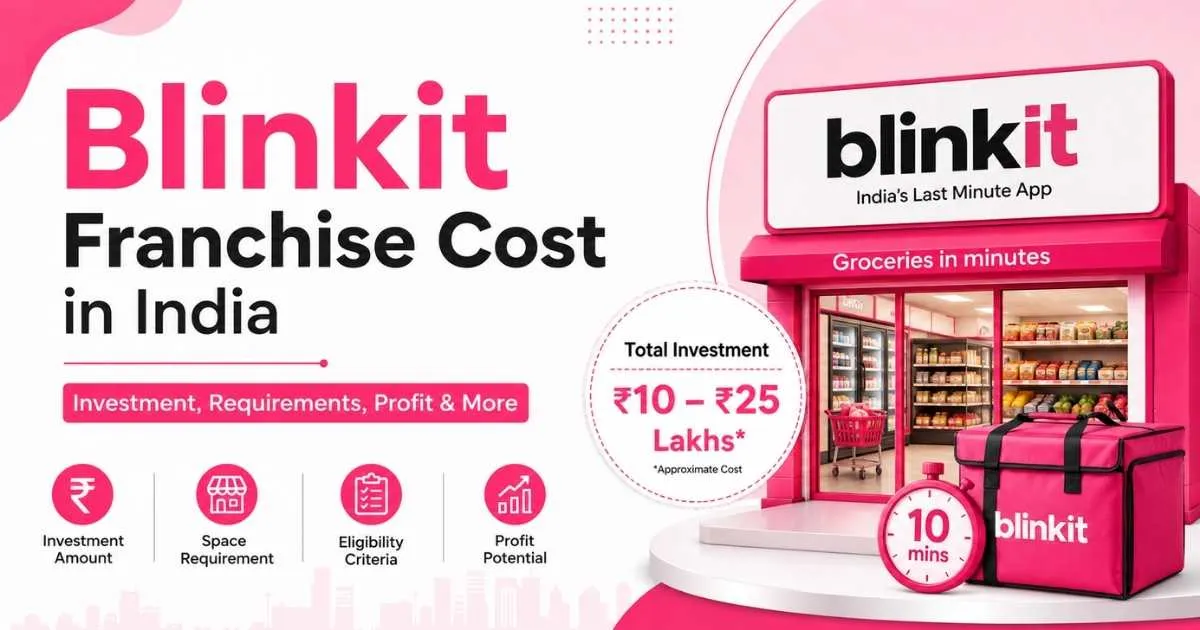
India’s quick-commerce revolution has well and truly arrived. While we used to plan grocery runs a day in advance, today millions of urban Indians expect their tomatoes, toothpaste, and evening snacks at their doorstep in under 10 minutes — and Blinkit is the brand making it happen at scale. With a commanding 44%–46% market share in 2026, Blinkit has pulled well ahead of rivals Zepto and Swiggy Instamart to become the undisputed leader in India’s Q-commerce space.
So if you’ve been thinking about entering this booming sector, a Blinkit franchise — or more precisely, a Blinkit dark store partnership — might just be one of the most exciting small-business opportunities in India right now. But before you jump in, you need real numbers, real expectations, and an honest assessment of what this business actually involves.
This guide covers everything: the 2026 Blinkit Franchise Cost breakdown, monthly profit estimates, city eligibility, the application process, and a head-to-head comparison with Zepto and Swiggy Instamart. Let’s get into it.
What Exactly Is a Blinkit Franchise?
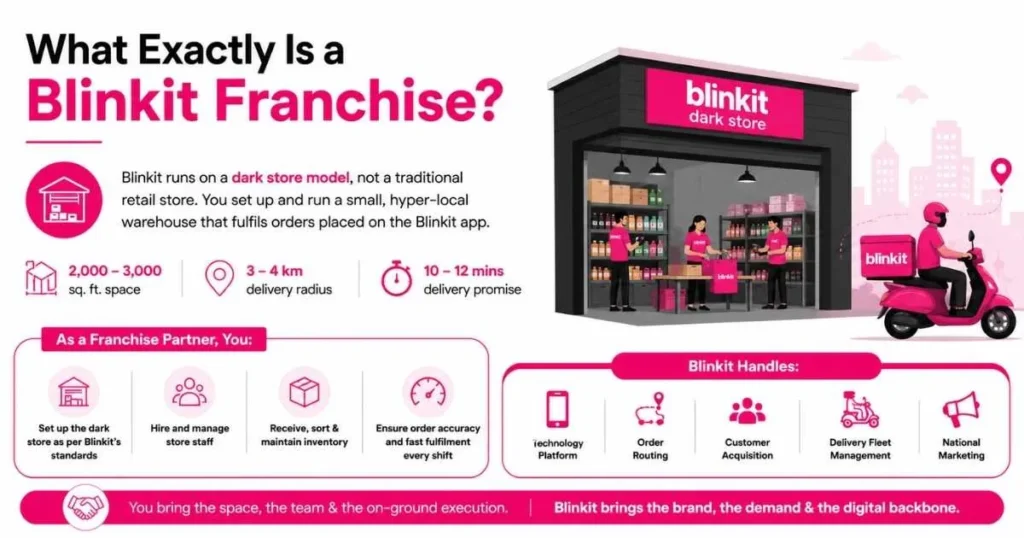
First, a quick clarification: Blinkit doesn’t run a traditional franchise model where you open a retail store with a storefront and walk-in customers. Instead, it operates through what’s called a dark store model.
A dark store is essentially a small, hyper-local warehouse — typically 2,000 to 3,000 sq. ft. — that sits inside a residential neighbourhood and fulfils orders placed on the Blinkit app. There’s no signage for customers to walk into, no checkout counters, no retail display. It’s a pure fulfilment hub, optimised for speed. When a customer in a 3–4 km radius places an order, your store team picks, packs, and hands it to Blinkit’s delivery riders — all in under 5–7 minutes — so it reaches the customer within the promised 10–12 minutes.
As a franchise partner, you’re responsible for:
- Setting up the physical dark store space according to Blinkit’s design and infrastructure standards
- Hiring and managing store staff — typically pickers, packers, and a store manager
- Receiving, sorting, and maintaining inventory supplied through Blinkit’s supply chain
- Ensuring order accuracy and fulfilment speed within every shift
Blinkit, on its end, handles the technology platform, order routing, customer acquisition, delivery fleet management, national marketing, and provides onboarding training and SOPs. It’s a partnership where you bring the space, the team, and the on-ground execution — and Blinkit brings the brand, the demand, and the digital backbone.
When you are a Blinkit franchise partner, you’re accountable for:
- Setting up the Store: You take on a commercial area (usually 1,500–3,000 sq. ft.) and set it up according to Blinkit’s infrastructure and design guidelines. This includes systematic shelving and a layout that is designed for speedy order picking.
- Hiring and Managing Staff: The store hires the store staff—typically a couple of pickers and packers—who process customer orders. A store manager could be designated by Blinkit to oversee smooth functioning.
- Inventory Management: Products are consigned or stocked by Blinkit’s supplier network, but it’s your responsibility to receive the inventory, sort it out, and ensure order accuracy and availability.
- Order Fulfillment: As soon as a customer places an order, your store team picks and packs the order immediately and hands it over to Blinkit’s delivery team for last-mile delivery.
Blinkit assists its franchise partners on the digital and delivery end of the business:
- Technology Platform: Blinkit’s app takes care of order flow, customer engagement, inventory management, and backend infrastructure. You don’t have to develop any of this.
- Delivery Network: Blinkit manages the entire delivery process through its own fleet of delivery partners who pick up the packed order from the dark store.
- Training & Support: Blinkit offers onboarding, training, and standard operating procedures to maintain consistency and efficiency in all stores.
- Branding & Customer Acquisition: Blinkit operates national advertising, app-based promotions, and customer service so that franchisees can concentrate solely on operations.
Also Read: Haldiram Franchise Cost
Blinkit Franchise Cost in India — 2026 Investment Breakdown
The total investment to set up a Blinkit dark store in 2026 typically falls in the range of ₹15 lakhs to ₹35 lakhs, depending on your city, the size of the commercial space, and local real estate costs. Here’s how that breaks down across categories:
| Expense Category | Estimated Cost (₹) | Details |
| Franchise / Brand Fee | ₹2 – ₹5 lakhs | One-time fee for platform access, brand usage, and tech onboarding |
| Store Setup & Fit-Out | ₹5 – ₹10 lakhs | Racking, shelving, lighting, civil work, HVAC, and layout design per Blinkit specs |
| Initial Inventory | ₹3 – ₹12 lakhs | First-time stocking of fast-moving groceries, packaged goods, and daily essentials |
| Security Deposit / Advance Rent | ₹1 – ₹6 lakhs | Refundable platform deposit plus advance commercial lease payment |
| Equipment & Cold Storage | ₹2 – ₹3 lakhs | Chillers, freezers, billing terminals, barcode scanners, and packaging equipment |
| Legal & Licensing | ₹0.5 – ₹1 lakh | FSSAI food licence, GST registration, local trade licence, NOC from municipality |
| Training & Staffing Setup | ₹0.5 – ₹1 lakh | Onboarding costs, initial staff hiring and training expenses |
| Miscellaneous (Tech, Marketing) | ₹1 – ₹3 lakhs | App integration support, local area promotions, delivery equipment |
| TOTAL ESTIMATED INVESTMENT | ₹15 – ₹35 lakhs | Varies by city tier, location, and store scale |
Important note: Tier-1 cities (Delhi NCR, Mumbai, Bengaluru, Hyderabad) tend to sit at the higher end of this range due to real estate premiums. Tier-2 cities like Jaipur, Lucknow, Pune, or Ahmedabad can often be set up at the lower end.
Ongoing Monthly Expenses
Beyond the initial investment, you’ll carry recurring Blinkit Franchise Cost every month. Planning for these is critical to understanding your actual take-home profit.
| Expense Type | Estimated Monthly Cost (₹) | Remarks |
| Royalty Fee | 5% – 10% of monthly revenue | Paid to Blinkit for platform access, tech, and ongoing support |
| Tech & Platform Fee | 2% – 3% of monthly revenue | Backend systems, app integration, order management |
| Marketing Contribution | 1% – 2% of monthly revenue | Blinkit’s national and regional campaigns |
| Employee Salaries | ₹2 – ₹5 lakhs | Depends on staff count and city; includes store manager, pickers, packers |
| Utility Bills | ₹15,000 – ₹30,000 | Electricity, internet, and water — cold rooms drive up power costs |
| Inventory Refill | 60% – 70% of revenue | Rolling restocking to maintain availability; highest recurring outgo |
| Store Maintenance | ₹10,000 – ₹20,000 | Cleaning, minor repairs, equipment servicing |
Is a Blinkit Franchise Profitable in 2026?
This is the question everyone asks, and the honest answer is: it can be — but it’s not a passive income business. Your profitability is directly tied to your store’s location, order volume, and operational discipline.
Monthly Revenue Expectations
A well-established Blinkit dark store operating in a high-density urban area can generate gross revenue of ₹18 lakhs to ₹25 lakhs per month. Newer stores, or those in lower-demand micro-markets, typically start in the ₹5 lakh to ₹12 lakh range and scale over time.
Revenue is driven by:
- Store location and surrounding population density
- Local demand and customer adoption of quick commerce
- Order volume and average basket size
- Operational speed and accuracy (which directly affects your app ratings)
Net Profit Margins
After deducting inventory costs, staff salaries, rent, royalties, platform fees, and utilities, most franchisees operate at a net profit margin of 8% to 25%. The range is wide because it depends heavily on revenue volume and cost management.
In practical terms, a well-run dark store can deliver a monthly net profit of ₹1.4 lakhs to ₹3 lakhs. Stores in premium locations with high order frequency can push this higher, but building to that level takes 6–12 months of consistent operation.
Break-Even & Return on Investment
| Metric | Estimate |
| Break-Even Period | 18 – 24 months (from launch) |
| Annual ROI (post break-even) | 35% – 70% per annum |
| Expected Monthly Net Profit | ₹1.4 lakhs – ₹3 lakhs |
| Gross Monthly Revenue (mature store) | ₹18 lakhs – ₹25 lakhs |
Factors That Directly Affect Your Profitability
- Store Location — High-density residential neighborhoods with strong urban demographics are ideal. Being within 2–3 km of a large apartment cluster makes a measurable difference.
- Inventory Accuracy — Keeping the right items stocked avoids order cancellations and reduces wastage. A well-managed inventory is your single biggest lever on margins.
- Staffing Efficiency — Experienced pickers who can fulfill an order in under 3 minutes directly enable 10-minute delivery and high ratings.
- Customer Ratings on App — Higher ratings mean more orders allocated to your store by Blinkit’s algorithm. Ratings are driven by delivery speed and order accuracy.
- Order Rejection Rate — High rejection due to out-of-stock items reduces your order share and revenue.
Which Cities Can You Apply in? (2026 Eligibility)
Blinkit has expanded its franchise partner network to over 200 cities across India. Active expansion is happening across both tiers:
Tier-1 Cities (Active & Expanding)
- Delhi NCR — the largest and most mature market
- Mumbai & MMR
- Bengaluru
- Hyderabad
- Chennai
- Kolkata
Tier-2 Cities (Fast Growing)
- Pune, Ahmedabad, Chandigarh, Jaipur, Lucknow
- Surat, Coimbatore, Kochi, Indore, Bhopal
Blinkit is prioritizing areas with high population density, strong urban demographics, and existing digital-commerce adoption. If you’re based in a Tier-3 town or rural area, the franchise opportunity may not yet be available — but it’s worth checking the Partner Portal directly for the latest city list.
Documents You’ll Need to Apply
Getting your paperwork ready in advance speeds up the onboarding process considerably. Here’s what Blinkit typically asks for:
- PAN Card and Aadhaar Card (KYC verification)
- Business registration certificate — LLP, Partnership, or sole proprietorship
- Active GST registration
- FSSAI food safety licence
- Lease agreement for the proposed commercial space (3–5 year validity preferred)
- NOC from the local municipal body, if applicable
- Bank statements or financial documents showing investment capability
- Property layout/floor plan of the proposed dark store location
How to Apply for Blinkit’s Franchise?
If you want to become a franchise partner with Blinkit, here’s an in-depth guide to assist you in the application process:
Step 1 — Do Your Research First
Before filling in any form, spend time understanding the operational realities of a dark store. Visit the Blinkit website, read through their partner guidelines, and talk to existing franchise partners in your city if possible. Going in with clear expectations will save you from surprises later.
Step 2 — Identify and Finalize Your Location
Your location is the single most important variable in your business’s success. Scout for a commercial ground-floor space of 2,000–3,000 sq. ft. in a high-density residential area, with clear access for delivery riders, at least 30 KV power capacity, and functional washroom facilities. Lock in a lease agreement before formally applying.
Step 3 — Submit Your Application
Head to blinkit.com/franchise (or the Blinkit Partner Program portal) and fill out the application form with your personal details, business background, proposed location, and financial capability. Double-check all information before submitting.
Step 4 — Initial Screening
Blinkit’s team reviews your application to assess your financial readiness and the viability of your proposed location. This screening is typically completed within 7–14 working days.
Step 5 — Site Inspection
If you clear the initial screening, a Blinkit field operations executive will visit your proposed space to physically assess its suitability — checking dimensions, access points, power infrastructure, and proximity to residential catchment areas.
Step 6 — Franchise Agreement
Once approved, you’ll receive a franchise agreement outlining your rights, obligations, revenue-sharing structure, and operational standards. Read this carefully — ideally with a legal advisor — before signing.
Step 7 — Store Setup and Staff Hiring
Blinkit’s internal team will provide a custom layout blueprint for your space. You’ll then execute civil work, install racking and cold storage, procure equipment, and hire your team — all within Blinkit’s operational guidelines.
Step 8 — Go Live
Once setup is complete, Blinkit integrates your store onto its platform and makes it visible to customers within a 3–4 km radius. Orders start flowing in — and your journey as a quick-commerce entrepreneur officially begins.
Blinkit vs Zepto vs Swiggy Instamart — Which Franchise Is Better in 2026?
If you’re evaluating quick-commerce franchise options, here’s how the three main players stack up head-to-head:
| Feature | Blinkit | Zepto | Swiggy Instamart |
| Parent Company | Zomato | Independent (Zepto) | Swiggy |
| Market Share (2026) | ~44%–46% (Market Leader) | ~29%–30% | ~23%–25% |
| Avg. Delivery Window | 10–12 minutes | 8–10 minutes | 12–15 minutes |
| Dark Store Setup Cost | ₹15 – ₹35 lakhs | ₹25 – ₹50 lakhs | ₹12 – ₹30 lakhs |
| Space Required | 2,000 – 3,000 sq. ft. | 2,000 – 4,000 sq. ft. | 800 – 1,200 sq. ft. |
| Onboarding Model | Open Self-Registration Portal | Partner Selection Portal | Curated / Invite-Based |
| Primary Strength | Tech ecosystem & market leadership | Aggressive growth, Gen-Z focus | Shared food-delivery user base |
The verdict? Blinkit’s combination of market leadership, tech maturity, and brand trust makes it the lowest-risk entry point into quick-commerce franchising in 2026. Zepto is growing aggressively but comes with a higher setup cost and a more selective onboarding process. Swiggy Instamart requires smaller space but gives partners less direct control and has a curated, invite-based entry process.
Pros and Cons of the Blinkit Franchise Model
The Upsides
- Strong, Established Brand: Blinkit is the market leader in India’s Q-commerce space — you’re walking into a business with built-in brand trust and a ready customer base from Day 1. You don’t need to build brand awareness from scratch.
- Booming Market Tailwinds: Demand for 10-minute delivery isn’t slowing down. Urban India’s appetite for quick commerce is still growing, which means the opportunity is in an expansion phase, not a saturation phase.
- Complete Tech and Logistics Support: Blinkit handles the entire digital stack — order management, inventory tracking, delivery routing, and customer service. You focus on operations; they handle the platform.
- Recurring, Everyday Revenue: Groceries and daily essentials are repeat-purchase categories. Unlike discretionary product businesses, your customers are placing orders multiple times per week, creating consistent, predictable revenue.
- No Customer Acquisition Needed: All orders come through the Blinkit app. You don’t need to run ads, manage social media, or worry about marketing. Your job is fulfilment, not sales.
The Challenges
- High Initial Investment: ₹15 to ₹35 lakhs is a significant capital commitment. Not everyone can absorb this, and the break-even window of 18–24 months means you need staying power.
- Thin Margins Demand High Volume: A net margin of 8%–25% sounds reasonable, but squeezing it upward requires high order volume and very tight cost discipline. Low-traffic locations can make this difficult.
- Limited Operational Autonomy: You follow Blinkit’s SOPs, pricing, and inventory standards — there’s no room for independent decisions on product range, pricing, or store design.
- Operationally Intensive: This is a 7-day-a-week business with multiple daily shifts, constant inventory management, and zero tolerance for delays. It demands active, hands-on involvement.
- Platform Dependency: Your entire business runs on Blinkit’s app. If the platform has technical issues, modifies its policies, or changes its fee structure, your revenues are directly impacted — and you have limited control over this.
Final Verdict — Should You Open a Blinkit Franchise in 2026?
If you have the capital, the right location scouted, and a genuine willingness to be operationally hands-on, understanding the Blinkit franchise cost is the first step toward entering one of the most compelling small-business opportunities in urban India right now. The Blinkit franchise model benefits from real and growing demand, while the brand handles much of the marketing heavy lifting and offers a mature, well-tested tech infrastructure.
It is not, however, a set-and-forget investment. Stories of underperforming dark stores almost always trace back to poor location selection, weak inventory management, or absentee ownership. The business rewards those who treat it with the same rigour as any other operationally intensive enterprise.
The numbers check out for the right partner in the right location: ₹1.4 lakhs to ₹3 lakhs in monthly net profit, a break-even within 18–24 months, and 35%–70% annual ROI post break-even. In a market where quick commerce is still in its expansion phase, getting in now — and getting in well — gives you a meaningful first-mover advantage in your micro-market.
FAQs
What is the Blinkit franchise cost in India in 2026?
The total investment to set up a Blinkit dark store ranges from ₹15 lakhs to ₹35 lakhs in 2026, covering the franchise/brand fee, store fit-out, initial inventory, equipment, legal costs, and security deposit. Tier-1 cities typically fall at the higher end of this range.
How much can I earn from a Blinkit franchise?
A mature, well-run dark store can generate gross monthly revenues of ₹18 lakhs to ₹25 lakhs. After all expenses, the realistic net profit works out to ₹1.4 lakhs to ₹3 lakhs per month.
How long does it take to break even?
Most franchisees break even on their initial investment within 18 to 24 months, depending on order volume, location quality, and operational efficiency.
Do I need retail or logistics experience?
It’s helpful but not mandatory. Blinkit provides onboarding training, SOPs, and operational support. That said, experience in managing a team and running a physical operation goes a long way in making the day-to-day smoother.
Is the Blinkit franchise available in my city?
Blinkit has partner stores across 200+ cities in India, with active expansion in both Tier-1 metros and fast-growing Tier-2 cities. Check the Blinkit Partner Program portal for the current city availability list.
Can I open multiple Blinkit dark stores?
Yes — franchisees with strong performance track records and stable finances can expand to multiple locations. Blinkit typically evaluates multi-store applications on a case-by-case basis.
Can I change product offerings or prices?
No. Product range and pricing are standardised across all Blinkit stores and managed centrally through Blinkit’s supply chain and demand planning systems. This is non-negotiable as a franchisee.
