How AI Is Changing Marketing Faster Than Most Teams Expect
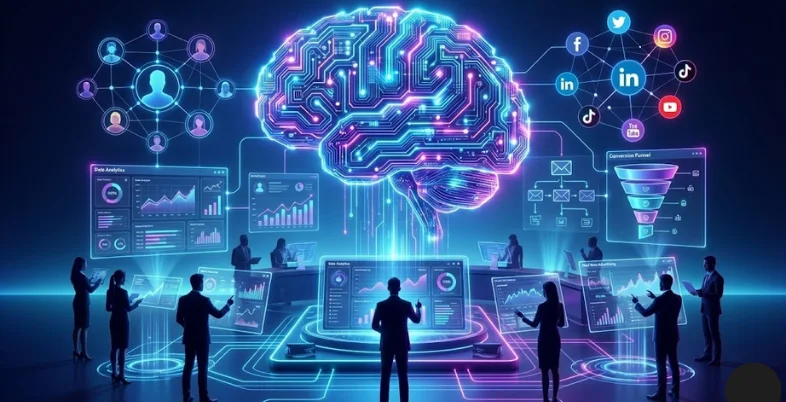
Marketing has always evolved alongside technology, but most changes followed a familiar pattern. New tools appeared, teams experimented, best practices formed, and adoption spread gradually.
AI does not follow that pattern.
AI is not arriving as a single platform or channel. It is quietly embedding itself into how marketing decisions are researched, learned, executed, and evaluated. Many teams are already using AI every day without fully realizing how much it has altered their workflow.
This is why the shift feels subtle but profound. Marketing is not just becoming faster. It is becoming structurally different.
Teams that understand this early gain leverage. Teams that treat AI as a productivity hack risk losing strategic clarity while believing they are ahead.
Why AI Feels Invisible but Changes Everything
One reason AI adoption feels deceptively easy is because it does not demand radical behavior change upfront. Marketers still research, still write, still analyze. The difference lies in how much thinking happens before action.
An AI chat tool today behaves less like software and more like a cognitive layer. Instead of switching between tabs, documents, and dashboards, marketers externalize thinking into conversation. Ideas are shaped, reframed, and summarized in real time.
This feels helpful, but it also changes decision dynamics. When thinking becomes faster, the temptation is to think less deeply.
The same applies to AI-powered search. An AI search engine does not simply return links. It interprets intent, compresses information, and presents conclusions. That efficiency is valuable, but it also reduces exposure to uncertainty, disagreement, and edge cases that often sharpen judgment.
As systems grow more capable, including those built on architectures approaching Chat GPT 5 level reasoning, the risk is not misinformation. The risk is overconfidence built on incomplete understanding.
How AI Has Changed Marketing Research at Its Core
Research used to be one of the slowest parts of marketing. Understanding an audience required time, repetition, and synthesis across many sources.
AI has collapsed that timeline.
Today, marketers can move from question to insight in minutes. Audience pain points, competitor positioning, content gaps, and emerging trends can be surfaced almost instantly. This is a genuine advantage, especially for lean teams.
The shift, however, is not just speed. It is where effort is spent.
Instead of collecting information, marketers now spend more time interpreting it. AI surfaces patterns, but it does not decide relevance. That responsibility remains human.
Teams that treat AI research outputs as conclusions often produce generic strategies. Teams that treat them as hypotheses tend to uncover sharper insights. The difference lies in whether AI is used to replace thinking or provoke it.
How Marketers Are Learning Differently Because of AI
Marketing education has traditionally been linear. Courses, certifications, mentorship, and experience built expertise gradually.
AI disrupts this by introducing learning at the moment of need.
Instead of stepping away from work to learn, marketers now learn inside the workflow. An unfamiliar metric, platform change, or concept can be explained instantly. This lowers friction and accelerates onboarding dramatically.
Used well, AI becomes a translator. It adapts explanations to context, simplifies complexity, and fills knowledge gaps quickly.
Used poorly, it creates surface-level competence without depth.
When answers arrive instantly, there is less incentive to wrestle with ideas. Over time, this can weaken strategic thinking. Marketers may know what to do without fully understanding why it works.
Strong teams counter this by using AI to support learning, not replace it. They treat explanations as starting points and still invest in fundamentals.
The Real Shift Most Teams Are Missing
The biggest change AI introduces is not automation. It is leverage.
A single marketer, supported by AI, can now operate with the reach of a small team. Research cycles shrink. Ideation accelerates. Feedback loops tighten.
This creates a new kind of competitive gap. Not between companies with AI and those without it, but between teams that use AI intentionally and those that use it casually.
Casual use speeds up output. Intentional use sharpens decisions.
That distinction will define marketing performance over the next few years.
Where AI Actually Improves Marketing Outcomes

AI creates real value in marketing when it is applied to areas where human effort is routinely wasted. These are not the glamorous parts of marketing. They are the repetitive, mentally draining stages that sit between insight and execution.
Research synthesis is one of the clearest examples. Marketing research rarely fails because information is unavailable. It fails because the volume of information overwhelms interpretation.
An AI chat system, when used well, behaves like a thinking surface. It helps marketers talk through messy inputs, compare perspectives, and identify themes that would otherwise stay buried across documents, tabs, and dashboards.
This is not automation in the traditional sense. It is closer to having a second brain that helps you slow down complexity before acting. The marketer still decides what matters, but the mental friction of sorting through noise is reduced.
AI-powered search works in a similar way. A traditional search experience forces marketers to hunt for answers. An AI search engine reframes the task. It aggregates, explains, and contextualizes information so that patterns emerge faster.
This allows teams to move from “What’s out there?” to “What does this mean for us?” with far less effort.
As AI systems continue to improve, including models approaching Chat GPT 5 type reasoning, this kind of synthesis will become more fluid. The danger is assuming that clarity equals correctness. The opportunity lies in using clarity to ask better follow-up questions.
Where AI Quietly Damages Marketing Strategy
The same qualities that make AI powerful can also undermine marketing when applied carelessly. Speed, confidence, and coherence are not always virtues.
One of the most common failures appears at the strategy level. AI can generate strategic-sounding outputs quickly. Positioning statements, go-to-market plans, audience segments, and messaging frameworks can all be produced in minutes. The problem is that strategy is not just a logical exercise. It is contextual, historical, and constrained by reality.
When teams rely on AI-generated strategy without grounding it in brand history, customer relationships, and internal trade-offs, the result is often directionless execution. Everything sounds reasonable, but nothing feels distinct. Campaigns launch smoothly yet fail to resonate.
Brand voice erosion is another subtle issue. AI systems are trained on vast amounts of generalized language. Without strong guidance, they naturally gravitate toward what is statistically common. Over time, this smooths away the rough edges that make brands recognizable.
The danger is not one piece of AI-generated content. It is cumulative dilution. When AI drafts are accepted too quickly, tone converges, personality fades, and differentiation weakens. Audiences may not notice immediately, but engagement drops quietly.
Trust is where the cost becomes most visible. Marketing relies on credibility and emotional connection. Over-automation, especially in customer-facing communication, risks replacing empathy with efficiency. As AI-generated content becomes more widespread, some teams are beginning to implement content authenticity tools to ensure messaging remains credible and aligned with brand standards. When responses feel fast but hollow, customers disengage.
Why AI Changes Decision-Making More Than Execution
Most discussions about AI in marketing focus on output. Faster content. More campaigns. Higher volume. That framing misses the deeper shift.
AI changes how decisions are made.
When information is summarized instantly and options are generated effortlessly, the temptation is to decide quickly. Over time, this conditions teams to value speed over judgment. Decisions feel easier, but they are often less examined.
An AI chat interface can either accelerate this problem or correct it, depending on how it is used. When marketers ask for answers, AI reinforces certainty. When they ask for trade-offs, assumptions, and counterarguments, AI supports reflection.
The same tool can either compress thinking or deepen it.
Advanced AI systems make this tension more pronounced. As outputs become more convincing and context-aware, it becomes harder to remember that they are still probabilistic, not intentional. The marketer’s role shifts from creator to editor, but the responsibility for outcomes remains unchanged.
Teams that succeed long-term will be those that design AI usage around decision quality, not output quantity.
The Difference Between Using AI Casually and Using It Well

Casual AI use feels productive. Drafts appear instantly. Research takes minutes. Learning happens on demand. On the surface, everything improves.
Intentional AI use feels slower at first. Teams define where AI is allowed to help and where it is not. They decide which decisions remain human-owned. They treat AI outputs as drafts, not conclusions.
Over time, intentional use compounds. Campaigns align better with strategy. Brand voice stays coherent. Teams trust their judgment instead of outsourcing it.
The difference is not technical. It is cultural.
AI amplifies whatever system it is placed into. In a thoughtful marketing organization, it sharpens clarity. In a reactive one, it accelerates noise.
What the Next Phase of AI in Marketing Will Actually Look Like
Most predictions about AI in marketing focus on tools. New features, faster models, smarter automation. That focus misses the real shift already underway.
The next phase is not about what AI can do. It is about how deeply it changes thinking behavior inside marketing teams.
As AI chat becomes more conversational and context-aware, it starts to function less like software and more like a cognitive environment. Marketers no longer step away from work to think. They think inside the tool. Ideas are tested, reframed, and validated in real time. This feels empowering, but it also subtly reshapes how decisions are formed.
At the same time, the AI search engine is replacing exploration with synthesis. Instead of navigating disagreement, marketers receive consolidated narratives. Instead of weighing sources, they receive conclusions. This saves time, but it also removes friction that once forced deeper understanding.
As the underlying technology improves, especially with systems approaching Chat GPT 5–level capability, this compression of thought will feel seamless. The risk is not error. The risk is reduced perspective.
Marketing has always benefited from tension. Between creativity and data. Between instinct and evidence. When AI resolves that tension too quickly, teams may stop noticing what they are losing.
Why Speed Is Becoming a Liability, Not an Advantage
Speed has always been a competitive advantage in marketing. Faster execution meant quicker testing, faster learning, and earlier wins.
AI changes the equation.
When every team can move quickly, speed stops being differentiating. In fact, speed without direction becomes dangerous. Campaigns launch faster, but mistakes scale faster too. Messaging spreads before it is refined. Positioning hardens before it is tested.
AI chat tools make this particularly tempting. A strategy outline can be generated in minutes. A content plan in seconds. The danger lies in mistaking coherence for correctness. Just because something sounds right does not mean it is right for your brand, your audience, or your moment.
Similarly, an AI search engine can surface “best practices” instantly. But best practices are, by definition, averages. When everyone optimizes toward the same synthesized advice, differentiation erodes.
Technology accelerates momentum. It does not supply direction. Marketing teams that fail to slow down at decision points will find themselves producing more while standing out less.
How Smart Teams Are Redefining the Role of Technology
The most effective marketing teams are no longer asking what AI can automate. They are asking where human judgment still creates the most value.
They use AI chat deliberately, not constantly. It becomes a space for sense-making, not approval. They use it to explore scenarios, challenge assumptions, and surface blind spots, not to rubber-stamp decisions.
They treat the AI search engine as a filter, not a compass. Its role is to reduce noise, not to define truth. Insights are cross-checked against lived customer experience, brand history, and strategic intent.
Most importantly, they design boundaries around technology use. Certain decisions remain intentionally human. Positioning, tone, long-term narrative, and ethical considerations are not outsourced, no matter how capable the tools become.
As models evolve toward Chat GPT 5–level reasoning, this boundary-setting becomes more important, not less. The more persuasive the output, the easier it is to defer judgment. Strong teams resist that pull.
The Marketing Teams That Will Win in an AI-Heavy World
The winners in an AI-driven marketing landscape will not be those who adopt the most technology. They will be the ones who integrate it with restraint.
They will understand that AI amplifies systems. In a thoughtful organization, it sharpens clarity. In a chaotic one, it accelerates confusion.
They will invest in human skills that technology cannot replace easily. Strategic thinking, narrative coherence, ethical judgment, and emotional intelligence will matter more, not less, as automation increases.
They will also recognize that learning does not disappear in an AI world. It changes shape. AI chat can support learning, but mastery still requires reflection. AI search engines can explain concepts, but understanding still comes from application.
In this sense, technology becomes a mirror. It reflects the quality of the thinking behind it.
Using AI Without Letting It Redefine Marketing for You
AI is not just another wave of marketing technology. It is a structural shift in how knowledge is accessed, processed, and acted upon.
Used intentionally, AI reduces friction, sharpens insight, and expands what small teams can achieve. Used carelessly, it replaces judgment with speed and depth with confidence.
The difference is not technical. It is philosophical.
Marketing teams that treat AI chat as a thinking partner rather than an answer engine, that use AI search engines to clarify rather than conform, and that see technology as support rather than authority will remain distinct in a market moving toward sameness.
AI will continue to evolve. Models will become more capable. Outputs will become more convincing.
What must remain constant is the marketer’s responsibility to think.
In an era where technology can do more than ever, the real advantage lies in knowing when not to let it decide.
