Cleaning Business Plan: How to Launch, Price & Scale in 2026
If you’re looking for a business that stays strong even during a weak economy, attracts steady customers, and has real income potential, then this Cleaning Business Plan guide is for you.
In 2026, the cleaning industry is no longer just about wiping surfaces. It combines smart planning, modern tools, recurring contracts, and profitable service models that can generate consistent cash flow. With the right business plan, a cleaning company can start small and scale into a highly profitable operation.
This guide outlines a simple, step-by-step cleaning business plan for beginners. Whether you’re starting as a solo cleaner from home or planning to build a full cleaning company with employees, you’ll learn how to structure your business, choose the right services, price your work, and grow sustainably.
No prior business experience is required—this plan explains everything in clear, practical terms so you can confidently turn your cleaning idea into a real business.
Introduction: The Gold Mine in the Mop Bucket
The cleaning business has evolved over the past five years. No more paper ledgers and cash only. Cleaning is now profitable thanks to a smart scheduling system, environmentally friendly branding, and customers who spend less time but more money.
Numbers You Need to Know (2026 Projections).
There are four facts worth mentioning:
- Billion Valuation of $112.5: The Cleaning market in the U.S. is set to hit this record revenue by the year 2026.
- The U.S. cleaning services market is forecast to reach $147.6 billion by 2030.
- 6.2% Annual Growth: The industry’s growth rate exceeds that of the U.S. economy. Millennials and Gen Z prefer to hire a maid to clean their homes so they can spend their weekends.
- 80% Recurring Revenue: The bulk of a cleaning business’s revenue comes from customers who remain for at least 12 months.
- $45–90 Hourly Rates: Residential cleaning rates in the U.S. have risen, and the business can still earn solid profits even after paying competitive wages.
Is a Cleaning Business profitable? (The Real Truth)
The answer to the question: Yes, it can be highly profitable. How you do it matters.
Profit is made on the manner in which you operate the business. You do not require an enormous plant as in a factory. The main cost is labour. When you make good use of your team time, you retain a majority of every dollar that you make.
Net Profit Reality
- Solo Operators: When you do everything, you make the amount that you earn as a profit. A single cleaner at $60/hour on a 30-hour schedule can earn $93,600 annually and have under $5,000 in outlays.
- Scaled Agencies: You will pay cleaners, but the total profit will increase as you hire help on every job. A well-run agency will retain 15-25% of net profit from all expenses, including management and marketing.
Why a Cleaning Business Plan is Important
A majority of cleaning business ventures go out of business in two years, not due to their being incapable of cleaning the building, but due to their inability to organise. In business, a business plan assists you in not falling into the trap of low price.
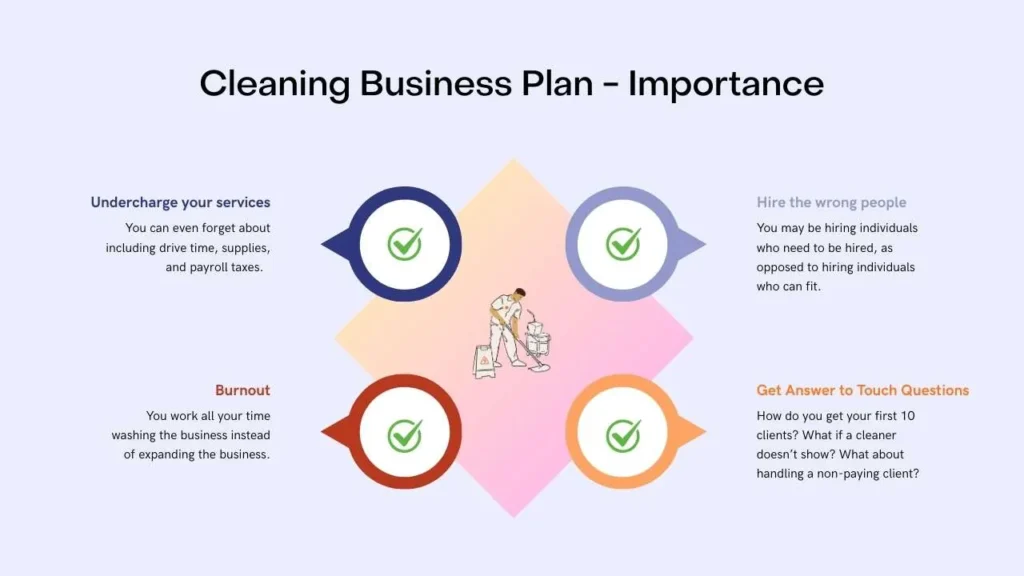
Without a plan, you may:
- Undercharge your services: You can even forget about including drive time, supplies, and payroll taxes.
- Hire the wrong people: You may be hiring individuals who need to be hired, rather than those who can fit.
- Burnout: You spend all your time on operational tasks instead of expanding the business.
- With a plan, you are required to answer tough questions now: How do you get your first 10 clients? What if a cleaner doesn’t show? What about handling a non-paying client?
Profitability & High-income Cleaning Services
General cleaning is a commodity in 2026. Specialising is necessary to make more. The following are the most lucrative niches.
1. Home Full Cleaning and Move-In/Move-Out.
Cleaning is regular and generates a steady amount of revenue from weekly cleaning, but deep cleaning generates the highest revenue.
It is profitable because you can earn between $300 and $600 per job by doing hard work, such as cleaning ovens, baseboards, and window tracks.
- Key Player Example: The Maids. They employ a 22-Step Healthy Touch Deep Cleaning System and charge a premium for quality.
2. Post‑Construction Cleaning
New houses or redesigned shops must have a fresh finish. Construction contractors are willing to invest heavily to ensure the site is handed over.
- Reasons it is profitable: You require specialised vacuum and safety expertise and assist the contractor in completing the work.
3. Medical and Healthcare Cleaning.
The cleaning of doctors’ offices or clinics must comply with strict OSHA regulations and bloodborne pathogen training requirements.
Why it is a good business: It is not easy, and therefore not everyone can do it. Such facilities will not seek the lowest price; instead, they will prioritize trustworthy partners.
- Key Player Example: Jani‑King. They specialise in healthcare cleaning and are a big business.
4. Short-Term Rental (Airbnb/VRBO) Cleaning
The Airbnb trend remains robust. Homeowners seek turnkey services, including doing laundry, replenishing necessities, and staging the house.
- Profitability: A fashionable rental could require 10-15 cleanings per month. You may charge a turnover fee and a cleaning fee.
Legal Requirements and Licences to Start
These are the boxes to be checked so that you can be a profitable and legal business in the U.S. It is possible to pay huge fines or go bankrupt if you do not cover them.
1. Business Personality (LLC vs. Sole Proprietorship)
Don’t run as a Sole Proprietor. In case you drop some bleach on a rug worth 10,000 dollars and are sued, a Sole Proprietorship would make you risk losing your savings and house. An LLC (Limited Liability Company) provides a corporate veil of protection to your personal assets.
2. EIN ( Employer Identification Number )
Obtain it for free by accessing the IRS website. You need it to open a business bank account and file taxes.
3. Business Insurance (The “Big Three)
- General Liability: This is property damage and bodily injury.
- Surety Bond: A Surety Bond that is also known as a Janitorial Bond. It insures the client against theft by your employee. Being Bonded and Insured is a huge selling point.
- Workers’ Compensation: You may have only one part-time helper, but in most states, this is mandatory to cover work-related injuries.
4. Local Permits
Check with your City Clerk. There are cities that demand a home-based business permit if you operate the office out of your kitchen table.
Step-by-Step Cleaning Business Plan for 2026
This section is your roadmap. These eight pillars can help you develop your document.
Step 1. Executive Summary
This is your “Why.” Summarise your vision.
Example: Elite Green Cleans LLC will become the best environmentally friendly residential cleaning company in Charlotte, NC, and achieve 250,000 annual turnover through automation in scheduling and non-toxic cleaning technology within 24 months.
Step 2. Business Description
Define your “Who.”
- Niche: Is it Residential, Commercial, or Industrial?
- Brand Voice: Does your brand have a Friendly, Family-Oriented, or a Professional, Clinical voice?
- Values: “We offer our cleaners a living wage (20 plus/hr) to provide them with the best service and the lowest turnover.
Step 3. Market Analysis
Don’t guess—use data.
- Customer Profile: “Our target customer is a 3050 year old dual-income worker, living in a zip code with a median household income of 120k+.
- Competitor Analysis: Check Merry Maids (expensive but regular) and local independent cleaners ( cheaper but regular). The middle of the gap is likely professionalism and competitive pricing.
Step 4. Services Offered
List your menu clearly.
- Mopping, cleaning bathrooms, dusting, vacuuming, and kitchen.
- Baseboards, lighting, and appliance interiors.
- Laundry (25 per load), Window washing (10 per window), Carpet Steaming (50 per room).
How to Price Cleaning Services:
Residential Cleaning Pricing
| Service Type | Pricing Model | Typical 2025 U.S. Rates | Best Use Case |
|---|---|---|---|
| Standard House Cleaning | Hourly | $25–$50 per hour (per cleaner) | Weekly / bi-weekly recurring jobs |
| Flat Rate | $100–$400 per visit | Predictable home sizes | |
| Per Room | $25–$60 per room | Small apartments | |
| Per Sq. Ft. | $0.10–$0.20 per sq. ft. | Large homes | |
| Deep Cleaning | Hourly | $50–$100 per hour | One-time intensive cleaning |
| Flat Rate | $240–$500+ per visit | First-time or seasonal cleans | |
| Move-In / Move-Out Cleaning | Flat Rate | $120–$420+ | Vacant properties |
| Airbnb / Short-Term Rental | Flat Rate | $80–$250 per turnover | Fast, repeat jobs |
Commercial & Janitorial Pricing
| Service Type | Pricing Model | Typical 2025 U.S. Rates | Best Use Case |
|---|---|---|---|
| Office Cleaning | Per Sq. Ft. | $0.07–$0.25 per sq. ft. | Recurring contracts |
| Hourly | $30–$90 per hour | Variable workloads | |
| Medical / Industrial Cleaning | Per Sq. Ft. | $0.12–$0.30+ per sq. ft. | Specialized sanitation |
| Hourly | $50–$150 per hour | Compliance-heavy jobs | |
| Post-Construction Cleaning | Flat Rate | $300–$1,200+ | One-time high-profit jobs |
Add-On & Upsell Services (Increase Profit)
| Add-On Service | Typical Rate (2025) |
|---|---|
| Window Cleaning | $3–$10 per window |
| Carpet Cleaning | $75–$200+ |
| Oven / Refrigerator Cleaning | $20–$50 each |
| Interior Cabinets | $30–$80 |
| Laundry / Folding | $15–$40 |
Step 5. Marketing and Sales Strategy
How will they find you?
- SEO & Website: It should have a mobile-friendly webpage with an instant quote button.
- Google Business Profile is the most important tool for local businesses. A rating of 4.5 stars or more is needed to appear in the Local Map Pack.
- Local Partnerships: Find local realtors. They will always have cleaners for their clients who are also selling homes.
Step 6. Operational Plan
How does the magic happen?
- The Tech Stack: Consider such Cleaning Business software as Jobber or ZenMaid. These applications handle tedious tasks such as sending automated messages to customers, GPS tracking for your maids, and credit card management.
- The Hiring Process: Three-step process: Phone screen, face-to-face interview, and paid test.
- Quality Control: Have a “Leave-behind” checklist for each job, and send a subsequent email requesting an evaluation.
How to retain employees in a cleaning business?
| Action | Why It Works |
|---|---|
| Pay competitive wages | Reduces turnover |
| Offer steady schedules | Provides income stability |
| Treat employees with respect | Builds loyalty |
| Train properly | Boosts confidence |
| Provide good tools | Makes work easier |
| Reward good performance | Increases motivation |
| Offer growth opportunities | Encourages long-term commitment |
Step 7. Financial Plan
This is where the Profitable part comes in:
Startup Costs:
- LLC Filing: $100–$500
- Insurance (Initial): $500
- Equipment (vacuum, mops, chemicals): 1000.
- Marketing (website/ads): $1,000
- Total: About $3,000.
Revenue Goals:
- Year 1: $75,000 (owner‑operated)
- Year 2: $250,000 (3–4 employees)
- Year 3: $500,000+ (full management)
Step 8. Funding & Growth Strategy
Most cleaning companies are bootstrapped (financed with savings). If you want to grow fast:
- Hit-and-miss: Purchase a van or commercial floor scrubbers under a lease-to-own scheme.
- Line of Credit: Obtain a business line of credit of 10,000 dollars to finance rainy-day cash flow problems (such as when a commercial client takes 60 days to pay).
Step-by-Step Cleaning Business Plan: Quick Recap
| Step | Focus | Key Points |
|---|---|---|
| 1. Executive Summary | Why | Vision, goals, revenue target |
| 2. Business Description | Who | Niche, brand voice, values |
| 3. Market Analysis | Demand | Target customer, competitors |
| 4. Services & Pricing | What | Core services, add-ons, rates |
| 5. Marketing & Sales | Growth | Website, SEO, Google Profile |
| 6. Operations Plan | How | Software, hiring, quality control |
| 7. Financial Plan | Profit | Startup costs, revenue goals |
| 8. Funding & Growth | Scale | Bootstrapping, credit, equipment |
Tips to make your business plan stand out.
- Highlight Clean-Tech: Be sure to tell them you offer HEPA-filtered vacuum cleaners to keep the inside of the house clean. This is an appeal to health-conscious consumers in 2026.
- Concentrate on Retention: Discuss your Employee Retention Plan. Cleaning, hiring, and training are the most costly expenses. When you retain employees in a positive state, you ensure higher profits.
- Make a Guarantee: “We offer a guarantee: In case you are not completely satisfied, we will refund and compensate you with a 24-hour free repair. This eliminates risk to the customer.
- Go Paperless: Demonstrate that you are all paperless. In 2026, customers will want to receive text notifications when the cleaner is approaching their location.
Top Industry Players Analysis
To become a great business, you need to examine the giants.
Merry Maids:
- Style of Service: Luxury residential.
- Major strength: High brand confidence. People are not afraid of letting them enter their homes.
- Lesson to you: You have to work on your branding and professional appearance (uniforms are obligatory!).
The Maids
- Cleaning Type: Team cleaning (3–4 individuals per house).
- Speed and efficiency: a significant strength. They can clean a whole house in 60 minutes.
- Lesson to you: If you want to go big, make your cleaning routine so you do it the same way every time.
Jani-King
- Service Style: Large-scale contracts for stadiums, hotels, and hospitals.
- That is a lack of a franchise model and robust local assistance.
- Lesson to you: Commercial cleaning is all about building strong relationships and reliability.
Conclusion: Your Way to Profit.
One of the few businesses you can start with a basic operation and grow into a multimillion-dollar enterprise through hard work and intelligent systems is a cleaning business. The demand for clean places is the greatest, and the means of conducting business is the greatest in 2026.
Don’t just be a “cleaner.” Be an entrepreneur and also provide cleaning services. Per the plan above, be consistent and keep in mind: there is no dirty floor without an opportunity to earn money.
Explore Another Niche: Food Van Business Plan
FAQs
Is the cleaning business worth it in 2026?
Yes. It is among the most stable small businesses in the market, driven by high demand, recurring revenue, and low start-up costs.
To what extent do I charge on an hourly basis?
Depending on the state, you will want to budget $50 to $90 per hour per cleaner. Do not sell below the amount required to break even on labour, overhead, and a 20 per cent profit.
What do you find to be the most difficult aspect of the business?
The major challenge is hiring and retaining good employees. This can be addressed by fostering a strong culture and paying fairly.
Is it possible to begin this while having another job?
Absolutely. Before going full-time, many owners start cleaning offices at night or houses on weekends.
How to handle non-paying clients in a cleaning business?
| Action | Reason |
|---|---|
| Set clear payment terms | Avoid disputes |
| Send quick reminders | Recover payment |
| Pause services | Stop losses |
| Charge late fees | Encourage payment |
| Use contracts | Legal protection |
| Drop repeat offenders | Protect profits |
