
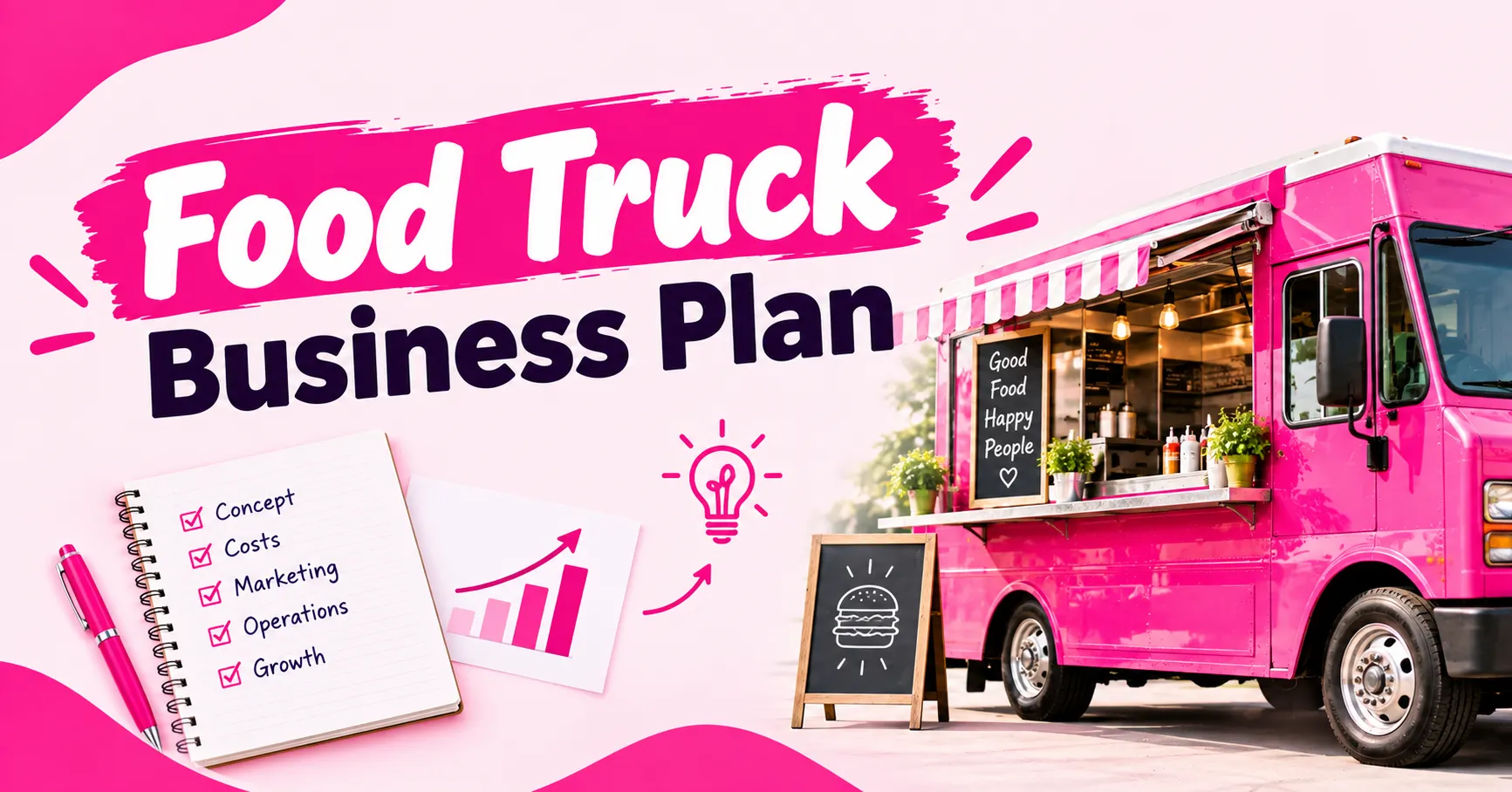
The picket-fence version of the American Dream has quietly changed. For a lot of people today, it looks more like a 16-foot truck parked outside a busy brewery, with a line of hungry customers waiting for the best tacos in town.
Food trucks are not a passing trend anymore. What used to feel like a risky side hustle has grown into a real, structured industry with its own rules, financing options, and proven playbooks. If you have a recipe you love and a dream of running your own kitchen on wheels, 2026 is actually a good time to start, as long as you go in with a real plan instead of just excitement.
This guide walks you through everything: fresh 2026 numbers, real startup costs, how to start with very little money, a free Food Van Business Plan structure you can copy today, food truck business ideas, and the honest challenges nobody puts on their Instagram page.
The Food Truck Industry In 2026: Fresh Numbers (And Why They Don’t All Match)

If you research food truck statistics, you will notice something strange fast. One report says the market is worth $1.16 billion. Another says $2.8 billion. A third says $4.8 billion. That is not one source being wrong, it is different research firms measuring different things.
- Narrow, value-added revenue estimates (like IBISWorld’s) count only the actual economic value food trucks add, landing around $2.8 billion for the US in 2026.
- Gross sales estimates (number of trucks multiplied by average revenue per truck) push the number much higher, with industry advocacy groups citing figures as high as $14 to $20 billion.
- Global market reports combine every country together, which is why some sources quote $4.8 billion or higher for the worldwide food truck market in 2026.
So which number is “right”? They all are, depending on what you are measuring. For a beginner, the numbers that actually matter are these:
| Metric | 2026 Figure |
| Number of food truck businesses in the US | 92,000+ (grew at 23.8% CAGR from 2020 to 2025) |
| Average annual revenue per food truck | Around $346,000 |
| Average food truck profit margin | 6.8% (versus 1-3% for traditional restaurants) |
| Average employees per truck | 1.8 full-time staff |
| Average customer spend per visit | $12.76 |
| Share of independent operators | 91% of food trucks are independently owned |
| Most common food type in 2026 | Mexican food, followed closely by American comfort food |
That profit margin gap is the most important line in that table. A food truck making 6.8% profit margin, against a restaurant’s 1-3%, is a real structural advantage. Lower rent, smaller teams, and no long lease all add up.
How We Sourced The Numbers In This Guide
Because food truck statistics vary so widely across the internet, it is worth being upfront about where these figures come from. The industry size and growth rate figures are pulled from IBISWorld’s 2026 industry report and cross-checked against Mordor Intelligence’s market sizing. The average revenue, profit margin, and customer spend figures come from a 2026 operator survey covering thousands of active US food trucks.
Startup and monthly cost ranges are averaged across multiple 2026 industry cost breakdowns, including data from restaurant equipment suppliers and small business lenders who finance food trucks directly. Where sources disagreed meaningfully, this guide notes the discrepancy rather than picking whichever number sounded most impressive, which is exactly the kind of transparency most competing guides skip.
Is Starting A Food Truck Still Worth It In 2026?
Short answer: yes, for the right person. Long answer: it depends on how you feel about the lifestyle, not just the money.
The Freedom Side
A food truck brings your kitchen to the customer instead of waiting for them to come to you. Tuesday could be an office park, Friday a brewery, Saturday a festival. You control the menu, the hours, and the brand, and there is real pride in handing someone a meal you built from scratch, cooked, and sold yourself.
The Hard Truth Side
It is physically demanding. You are the chef, the driver, the mechanic, the social media manager, and the bookkeeper, often all in the same day. Most new owners report working 60 to 80 hours a week in year one, and the “cooking and serving” part is often only a third of the actual workload once you count shopping, prep, driving, and cleanup.
The Financial Side
Because overhead is lower than a restaurant (no dining room lease, smaller staff, no long-term commitment), a food truck can break even faster. With average annual revenue around $346,000 and a 6.8% margin, that puts typical annual profit somewhere in the $15,000 to $30,000 range for an average truck, with well-run, well-located trucks earning considerably more, especially once catering is added in.
Food Truck Startup Costs In 2026: The Real Numbers
This is the number everyone actually wants. Based on 2026 cost data across multiple industry sources, most new owners should budget between $75,000 and $150,000 for a professional, properly-capitalized launch. Here is where that money goes.
1. The Vehicle (50-60% Of Your Budget)
| Option | Estimated Cost | Best For |
| New custom-built truck | $100,000 – $175,000+ | Owners who want it built exactly to spec, with a warranty and no surprise repairs |
| Used food truck | $30,000 – $70,000 | Most first-time owners; requires a full mechanical and equipment inspection before buying |
| Food trailer | $20,000 – $50,000 | Cheaper option, but needs a strong tow vehicle and is harder to maneuver on narrow city streets |
| Food cart or MVP setup | $5,000 – $15,000 | Testing a concept cheaply before committing to a full truck (see the no-money section below) |
2. Permits And Legal Fees
Budget $2,000 to $5,000 for your business license, health department plan review, fire safety inspection, and your first commissary deposit. Fair warning: cities like New York and Chicago run lottery systems or long waitlists for mobile vending permits, and buying a permit second-hand from an existing holder can push this cost much higher.
3. Operational Setup Costs
| Item | Estimated Cost |
| Initial inventory (food, packaging, supplies) | $2,000 – $5,000 |
| POS system (Square, Toast, Clover) | $1,000 – $2,500 |
| Marketing and branding (truck wrap, website, launch push) | $2,000 – $5,000 |
| Insurance (commercial auto, general liability, property) | $2,000 – $4,000 per year |
| Commissary kitchen rental (monthly, ongoing) | $500 – $2,000 per month |
4. Monthly Operating Costs Once You’re Running
Once the truck is on the road, expect ongoing monthly costs of roughly $5,000 to $15,000, covering food costs, fuel, commissary fees, insurance, and any staff wages. This is the number a lot of first-time owners forget to plan for, and it is the reason having a cash reserve matters as much as the launch budget.
How To Start A Food Truck With No Money (Or Very Little)
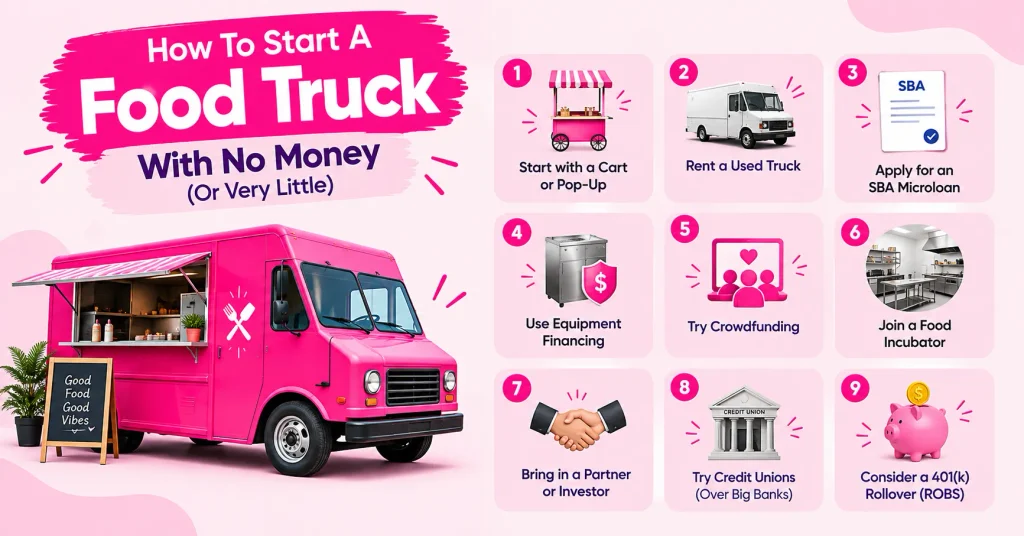
This is one of the most searched questions in this space, and most articles either dodge it or give one vague tip. Here are real, honest paths people actually use in 2026.
1. Start With A Cart Or Pop-Up Instead Of A Full Truck
A simple food cart or stand can cost as little as $5,000 to $15,000, compared to $50,000+ for a truck. Test your concept at farmers markets or pop-up events first. If it does not work, you have lost far less money, and if it does work, you now have sales data to show a lender.
2. Rent A Used Truck Before You Buy One
Several companies now rent fully-equipped food trucks by the day, week, or month. This lets you test locations, menus, and demand without the full purchase price, and many owners use a rental period specifically to build a sales track record before applying for a loan.
3. Apply For An SBA Microloan
The US Small Business Administration’s microloan program offers loans up to $50,000 through nonprofit lenders, specifically aimed at small businesses that traditional banks often turn away. Food trucks are one of the most common uses for these loans, since the loan size matches a used truck purchase reasonably well.
4. Use Equipment Financing
Instead of taking a large personal loan, equipment financing lets the truck itself act as collateral. Lenders are often more comfortable with this structure since they can repossess the equipment if payments stop, which usually means an easier approval process for a first-time business owner with limited credit history.
But caution: it is not passive income. When you are not riding on the truck, it does not run very well. It needs your commitment and your interest.
5. Try Crowdfunding
Platforms built for local business launches let you pre-sell meal vouchers, merchandise, or simply ask your community to back your dream in exchange for early perks. This works especially well if you already have some kind of local following or an unusual, shareable food concept.
6. Join A Restaurant Or Food Business Incubator
Many cities run food business incubator programs that provide shared commercial kitchen space, mentorship, and sometimes small grants or seed funding, in exchange for a structured program and sometimes a small equity or revenue share.
7. Bring In A Partner Or Small Investor
If you have the recipes and the drive but not the capital, a partner who can fund the truck in exchange for a share of ownership is one of the oldest and most common paths in this industry. Just make sure the ownership split and responsibilities are written down clearly from day one.
8. Look Into Credit Unions Over Big Banks
Credit unions are often more willing to work with first-time small business owners than large national banks, and their food truck loan terms are frequently more flexible, especially if you already bank with them.
9. Consider A 401(k) Business Rollover (ROBS)
If you have existing retirement savings, a Rollover for Business Startups (ROBS) structure allows you to invest that money into your new business without early withdrawal penalties. This is a serious financial decision with real risk, since it uses your retirement funds, so speak with a qualified financial advisor before going this route.
The honest truth: “no money” almost always really means “very little of your own money.” Nearly every one of these paths above still requires some capital, a solid plan, or a lender willing to take a chance on you, which is exactly why the next section matters so much.
Food Van Business Plan: Free Template Structure
You do not need to pay for a $500 business plan template. Below is the exact structure banks, investors, and the SBA actually expect to see. Copy these nine section headers into a blank document today and fill them in as you work through this guide.
1. Executive Summary
Write this section last, even though it goes first. In one page, cover your concept in one sentence (your “hook”), your revenue goals for year one, and if you are seeking funding, exactly how much you need and what it will be used for.
2. Business Description
Describe your concept’s vibe (fast-casual, upscale, late-night), your mission statement, and your legal structure. Most first-time owners choose an LLC, since it separates your personal assets from business liabilities.
3. Market Analysis
Define your target customer in one clear sentence. List your direct competitors in your city and identify the gap in the market you plan to fill. Include a simple SWOT breakdown: your Strengths, Weaknesses, Opportunities, and Threats.
4. Menu And Services
List 5 to 8 core menu items, no more. Explain your pricing strategy (most trucks aim for a 25-30% food cost). State whether you will do street vending, catering, delivery apps, or a mix, and remember that delivery apps typically take a 20-30% commission.
5. Marketing And Sales Strategy
Detail your social media plan (daily location posts are non-negotiable for food trucks), whether you will list on location-finder apps, your loyalty program idea, and your opening launch plan.
6. Operations Plan
Name your commissary kitchen, your supplier list with backups, and map out a sample daily schedule from shopping to cleanup.
7. Financial Plan And Projections
Include three things: your full startup cost list, a month-by-month profit and loss projection for year one (be conservative and plan for slow months), and a cash flow statement showing when money comes in versus when bills are due.
8. Risk And Contingency Plan
Answer directly: what happens if the truck breaks down before a festival? What is your plan if the fridge fails overnight? What if a city changes its parking rules for food trucks?
9. Exit Or Growth Strategy
State whether you want a second truck by year three, a future brick-and-mortar location, or if you are building something designed to be acquired later. Clean financial records from day one make your business worth far more to any future buyer or investor.
That is a genuinely complete, free food truck business plan template. No paid download needed, though if you want a filled-in example version with real sample numbers, most SBA district offices and SCORE mentors will review a draft with you for free.
Food Truck Business Ideas: What To Actually Sell
Picking a concept is often the hardest part. Here are proven, currently popular categories for 2026, grouped so you can find your lane.
Comfort Food And American Classics
- Gourmet burgers
- Grilled cheese and soup combos
- Philly-style cheesesteaks
- Fried chicken sandwiches
- BBQ and smoked meats
Global And Fusion Concepts
- Gourmet street tacos
- Korean-Mexican fusion
- Ramen and noodle bowls
- Mediterranean wraps and bowls
- Indian street food (chaat, kathi rolls)
Breakfast And Brunch
- Bagel and coffee combos
- Breakfast burritos
- Waffle and pancake specialties
- Brunch tacos and smoked brisket benedicts
Specialty Diet And Health-Focused
- Fully vegan or plant-based menus
- Gluten-free baked goods
- Smoothie and juice bars
- Poke and grain bowls
Desserts And Drinks
- Artisan ice cream and soft serve
- Churro and dessert fusion (churro ice cream sandwiches, mochi waffles)
- Specialty coffee and cold brew trucks
- Boba and bubble tea
The pattern across every successful concept is the same: a narrow, focused menu that travels well and cooks fast. A truck trying to sell 40 items will always struggle against one that sells 6 things perfectly.
What Actually Makes A Food Truck Profitable
Selling a lot of food does not automatically mean making money. Profitability comes down to managing a few specific levers well.
1. High-Margin Menu Items
Build your menu around ingredients with a low food cost percentage, like tacos, pasta, fries, and grilled cheese, which lean on cheap staples like flour, potatoes, and corn. Avoid building a menu around steak or seafood as your core item, since these spoil fast and eat into margins quickly.
Aim for a 25-30% food cost, meaning a $3 item should sell for $10 to $12. For vetted, professional units and spec sheets, you can shop commercial waffle makers at RestaurantSupply.com to compare capacities, clearances, and accessories like batter dispensers and holding cabinets.
2. Catering And Private Events
Street vending is unpredictable; weather, foot traffic, and office occupancy all swing daily sales. Catering is the opposite: guaranteed headcount, payment upfront, and no weather risk. Corporate catering contracts often guarantee a minimum of $800 or more per three-hour booking, and many successful trucks earn a large share of their annual revenue from catering and private events alone.
Weddings, corporate holiday parties, and school events tend to book months in advance, which also gives you predictable cash flow to plan around during slower street-vending seasons. Building a simple one-page catering menu and rate sheet, separate from your regular street menu, makes it far easier to close these bookings quickly when a customer reaches out.
3. Lean Staffing
Labor is the biggest profit killer in the restaurant world. A truck typically runs comfortably with just 1.8 employees on average: one cook, one assembler, and one order-taker. If you personally work the window, you save an entire salary.
4. Strategic Location Partnerships
Breweries usually brew but do not cook, and want a truck parked outside to keep customers drinking longer. Office parks have a captive lunch crowd with a 30-minute window. Locking in a recurring weekly slot at either type of location turns unpredictable street selling into dependable, repeat revenue.
Common Challenges Every Owner Should Plan For
Regulatory Complexity
Every city has different rules. Some ban parking within 500 feet of a competing restaurant’s front door. Most health departments require you to prep food in a licensed commissary kitchen rather than at home, which adds a recurring monthly cost.
Mechanical Breakdowns
When a restaurant’s oven breaks, you remove one item from the menu. When your truck’s engine fails, your entire business stops. Budget for repairs and build a relationship with a trusted mechanic early.
Weather Dependency
Rain can cut foot traffic in half. Summer heat inside a metal truck with a running grill can hit 120°F. In colder climates, the outdoor selling season can shrink to 7-8 months a year, so plan a winter income source like catering or indoor pop-ups.
Tight Physical Space
Working shoulder-to-shoulder in a 16-foot box during a lunch rush is demanding, and limited storage is exactly why a focused menu of 5-10 items works better than a sprawling one.
Food Truck vs. Food Trailer vs. Ghost Kitchen: Which Fits You?
This comparison rarely gets covered clearly elsewhere, but it matters a lot when you’re deciding where to put your first dollars.
| Model | Startup Cost | Mobility | Best For |
| Food Truck | $30,000 – $175,000+ | High; self-powered, can relocate same-day | Owners who want street visibility and event flexibility |
| Food Trailer | $20,000 – $50,000 | Moderate; needs a tow vehicle | Owners with a truck already, or who mostly work fixed events |
| Ghost Kitchen | $10,000 – $50,000 | None; delivery-only, fixed kitchen | Owners focused purely on delivery apps with no interest in street sales |
| Food Cart / Stand | $5,000 – $15,000 | Low; manually moved, fixed spots | Testing a concept cheaply before a bigger investment |
None of these is universally “better.” A ghost kitchen skips permits like street vending zones entirely but loses the walk-up visibility and brand-building power of a truck parked in a busy area. A trailer is cheaper but harder to park in tight city streets. Match the model to your budget and your actual daily routine, not just the cheapest sticker price.
Final Checklist Before You Launch
Before you flip on the grill for your first paying customer, run through this list:
- Have you tested your recipes on strangers, not just friends and family who might be too kind to be honest?
- Can you make your signature dish in under 60 seconds during a rush? If not, simplify it.
- Do you have a physical binder with every license, permit, and insurance document, kept in the truck at all times?
- Do you have at least $5,000 set aside for your first mechanical emergency?
- Have you done a soft launch with friends and family at a discount, purely to stress-test your service flow before real paying customers show up?
Starting a food truck is genuinely hard work, but few small businesses let you test an idea, build a loyal following, and become profitable this quickly with this little overhead. Go in with real numbers, a written plan, and a clear-eyed view of the workload, and 2026 is a perfectly good year to open that service window for the first time.
FAQs
Is there a free Food Van Business Plan template?
Yes. The nine-section structure in this guide (Executive Summary, Business Description, Market Analysis, Menu and Services, Marketing Strategy, Operations Plan, Financial Plan, Risk Plan, and Exit Strategy) is the same structure banks and the SBA expect, and you can copy it into a blank document for free.
How can I start a food truck with no money?
No path is truly free, but realistic low-cost options include starting with a cart or pop-up, renting a truck before buying, applying for an SBA microloan, using equipment financing, crowdfunding, joining a food business incubator, or bringing in a partner who funds the truck for a share of ownership.
What are good food truck business ideas for beginners?
Focused, fast-cooking concepts work best for beginners: gourmet tacos, grilled cheese, burgers, breakfast burritos, or a specialty coffee truck. Pick something with a narrow menu of 5-8 items that travels well and matches a cuisine you can execute consistently.
How much does it cost to start a food truck in 2026?
Most owners should budget $75,000 to $150,000 for a fully-capitalized launch, though a used truck path can start closer to $50,000-$60,000, and a cart-based MVP can start under $15,000.
What is the average revenue and profit margin for a food truck?
Average annual revenue is around $346,000 in 2026, with an average profit margin of 6.8%, notably higher than the 1-3% margin typical of traditional restaurants.
Do I need a commissary kitchen?
In most cities, yes. Health departments generally do not allow food prep inside the truck itself or at home, so you will need to rent a licensed commercial kitchen, typically costing $500 to $2,000 per month.
What permits does a food truck need?
Requirements vary by city, but generally include a business license, a mobile food vendor permit, a health department inspection, and a fire safety inspection. Budget $2,000 to $5,000 for permits and legal fees, more in high-demand cities with permit waitlists.
Is a food truck more profitable than a restaurant?
On a margin basis, yes. Food trucks average a 6.8% profit margin compared to 1-3% for traditional restaurants, mainly due to lower rent, smaller staffing needs, and no long-term lease.
