
You’ve poured your heart into writing your book, but the journey doesn’t end at the final chapter. In a world where more people listen than read, turning your manuscript into audio can open the door to a much larger audience. Thanks to recent advances in technology, authors and publishers no longer need big budgets or long production timelines to create professional-sounding narration. What once required studios, voice actors, and weeks of editing can now be done faster, more affordably, and with remarkable quality using AI tools to turn your book into an audiobook.
This guide walks you through the rapidly evolving landscape of modern audiobook creation, offering a clear look at the leading tools available today, how they differ, and what each one excels at. You’ll also gain practical insight into choosing the right solution for your project, plus proven workflow strategies that help you produce a polished final product while sidestepping common mistakes.
Why AI Audiobooks Are the Future
- Growing demand: With smartphones and streaming apps becoming ubiquitous, more readers prefer to “read” with their ears.
- Cost-effective: Traditional audiobooks require hiring voice actors, studio time, and editing — often costing hundreds or thousands of dollars per hour of audio. AI dramatically cuts that cost.
- Faster turnaround: What used to take weeks of recording and post-production can now be done in hours or days.
- Scalability: Authors and publishers can produce multiple titles (even translations) quickly, branching into global markets with minimal extra investment.
With the technology maturing rapidly, now is a great time to explore AI-powered audiobook creation.
List of Top 10 AI Tools to Turn Your Book into an Audiobook
1. ElevenLabs
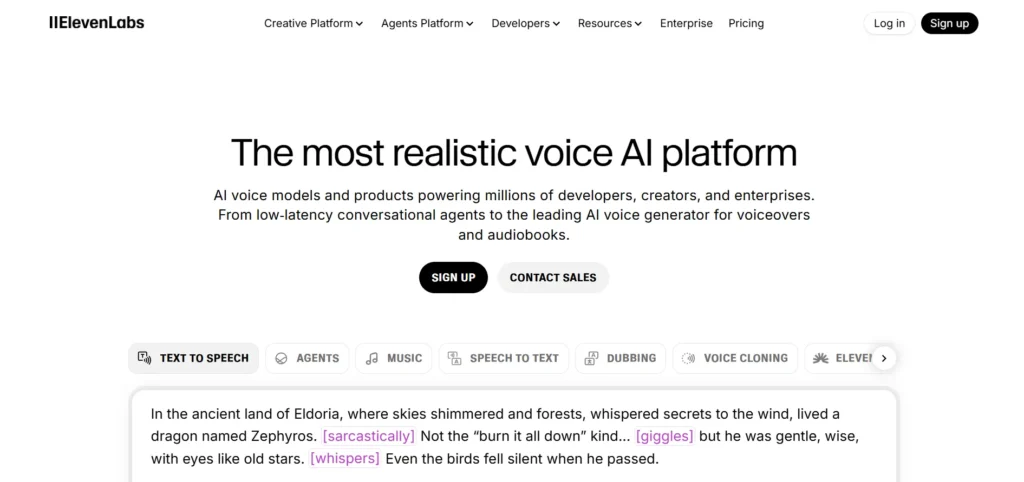
ElevenLabs is widely regarded as one of the most natural-sounding AI narration tools, offering audio quality that feels close to a human voice actor. It is especially useful for authors who want reliable pacing, expressive tone, and smooth transitions without complex editing.
The platform supports full audiobook workflows, allowing users to upload entire manuscripts and process them chapter by chapter. Its voice cloning feature also makes it possible to maintain consistency across a book series or build a recognizable narrator identity. For creators aiming at commercial distribution, it delivers dependable, studio-like output.
Best For: Authors and small publishers who want a polished, professional-sounding audiobook without hiring real voice actors.
Why It’s Great:
- Produces very natural, expressive narration — subtle pauses, breaths, and human-like pacing.
- Offers voice cloning: you can create a narrator that sounds like you or an entirely unique voice for your brand.
- Supports 30+ languages and a broad voice library, ideal for global distribution.
- Provides a structured chapter / project workflow: upload your manuscript, split into chapters, fine-tune each part, and export a full audiobook.
When to Use It:
- You want near-human quality for a commercial audiobook (fiction or non-fiction).
- You’re self-publishing but aiming for a professional result.
- You want consistency across multiple titles or series.
2. Murf AI
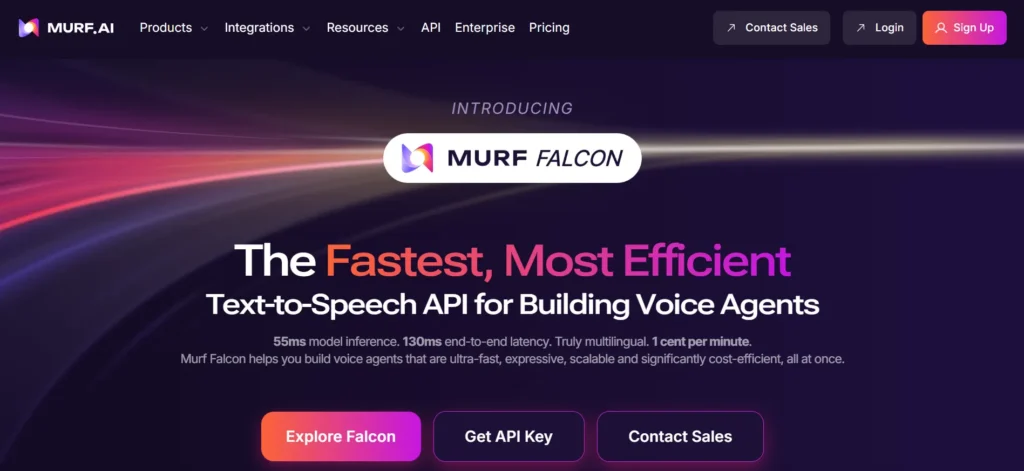
Murf AI gives creators more control over the emotional delivery of narration, which makes it ideal for books that depend heavily on tone shifts. Its editor feels like a simplified audio studio where you can adjust pitch, pace, emphasis, and pronunciation. This flexibility makes it easy to shape narration with precision, especially for business, fiction, or educational audiobooks.
With its wide voice library and detailed editing tools, users can fine-tune scenes to feel calmer, more dramatic, or more energetic as needed. Murf strikes a balance between usability and advanced voice direction.
Best For: Writers and content creators who want to shape the narrator’s performance — pitch, pace, emphasis — like an audio engineer.
Why It’s Great:
- 200+ realistic voices in 20+ languages — with many variations for tone and style.
- Fine control over pitch, speed, pauses, emphasis, pronunciation, allowing nuanced deliveries (e.g., dramatic scenes vs calm explanations).
- Timeline editor where you can split chapters, insert pauses, adjust breathing, or even add background music if desired.
- Offers a free trial, making it easy to test before committing.
When to Use It:
- Your book has complex structure or needs tone shifts — e.g., business books, poetry, dramatic fiction.
- You want to craft narration carefully, like a director for voice-over.
3. Resemble AI
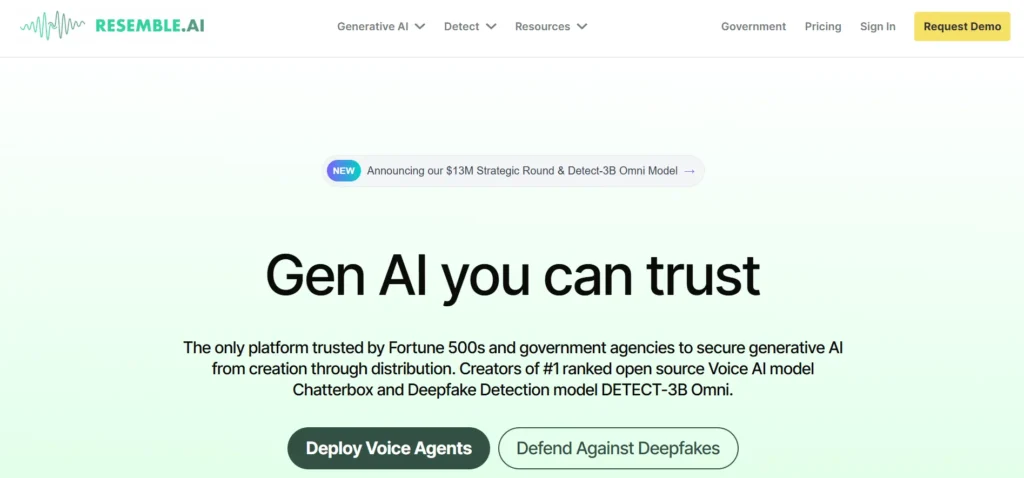
Resemble AI is designed for creators who want a fully unique narrator voice rather than selecting from pre-existing templates. As one of the most advanced AI audiobook tools, it delivers lifelike narration with strong clarity and emotional structure, making it ideal for premium or large-scale audiobook projects.
With support for over a hundred languages, it enables authors and publishers to reach international audiences without additional recording work. Its API integration allows publishers to automate audiobook production or manage multiple titles efficiently. This makes Resemble a top choice for businesses that need scalable, branded audio content.
Best For: Publishers, brands, or authors who want custom voices (like a brand narrator) or need to produce audiobooks in many languages.
Why It’s Great:
- Delivers high-fidelity, expressive TTS narration with realistic tone and pacing.
- Supports 120+ languages, making it ideal for global reach.
- Offers voice cloning — useful for brand identity or consistent narrator across multiple titles.
- Built for API-driven workflows, which is valuable for larger publishers or automated pipelines.
When to Use It:
- You want a unique narrator voice.
- You’re producing audiobooks in multiple languages or for multiple markets.
- You value flexibility and scalability over simplicity.
4. LOVO (Genny)
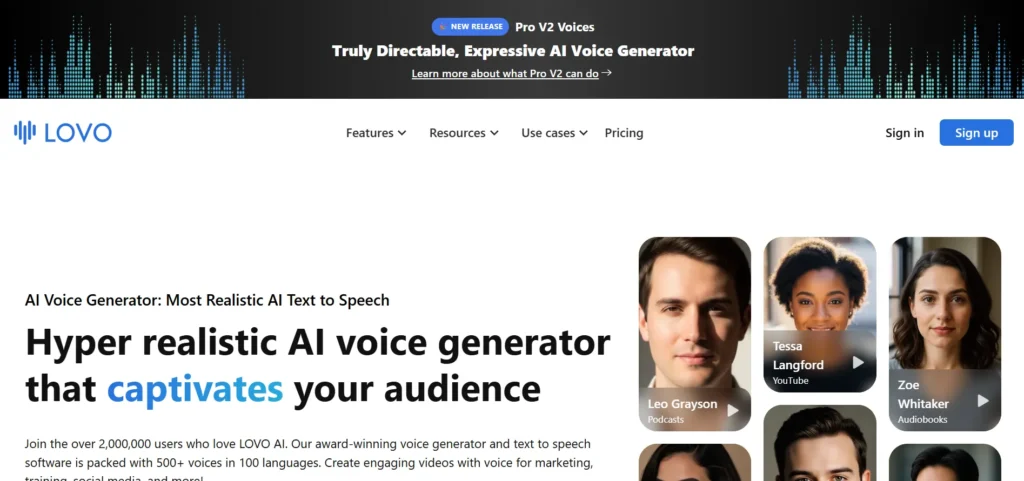
LOVO’s strength lies in delivering emotionally rich voices suited for storytelling. Its library includes hundreds of voices with distinct personalities, ages, and tones, making it ideal for genres like romance, fantasy, and narrative fiction.
The platform also supports multi-speaker output, which helps bring dialogues and character interactions to life. Its editing interface is beginner-friendly, yet powerful enough for large projects. Creators appreciate LOVO for its balance of expressive delivery and ease of use.
Best For: Fiction authors (romance, fantasy, YA), storytellers, or creatives who care about emotion and narration style.
Why It’s Great:
- 400–500+ voices covering 100+ languages — with narrators featuring different ages, genders, tone styles.
- Good control over emotion and pitch to match scene tone.
- Supports multi-speaker narration, handy for dialogue-heavy books.
- Simple interface for batch generating chapters.
When to Use It:
- Your book is fiction, dialogue-heavy, or story-driven.
- You want a narrator with character, warmth, or dramatic tone.
5. Speechify
Speechify is built for speed and convenience, making it a popular choice for authors who already have a completed manuscript. Its mobile-friendly design allows users to generate, preview, and edit audiobooks from phones, tablets, or desktops.
With a massive voice library and multilingual support, it can convert long documents into clean narration with minimal effort. Speechify’s voice cloning gives creators an added layer of personalization, whether for branding or unique narration style. The tool is excellent for quick audiobook creation and revision.
Best For: Authors who want speed and convenience — especially if their book already exists as a PDF, DOCX, or ePub.
Why It’s Great:
- 1000+ voices in 60+ languages and multiple accents — offering considerable flexibility.
- Supports direct upload of documents: PDFs, ePubs, or Word docs.
- Cloud-based: works across devices (desktop, phone, tablet), so you can generate and listen on the go.
- Includes voice cloning and basic editing tools.
When to Use It:
- You want to quickly generate an audiobook version of an existing e-book or manuscript.
- You value mobility — perhaps reviewing or listening while commuting or working.
6. VEED Audiobook Maker
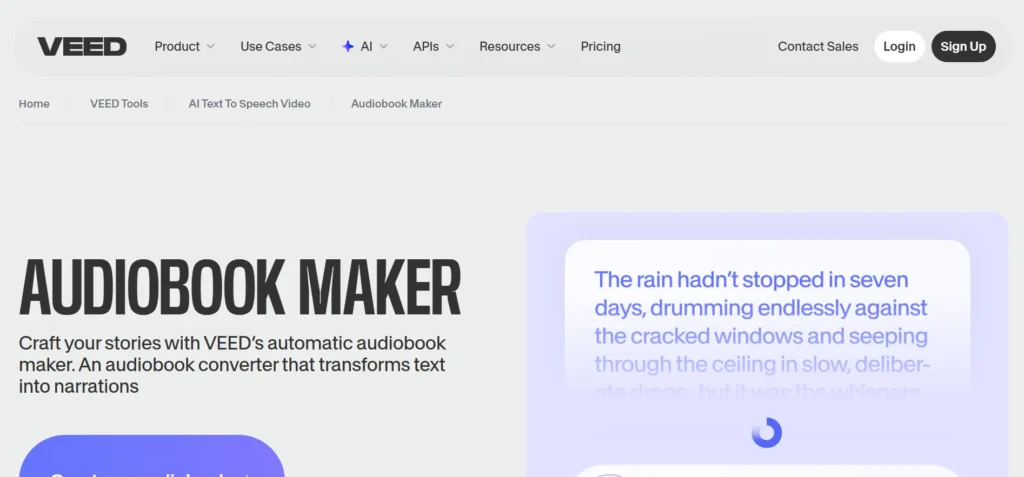
VEED is designed for authors who want a simple, no-learning-curve tool for producing short audiobooks or promotional audio clips. It offers fast text-to-speech conversion and the ability to pair audio with visuals such as waveforms or book covers.
This makes it ideal for marketing snippets or sample chapters shared on social media. The platform is lightweight but effective for small projects and short-form storytelling. VEED is perfect for testing audiobook potential without heavy editing needs.
Best For: Short stories, novellas, sample chapters, or promotional content (audio trailers, video teasers, etc.)
Why It’s Great:
- Super-simple paste text → choose voice → export workflow.
- Can export audio only (MP3) or audio + video (with waveform or cover art), useful for marketing.
- Great if you want to publish short reads, sample chapters, or test audiobook potential.
When to Use It:
- You’re publishing short books or stories, or releasing audible previews.
- You want to create audiobook content + visual promos (for social media or YouTube).
7. Podcastle
Podcastle goes beyond text-to-speech by offering a combined environment for recording, editing, and AI narration. Authors who want to include personal intros, commentary, or podcast-style extras find it especially useful. Its editor includes noise reduction, remote recording, multitrack arrangement, and mastering tools.
The TTS voices are clear enough for narration, while the recording tools let you blend human and AI audio smoothly. This hybrid approach makes Podcastle a versatile choice.
Best For: Authors who also host podcasts or want to combine human-recorded intros with AI-narrated chapters.
Why It’s Great:
- Large voice library with various accents — suitable for narration or character voices.
- Built-in audio recorder and editor, with tools for noise reduction, remote recording, and mastering.
- Allows you to mix your own voice (intro, commentary) with AI narration, ideal for audiobook + bonus content.
When to Use It:
- You want an integrated hub for both podcasts and audiobooks.
- You plan to mix human voice segments (like author’s note) with AI narration.
8. Respeecher
Respeecher focuses on delivering extremely high-quality, lifelike narration suitable for premium productions. As one of the most advanced AI audiobook tools, it is known for its film- and game-grade voice synthesis, bringing exceptional realism to long-form content.
The tool is preferred by creators who want narration that closely resembles a professional actor’s performance. Its voice cloning technology is highly precise, allowing the creation or replication of unique narrator voices. Overall, Respeecher is best suited for creators who prioritize the highest possible audio quality.
Best For: Publishers or authors seeking top-tier narration quality, especially for long-form or premium audiobooks.
Why It’s Great:
- Produces studio-grade, human-like voice output suitable for commercial audiobooks, games, and cinematic projects.
- Offers voice cloning, giving you bespoke narrators with unique tone and identity.
- Built for professional production flows — with custom packages and higher fidelity.
When to Use It:
- You want your audiobook to sound like a professionally produced audio drama or narrative.
- You are comfortable investing more (time or money) for premium quality.
9. Amazon Polly (AWS)
Amazon Polly is designed for large-scale audiobook production where cost, automation, and efficiency matter. It integrates seamlessly with AWS services, allowing publishers to automate entire audiobook pipelines.
While its voices are not as emotional as some competitors, they are reliable, clear, and suitable for nonfiction or instructional content. Polly is ideal for those managing multiple titles or creating audio at scale. It offers flexibility, affordability, and strong cloud integration.
Best For: Tech-savvy authors or publishers who want to automate audiobook production or handle many titles at once.
Why It’s Great:
- Offers many neural voices across multiple languages, with decent clarity and pacing.
- Cost-effective, especially for bulk production; works well with automated pipelines (via AWS).
- Can be integrated with other AWS tools (storage, processing, publishing workflows) — making it ideal for scalable audiobook production.
When to Use It:
- You manage a large catalog of books.
- You prefer an automated, backend-driven workflow rather than manual uploads.
Suggested read: Photo Editing Software
10. NaturalReader
NaturalReader is a straightforward text-to-speech converter ideal for new authors or small creators. It supports various document formats and offers natural-sounding voices without requiring technical knowledge.
The software is available as both a desktop app and an online tool, giving users flexibility in how they work. Its pricing is accessible, making it a safe entry point for experimenting with audiobook production. For non-commercial or educational content, it performs reliably.
Best For: Authors new to audiobooks, educators, or creators on a budget who want to experiment.
Why It’s Great:
- Offers both online and desktop apps for converting documents to speech.
- Has several natural-sounding voices across languages.
- Offers free and reasonably priced premium plans — good for experimentation.
When to Use It:
- You want to test the audiobook format for your book without big investment.
- You are publishing non-commercial content, such as internal training materials, educational content, or shorter works.
Comparison Table
| Tool | Best For | Languages / Voices | Free Plan / Trial |
| ElevenLabs | Top-quality narration & publishing-ready audio | 30+ languages, large voice catalog | Yes (limited) |
| Murf AI | Authors who want precise voice control | 200+ voices, 20+ languages | Free trial |
| Resemble AI | Custom / cloned voices & enterprise-grade projects | 120+ languages / voices | Trial / demo |
| LOVO (Genny) | Emotional storytelling / fiction or creative books | 400–500+ voices, 100+ languages | Yes (limited) |
| Speechify | Quick conversion of e-books / documents to audio, multi-device | 1000+ voices, 60+ languages | Yes (limited) |
| VEED Audiobook Maker | Shorter works, sample chapters, promo content (audio + video) | Multiple voices | Yes |
| Podcastle | Authors who also podcast or want mixed audio content | Large voice library + accents | Yes |
| Respeecher | Professional-grade narration, studios, branded audiobooks | Multi-language, custom voices | Custom pricing |
| Amazon Polly (AWS) | Developers or publishers needing scalable, automated pipelines | Many languages and neural voices | Free tier available |
| NaturalReader | Budget-friendly option and beginners | Multiple voices & languages | Free + Paid |
Smart Workflow: How to Turn Your Manuscript into a Polished Audiobook
No matter which tool you choose, here are best practices to get professional results:
- Clean up your manuscript first: remove formatting errors, fix typos, expand abbreviations, remove unnecessary markup, and structure chapters properly.
- Add “spoken-friendly” punctuation — commas, periods, paragraph breaks, to guide natural breaths and pauses.
- Use pronunciation notes for names, places, or special terms (many AI tools let you store custom dictionaries).
- Test with one chapter first — listen for odd pauses, mispronunciations, or tone issues.
- Listen straight-through (or at 1.25× speed) to check flow, pacing, and narration fatigue.
- If your book is dialogue-heavy, use a tool that supports multi-voice narration or choose a narrator with character.
- Consider adding music or ambient sound (especially for fiction) — but keep volume and pacing natural (avoid overproduction).
- Render in the highest quality settings (e.g. 320 kbps MP3 or WAV if supported).
- Get feedback: share a sample with beta-readers to catch pronunciation or pacing issues before finalizing.
Final Thoughts
Bringing your book into the audio space is no longer a complicated or costly undertaking. Modern technology—especially AI tools to turn your book into an audiobook—has made it possible for any creator to produce a polished listening experience that resonates with audiences everywhere. By understanding the options available, choosing what aligns with your goals, and following a streamlined workflow, you can create an audiobook that feels engaging, professional, and true to your vision.
Ultimately, the transition from page to audio is more than a format shift—it’s an opportunity to expand your reach, deepen your impact, and share your story in a way that fits how people consume content today. With the right preparation and a thoughtful approach, your work can speak to listeners just as powerfully as it does to readers.
FAQs
1. Why are AI Audiobooks Becoming so Popular?
AI audiobooks are gaining traction due to their affordability, efficiency, and ability to produce high-quality narrations quickly.
2. What are The Best AI Audiobook Tools?
Top tools include Speechify, Descript, and WellSaid Labs. Each has unique features tailored to different needs.
3. How do AI Audiobook Tools Work?
These tools use AI to convert text into speech, allowing you to choose voice styles, adjust pace, and add intonations for a natural-sounding audiobook.
4. How do I Choose the Right AI Audiobook Tool?
Consider factors like voice quality, customization options, ease of use, and pricing when selecting a tool.
5. Can I Make a Polished Audiobook Without a Huge Budget?
Yes! By choosing the right AI tool and following a smart workflow, you can create professional-sounding audiobooks without overspending.
