

India runs on chai. Whether it is a rainy morning in Mumbai or a cold winter afternoon in Delhi, tea is the one thing that brings everyone together. And right now, that deep-rooted love for tea is turning into one of the most promising franchise opportunities in the country.
India is the world’s largest tea market, with over 1 billion cups consumed every single day. That number is not just impressive — it is the backbone of an entire industry waiting to be tapped by smart entrepreneurs. The shift from roadside chai stalls to organized, branded tea retail is well and truly underway, and Tea Time is right at the centre of that change.
If you have been thinking about opening a Tea Time franchise, this guide will give you everything you need — full Tea Time Franchise Cost breakdown, honest ROI numbers, a brand comparison, and a step-by-step process to get started in 2026.
Why Is the Tea Franchise Market Booming Right Now?
A few things are happening at the same time that make 2026 a particularly good year to enter the tea franchise business in India:
- Young consumers, especially those between 18 and 35, are moving towards specialty teas, bubble teas, and handcrafted brews. They want an experience, not just a beverage.
- Organized tea retail is slowly replacing the unorganized chai stall economy, especially in Tier 1 and Tier 2 cities.
- Tea consumption in India is growing at 6-8% per year, which means demand is only going up.
- Government policies supporting small business loans and MSME financing have made franchise investment more accessible than before.
All of this puts an investor in a strong position — especially with a brand like Tea Time that already has proven systems in place.
About Tea Time: Brand at a Glance

Tea Time was founded by a team of tea enthusiasts with one clear goal: to make great tea accessible to everyone while giving customers a modern, consistent experience they could trust.
The brand has built a menu of over 50 types of tea — premium Assam and Darjeeling teas, herbal infusions, fusion blends, and seasonal specials. What separates Tea Time from the average chai shop is its focus on quality sourcing, standard preparation across all outlets, and a customer experience that keeps people coming back.
The franchise model is designed so that even a first-time business owner can run a profitable outlet with the right support. The brand currently operates across 20+ states in India and is on track to reach 100+ cities and 500+ franchise units in the next three years.
Why Should You Consider a Tea Time Franchise?
Tea Time has a strong franchise opportunity in the Indian market that is growing at a high rate and it is a recession proof business with high growth potential providing an investor an opportunity to invest in such a business. The successful business model of the brand, the well-developed system of support, and the constantly increasing market demand provide the perfect conditions of becoming a successful entrepreneur.
- Profitability: The franchisee of the Tea Time tea shop has a break-even point of 12-18 months, and the profit margin is 25-35 percent because the cost of operation is low, and volumes are possible.
- Support: A detailed training regimen, regular operational advice, marketing support, and supply chain management provide the franchisees with constant help during their business life.
- Market: The consumption of tea in India is increasing at 6-8 percent per year, which means a long-lasting demand of quality tea retailers who use modern presentation and a wide variety of products.
- Scalability: The franchise provides an opportunity to expand easily with a number of outlets and hence the successful franchisee has a chance of establishing large portfolios of business in their territories.
- Innovation: Tea Time constantly presents new products, seasonal items, and interaction programs with the customer, which keeps the brand new and competitive in the changing market.
Tea Time Franchise Models: Which One Is Right for You?
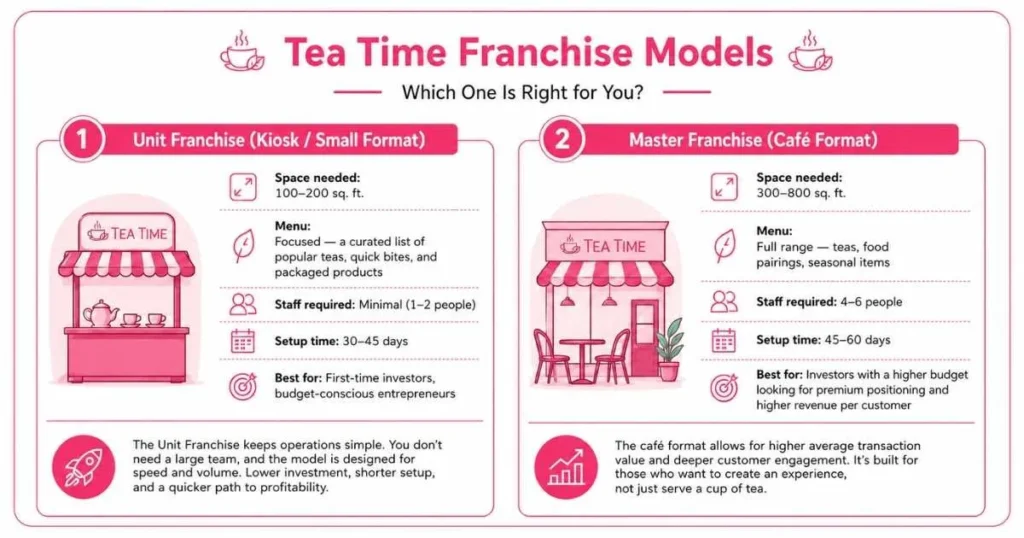
1. Unit Franchise (Kiosk / Small Format)
This is the entry-level option — compact, efficient, and built for high-footfall locations. Think railway stations, college canteens, hospital lobbies, and busy market streets.
- Space needed: 100–200 sq. ft.
- Menu: Focused — a curated list of popular teas, quick bites, and packaged products
- Staff required: Minimal (1–2 people)
- Setup time: 30–45 days
- Best for: First-time investors, budget-conscious entrepreneurs
The Unit Franchise keeps operations simple. You don’t need a large team, and the model is designed for speed and volume. Lower investment, shorter setup, and a quicker path to profitability.
2. Master Franchise (Café Format)
The Master Franchise is a full café experience — seating, extended menu, food service, and a relaxed ambience that encourages longer customer stays. This model targets customers who want to spend time over their tea, not just grab one on the go.
- Space needed: 300–800 sq. ft.
- Menu: Full range — teas, food pairings, seasonal items
- Staff required: 4–6 people
- Best for: Investors with a higher budget looking for premium positioning and higher revenue per customer
The café format allows for higher average transaction values and stronger customer relationships. It takes a bit more investment upfront, but the absolute profit potential is significantly higher.
Tea Time Franchise Cost Breakdown (2026)
Let us break this down Tea Time Franchise Cost, clearly so you know exactly what you are getting into before signing anything.
Franchise Fee & One-Time Charges
| Component | Unit Franchise | Master Franchise |
|---|---|---|
| Franchise Fee | ₹2,00,000 | ₹5,00,000 |
| Security Deposit | ₹1,00,000 | ₹2,00,000 |
| Brand Development | ₹50,000 | ₹1,00,000 |
| Training Fee | ₹25,000 | ₹50,000 |
| Monthly Royalty | 3% of gross sales | 1.5% of gross sales |
The franchise fee gives you exclusive territory rights, access to Tea Time’s full training programme, and onboarding support. Royalties are ongoing and support brand-level advertising, new product launches, and operational guidance.
Setup & Infrastructure Costs
| Component | Unit Franchise | Master Franchise |
|---|---|---|
| Store Setup & Renovation | ₹3,00,000 | ₹8,00,000 |
| Equipment | ₹2,50,000 | ₹5,00,000 |
| Furniture | ₹1,00,000 | ₹3,00,000 |
| Signage & Branding | ₹75,000 | ₹1,50,000 |
| Initial Inventory | ₹1,50,000 | ₹2,50,000 |
Tea Time provides full architectural guidelines and an approved vendor list so you are not left figuring out where to source equipment or how to design the store. The initial inventory covers 2–3 months of operations.
Monthly Operating Costs
| Component | Unit Franchise | Master Franchise |
|---|---|---|
| Monthly Rent | ₹25,000 | ₹60,000 |
| Staff Salaries | ₹30,000 | ₹80,000 |
| Utilities | ₹8,000 | ₹15,000 |
| Marketing Contribution | ₹10,000 | ₹20,000 |
| Cost of Goods Sold (COGS) | 35% of sales | 32% of sales |
These are your regular working costs. Rent will vary significantly depending on city and location — a metro railway station kiosk will cost more than a neighbourhood setup in a Tier 2 city, but it will also bring in much higher footfall.
Total Investment Summary
| Model | Total Estimated Investment |
|---|---|
| Unit Franchise (Kiosk) | ₹5 Lakhs – ₹10 Lakhs |
| Master Franchise (Café) | ₹15 Lakhs – ₹22 Lakhs |
Profitability & ROI: What the Numbers Actually Look Like
This is the part most people want to get to quickly, so let us be direct about it.
| Model | Monthly Revenue | Net Profit/Month | Break-Even Period | Annual ROI |
|---|---|---|---|---|
| Unit Franchise | ₹1.5 – 2.5 Lakhs | ₹35,000 – 60,000 | 12–15 months | 35–40% |
| Master Franchise | ₹4 – 6 Lakhs | ₹1,00,000 – 1,50,000 | 15–18 months | 30–35% |
A few things worth highlighting here:
Revenue is not heavily seasonal — tea consumption in India remains steady year-round, with small spikes in winter months.
High-traffic locations like metro stations can reduce the break-even window to as little as 6 months for the Unit model.
Profit margins for Tea Time are strong — between 40% and 80% gross margin — because raw material costs are low and there is no need for elaborate dine-in infrastructure in the kiosk model.
After break-even, successful franchisees typically see annual returns of 30–40%, which is competitive against most other food and beverage franchise options.
Site Requirements: Where to Open Your Outlet
Location is everything in this business. Here is what Tea Time looks for when approving a site:
- Footfall: High pedestrian traffic is non-negotiable. Railway stations, metro nodes, college campuses, hospitals, and busy market streets are ideal.
- Visibility: Ground floor, street-facing, with clear signage visibility. The outlet should be easy to spot and easy to walk into.
- Demographics: Young professionals, students, and middle-class families within a 1–2 km radius are the primary target audience.
- Distance from competition: At least 200 metres from direct competitors is preferred, though being near offices, colleges, and shopping centres is a plus.
- Infrastructure: Reliable electricity, water supply, and waste management — basic but important for daily operations.
What Support Does Tea Time Offer Franchisees?
One of the strongest arguments for going with Tea Time over an independent setup is the support structure. Here is what you get:
- Training: A 2-week comprehensive training programme covering tea preparation, customer service, inventory handling, and day-to-day business management.
- Marketing: National advertising campaigns, digital presence management, and local marketing materials — all managed at the brand level.
- Operations: Ongoing operational guidance, quality audits, new product rollouts, and best-practice sharing across the franchise network.
- Supply Chain: Centralised procurement ensures quality consistency and competitive ingredient pricing across all outlets.
- Technology: POS systems, inventory management software, CRM tools, and online ordering integration to keep operations smooth and data-driven.
Tea Time vs Chaayos vs MBA Chai Wala: Honest Comparison (2026)
If you are comparing your options in the tea franchise space, here is a straightforward breakdown of how the three main players stack up:
| Brand | Total Investment | Format | Profit Margin | Break-Even |
|---|---|---|---|---|
| Tea Time | ₹5L – ₹10L | Kiosk / Local outlet (100–300 sq.ft) | 40% – 80% | 6–12 months |
| Chaayos | ₹6L – ₹15L | Premium café / Lounge (300–800 sq.ft) | 15% – 30% | 12–18 months |
| MBA Chai Wala | ₹5L – ₹8L | Standard kiosk / Café (100–300 sq.ft) | 10% – 25% | 10–14 months |
What stands out here is that Tea Time offers the strongest profit margin among the three — and a faster break-even period than both Chaayos and MBA Chai Wala. Chaayos requires a larger upfront investment in premium interiors without delivering proportionally better margins. MBA Chai Wala is competitively priced but trails on profitability.
For investors who want strong margins, a quick return on investment, and a relatively low barrier to entry, Tea Time is the most compelling option in this comparison.
How to Apply for a Tea Time Franchise in 2026
The process is straightforward and transparent. Here is how it works:
- Submit your inquiry through the Tea Time franchise official portal or by contacting the franchise development team directly. You will need your name, location preference, and a rough sense of your investment capacity.
- Local consultation: A regional representative will reach out to assess demand in your area, discuss territorial boundaries, and evaluate financial feasibility.
- Location inspection: You identify a commercial space that meets Tea Time’s site criteria — minimum 100–150 sq. ft. in a high-footfall zone.
- Official approval & MOU signing: Once approved, you sign a Memorandum of Understanding and pay the franchise fee to lock in your territory.
- Store setup & launch: Tea Time’s team provides complete interior plans, equipment packages, and training. Most outlets are ready to open within 30–45 days of approval.
Risks You Should Know Before Investing
No business is risk-free. Here are the key challenges to plan for:
- Competition: The tea space is getting crowded — established brands, new entrants, and local chai stalls all compete for the same customers. Strong customer service and consistent quality are your best defences.
- Location risk: A poor location choice can significantly drag down sales. Do your own market research — do not rely solely on the franchisor’s assessment.
- Operational consistency: Maintaining quality across every cup requires discipline and a trained team. This is an everyday commitment, not a one-time setup.
- Seasonality: While tea demand is broadly stable, there are natural seasonal patterns. Have flexible inventory management in place for peak and off-peak periods.
- Regulatory compliance: Food safety standards (FSSAI), local licensing, labour laws, and GST filings need to be in order from day one.
Is the Tea Time Franchise Worth It in 2026?
Let us be honest. A tea franchise is not a get-rich-quick scheme. But it is one of the more solid, low-risk entry points into food and beverage entrepreneurship available in India right now.
The market fundamentals are strong — India is not going to stop drinking chai any time soon, and the shift towards organized, branded tea retail is still in its early stages. Tea Time’s combination of low capital requirements, strong profit margins, extensive franchisee support, and a proven business model make it genuinely worth considering.
If you have the capital, the right location in mind, and the willingness to put in the work of running a business day-to-day, a Tea Time outlet can realistically deliver a full return on your investment within 12–18 months and generate consistent profits well beyond that.
For a first-time entrepreneur especially, the structured training and ongoing operational support significantly reduce the learning curve and the risk of early failure.
Conclusion
Tea Time is an excellent franchise opportunity that can attract entrepreneurs who want to invest in India and enter the large tea retail market with relatively low investment requirements and high growth opportunities. A tested business model, solid support network, and competitive tea time franchise cost model position the brand well to achieve success to franchisee under varying market conditions.
With the rising demand of tea in India, the increase in the desire to use structured retail stores, and the scalable franchise model that Tea Time has to offer, the brand has a chance to grow continuously until 2025 and even further. The emphasis not just on the quality but also affordability and customer experience reflects the changing consumer demand, and at the same time helps the brand to stay efficient and profitable in its operations.
To a budding entrepreneur with no or little experience in the restaurant business the extensive training and continued support offered by Tea Time can be instrumental in reducing the amount of risk they are taking as well as giving them a head start on the learning process. The various format alternatives in the brand enable the investors to select the models that suit their investment ability, availability of location, and business targets. The franchise opportunity seems to be well-prepared to succeed in the Indian retail environment in the modern Indian market since Tea Time has competitive advantages and the market is growing.
Discover More Franchise Opportunities:
FAQs
How much does a Tea Time franchise cost in total?
The total investment for a Unit Franchise (kiosk) is ₹5–10 lakhs. A Master Franchise (café) requires ₹15–22 lakhs. Both figures include franchise fees, setup costs, initial inventory, and working capital for the first few months.
How long does it take to recover the investment?
Most Unit Franchise outlets break even within 12–15 months. High-traffic locations can cut this to as little as 6 months. The Master Franchise model typically breaks even in 15–18 months.
Are there hidden costs in the franchise fee?
Tea Time’s fee structure is fully disclosed before signing. The main ongoing cost beyond setup is the monthly royalty (3% of gross sales for Unit; 1.5% for Master) and a marketing contribution that funds brand-level advertising.
Can I get financing to open a Tea Time franchise?
Yes. Several financial institutions partner with Tea Time to offer franchise-specific loan products. Tea Time also has a phased payment structure for eligible applicants who cannot fund the entire amount upfront.
Does the franchise fee include marketing support?
The initial fee covers onboarding and setup marketing. Ongoing marketing support — national campaigns, digital promotions, seasonal offers — is funded through the monthly marketing contribution paid by all franchisees.
