

Lots of millions of people use google in India every day. They look for information about news, recipes, exam results, train times, and more. Google seems to be an integral part of the internet. The question that arises in everyone’s mind is: is there a Google of its own for India? There’s a short answer, but it isn’t yet. However, there are a few local search engines in India. Some emphasize privacy. Some are AI chat apps which speak numerous Indian languages. Some of them are old web directories and local directories. They’re all very small in comparison to Google.
Nevertheless 2026 is an interesting year. New tools have emerged such as Sarvam Indus, which are powered by AI, that have given new hope. Here I’m going to explain what is an Indian Search Engine in very simple terms. I give you a list of 10, compare them with Google and give you a real world appraisal of what the future will bring.
Quick Answer: Top Indian Search Engines at a Glance
| Search engine | Type | Origin / launch | Languages | Privacy stance | Still working? (date tested) | Best for |
| Qmamu | Web | India, 2021 | English, some Indian languages | No tracking (its claim) | Likely live; seen in June 2026 usage data | Privacy |
| 13Tabs | Web | Dhanbad, 2019 | Mainly English | No private data stored (its claim) | Unverified, 30 Sep 2026 | Fact-checking |
| Sarvam Indus | AI | Bengaluru, Feb 2026 | Up to 22 Indian languages | Account needed | Live in beta, 30 Sep 2026 | Voice |
| Krutrim AI | AI | Ola, 2024 | Hindi, English, others | Account-based | Unverified, 30 Sep 2026 | Chat |
| BharatGPT | AI | CoRover, 2023 | Many Indian languages | Account-based | Unverified, 30 Sep 2026 | Business |
| Bharat Search | Web | Kanpur, 2022 | Hindi, English | Not clear | Unverified, little recent news | Curiosity |
| 123Khoj | Web / legacy | India, older project | English, Hindi | Not clear | Unverified, 30 Sep 2026 | Basics |
| Rediff | Legacy | Mumbai, 1996 | English | Ad-based | Site exists; search role unclear | News |
| Justdial | Directory | Mumbai, 1996 | English, Hindi, others | Ad and account-based | Live, 30 Sep 2026 | Local |
| Sulekha | Directory | India, late 1990s | English | Ad-based | Unverified, 30 Sep 2026 | Services |
Google still has a 97% share of search in India. Bing is near 1.2% (July 2026). None of these tools poses any threat to Google at this time.
What Is an Indian Search Engine?
An Indian Search Engine is a search engine developed by a local Indian firm or team, primarily for Indian users. Helps locate websites, answers, locations or services on the internet. It’s not much different from Google in one key aspect. It has an intent to cater to India first. This is something that can have a lot of meanings:
- Made in India: The Company and the team is Indian.
- Made for India: It is able to understand Hindi, Tamil, Bengali and other languages. There are those who can read the “Hinglish”!
- First, privacy: Some assure that they don’t track what you’re searching.
- Newer tools: Gives direct answers, rather than a list of links, as a result of using AI.
- Local first: Some assist you to locate shops, physicians and plumbers in your area.
One good thing to say: Many projects that are made at home don’t have their own complete web index that Google has. Some of the results of the Borrowed from larger search engines. It’s expensive to build and add to a billion page index. This has set a hurdle for many teams to overcome, which is why so few have attempted it.
Explore Top Search Engine Submission Sites
List of 10 Indian Search Engines in 2026
1. Qmamu
| Field | Details |
| Type | Web search |
| Origin / launch | India, 2021 |
| Languages | English, some Indian languages |
| Privacy stance | Privacy-focused Indian search engine and browser |
| Still working? | Yes |
| Best for | Privacy |
| Link | https://qmamu.com/ |
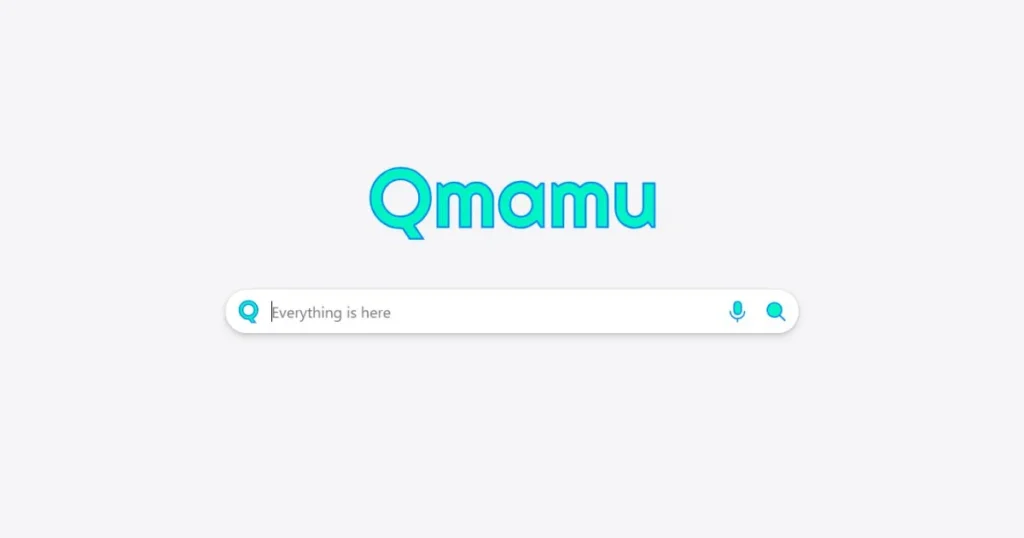
The web search tool ‘Qmamu’ has been released on 15 August 2021, which is Republic Day. It is said to be India’s first private search engine. The most basic assurance is that it won’t store your search history or monitor your browsing. That’s what the company says, and has not been reviewed by an external expert. It primarily operates in English, and has limited support in Indian languages via its voices. In June 2026 it showed up in usage statistics so it’s probably still around but it only has a small portion. It’s ideal for those who do not wish to have tracking in their search box. For more information on its privacy policy, please read its privacy policy.
2. 13Tabs
| Field | Details |
| Type | Web search |
| Origin / launch | Dhanbad, 2019 (prototype 2016) |
| Languages | Mainly English |
| Privacy stance | No Search History Tracking |
| Still working? | Yes |
| Best for | Fact-checking |
| Link | https://13tabs.com |
The concept of ‘13tabs’ started in December 2016 as a prototype and the 13tabs is a start-up founded by two brothers Sagar and Varun Mishra in Dhanbad in 2019. It is a search engine for the Web that is primarily English language based. According to the makers it does not store private data, but only their claim. The project also provided a tool to monitor viral posts and news, hence why it is included in fact-checking. For a small team, it may also be difficult to maintain a search product that’s fast and fresh over the course of years. Try out the link before depending upon it.
3. Sarvam Indus
| Field | Details |
| Type | AI chat and answer tool |
| Origin / launch | Bengaluru, February 2026 |
| Languages | Up to 22 Indian languages |
| Privacy stance | Data Fiduciary |
| Still working? | Yes |
| Best for | Voice |
| Link | https://www.sarvam.ai |
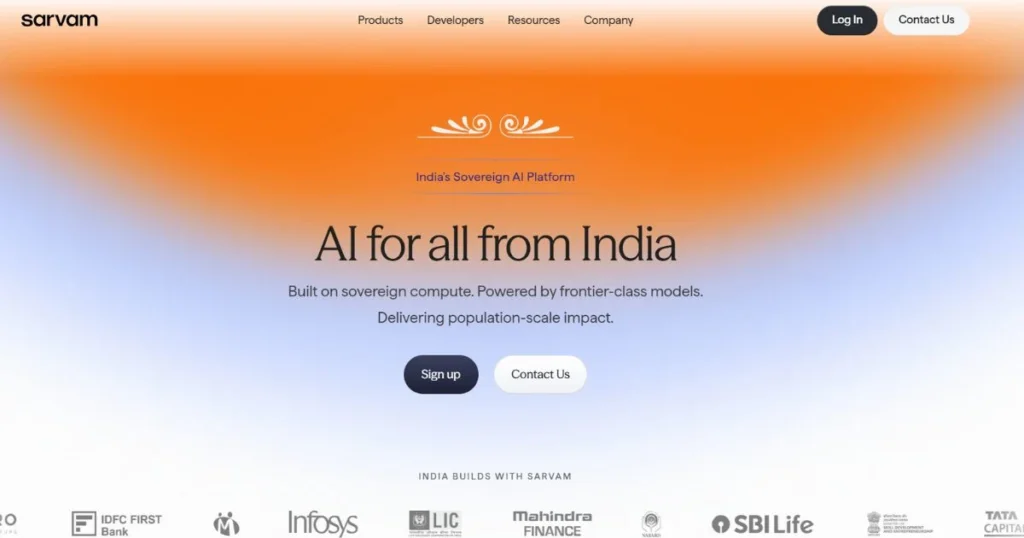
Sarvam Indus is an AI chat app from Bengaluru, which was launched in Feb. 2026. It is based on Sarvam’s 105-billion-parameter model, and is available in up to 22 Indian languages. Users can send text and/or voice queries and receive text and audio responses. It’s not a traditional search engine since it does not have a massive web index such as Google’s. It is in beta and may not be accessible quickly in practice due to limited computing power, and may require a waitlist. In order to sign-in you have to sign-in, otherwise your chats will not be linked to your account. It is the most suitable choice among all of them for voice and Indian languages.
4. Krutrim AI
| Field | Details |
| Type | AI assistant |
| Origin / launch | Ola, 2024 |
| Languages | Hindi, English, others |
| Privacy stance | Customer Inputs and Data |
| Still working? | Yes |
| Best for | Chat |
| Link | https://www.olakrutrim.com |
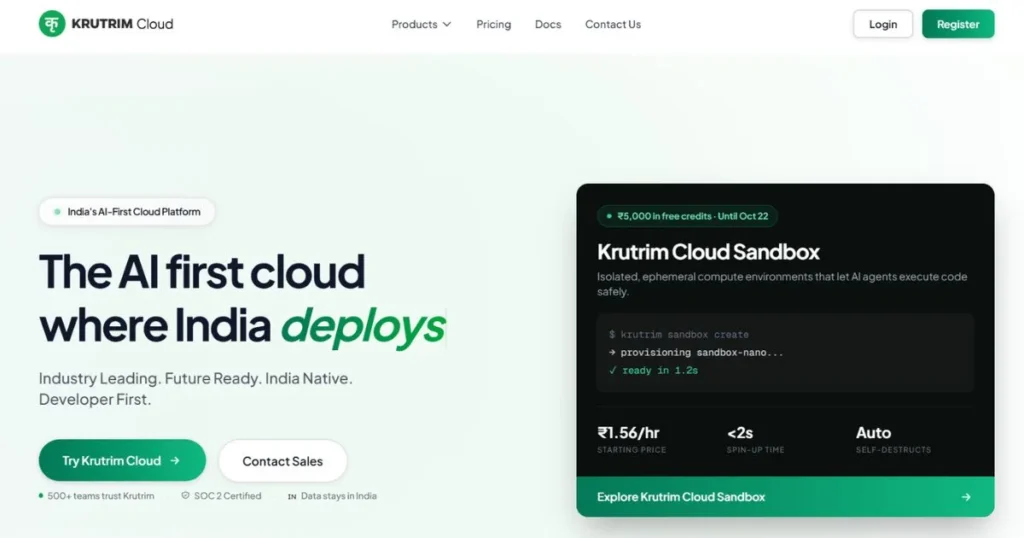
Krutrim AI is a start-up from Ola group with the launch date of 2024. It’s an AI assistant and after asking a question, it will respond to you in a chat style rather than provide a list of links. It could also be used in Hindi, English and other languages. As it requires an account then your chats could connect to you so check the privacy policy before. It should be thought of more as a tool to help in search than a search tool itself. As of 30 Sep 2026, its status is unverified, so click on the link and verify that it is functioning. It’s perfect for those who prefer answers on a chat basis.
5. BharatGPT
| Field | Details |
| Type | AI assistant |
| Origin / launch | CoRover, 2023 |
| Languages | Many Indian languages |
| Privacy stance | Strict On-Soil Isolation |
| Still working? | Yes |
| Best for | Business |
| Link | https://bharatgpt.ai |
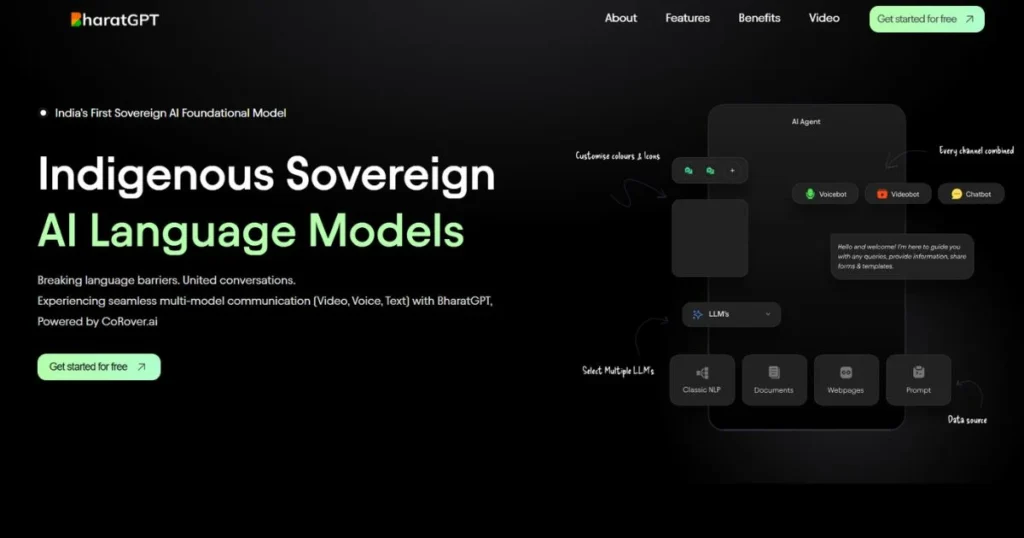
BharatGPT was built by CoRover and launched in 2023. It is an artificial intelligence assistant which has been made with the help of various Indian languages. Its core business is to provide chatbots which converse to consumers in their native tongue, particularly for businesses that wish to develop conversational bots in native languages. For this reason, it may not be as beneficial to the everyday user as Sarvam Indus and Krutrim. It’s account based, so review any privacy policies prior to uploading personal information. Not a search engine and does not index the entire Web. Currently its online status is not confirmed (30 Sep 2026). Best suited for business use, not searching everyday.
6. Bharat Search
| Field | Details |
| Type | Web search |
| Origin / launch | Kanpur, 2022 |
| Languages | Hindi, English |
| Privacy stance | Digital Personal Data Protection |
| Still working? | Yes |
| Best for | Curiosity |
| Link | https://ibharat.org/ |
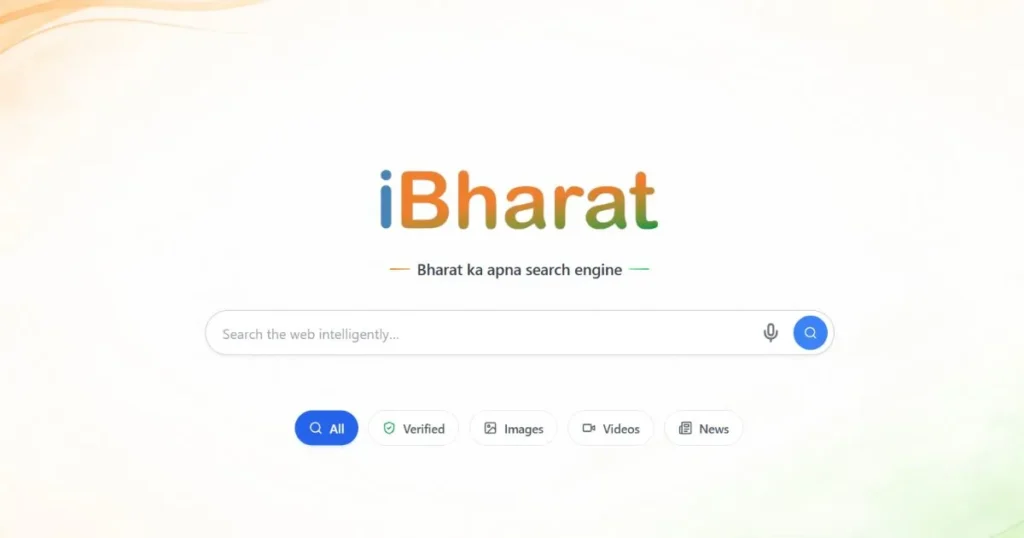
Bharat Search is one of the web search engines from Kanpur, which was started in 2022. It’s a product of a company started at Chhatrapati Shahu Ji Maharaj University called Bharat Tech. This group also developed other products such as B-mail and B-maps. It is bilingual (Hindi/English). It’s not clear what it’s privacy stance is. Very little news appears about it since 2022 with it possibly being dormant. We could not find a working link, look for “Bharat Search Bharat Tech” to find it. Think of it as a “cool idea experiment” and not something you can use all the time.
7. 123Khoj
| Field | Details |
| Type | Web / legacy |
| Origin / launch | India, older project |
| Languages | English, Hindi |
| Privacy stance | Third-Party Advertising |
| Still working? | Yes |
| Best for | Basics |
| Link | https://www.123khoj.com |
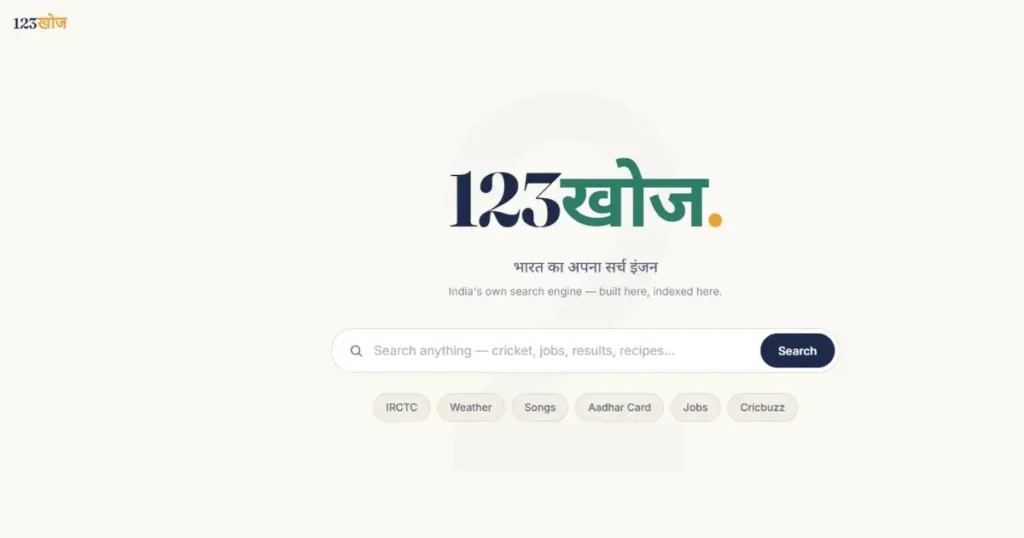
123Khoj is a very old Indian search project. According to a list from 2024, it is a tool to find websites, articles and images. It is available in English and Hindi language. It does not have an obvious privacy positioning, so don’t enter any sensitive data. The tool looks lightweight and simple, and the activity that is public is difficult to find. That’s why, perhaps, it’s referred to as legacy or even dormant. If you wish to give it a go, go to the link and conduct some basic questions. For basic needs, not for serious or daily research it is best.
8. Rediff
| Field | Details |
| Type | Legacy portal |
| Origin / launch | Mumbai, 1996 |
| Languages | English |
| Privacy stance | Ad-based portal |
| Still working? | Yes |
| Best for | News |
| Link | https://www.rediff.com |
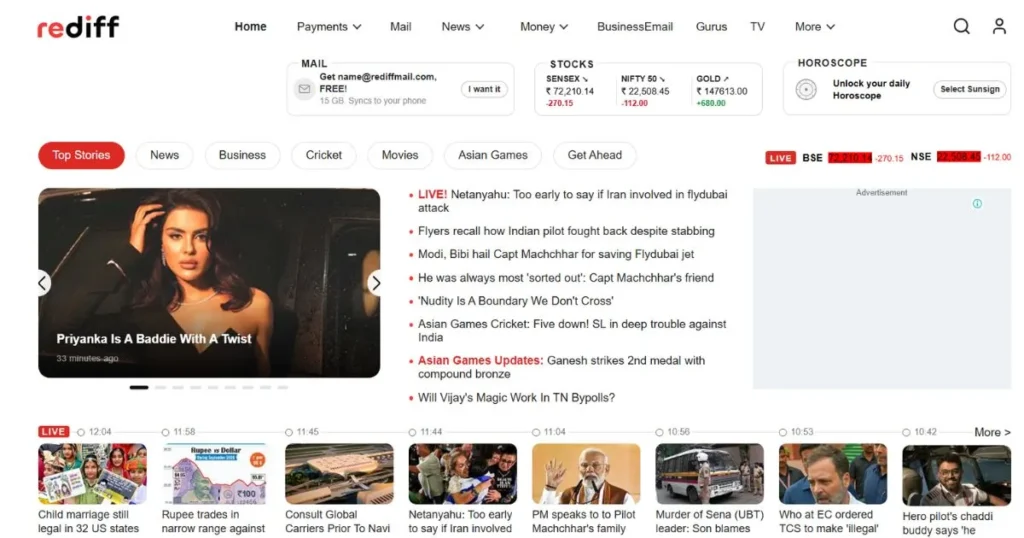
Rediff began in Mumbai in 1996 and was a one of top-notch websites in India. Now it’s more of a news portal and e-mail service than a search engine. It is primarily for use in the English language. It’s a money spinner, so there’s some tracking involved when using it. The site is still available, but it’s unclear how it will be again used as a web search. It’s a good piece of Indian history, as well as a good source of news. It shouldn’t be considered as a serious alternative to Google. If you wish to read the news, it’s still worth visiting.
9. Justdial
| Field | Details |
| Type | Directory |
| Origin / launch | Mumbai, 1996 |
| Languages | English, Hindi, others |
| Privacy stance | Ad and account-based |
| Still working? | Yes |
| Best for | Local |
| Link | https://www.justdial.com |
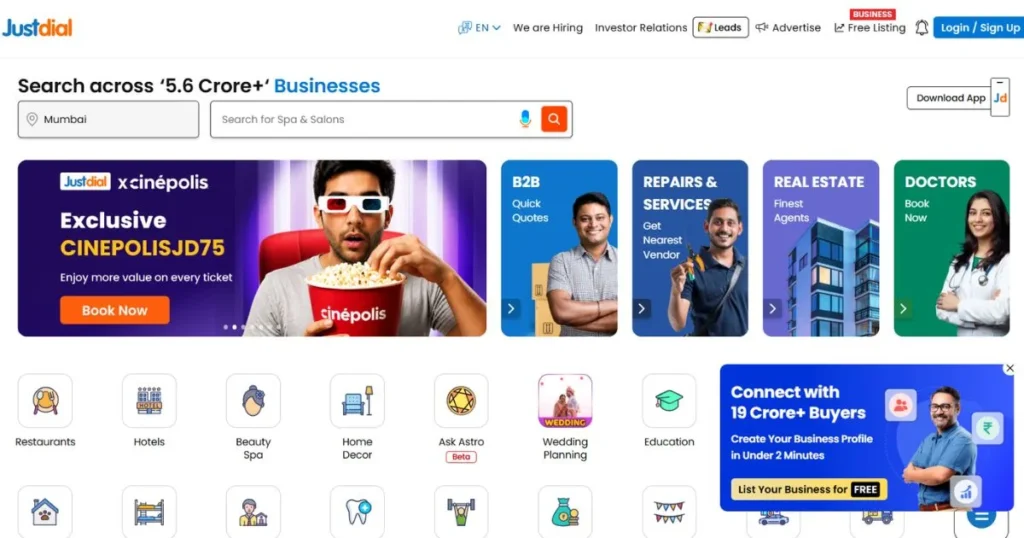
Justdial also began in Mumbai in 1996, and it is a local directory. It helps you find shops, restaurants, doctors and other services near you. It works in English, Hindi and other languages. It is live as of 30 Sep 2026. Its business is based on ads and leads, and many features need an account, so expect some tracking. It does not search the whole web, but it does one job very well: local search. If you want a plumber, a clinic or a nearby store, Justdial is a simple and very Indian choice. It is the best pick here for local needs.
10. Sulekha
| Field | Details |
| Type | Directory |
| Origin / launch | India, late 1990s |
| Languages | English |
| Privacy stance | Ad-based |
| Still working? | Yes |
| Best for | Services |
| Link | https://www.sulekha.com |
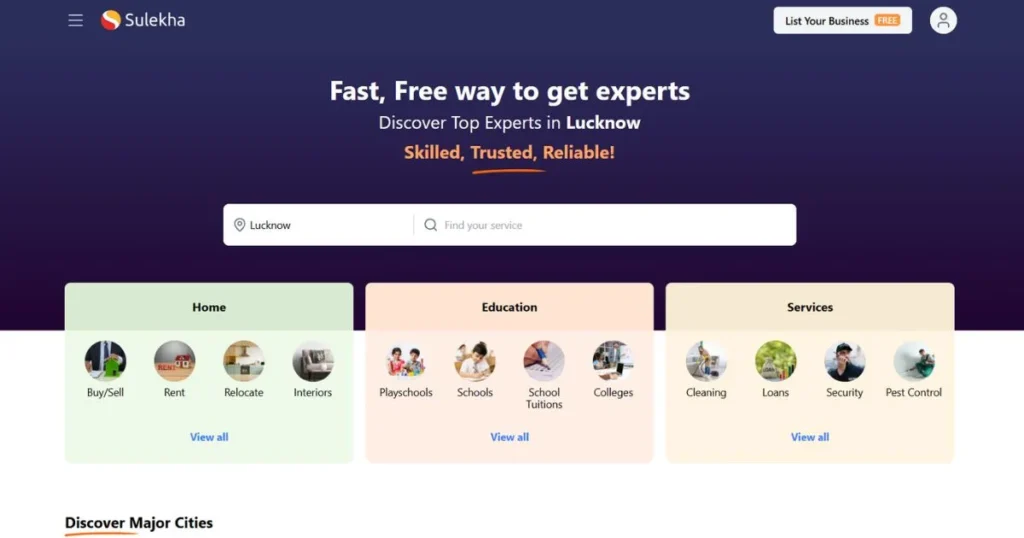
Sulekha is an Indian directory which was started in the late 90s. Lays the foundation for home services and local providers. Primarily operates in English. Supported by ads so, as usual, there will be some tracking when you use it! It’s not a tool used for searching the whole Web like Justdial. It will come in handy if you’re having a service called—repairees, home helpers, etc.—and it will not come in handy if you have a general question. As of 30 Sep 2026, it is not known if it is live or not: test the link before using it. It’s optimal for services and should be used with Google and not in lieu of it.
Indian Search Engine vs Google: Honest Comparison
| Point | Homegrown tools | |
| Web index size | Small or borrowed | Hundreds of billions of pages |
| Market share in India | Tiny (Qmamu shows about 0.01% on tablets) | About 97% |
| Speed and accuracy | Mixed | Very strong |
| Indian languages | Better in AI tools like Indus | Wide, and improving |
| Voice search | Strong focus in new AI apps | Mature and built into phones |
| Privacy | Often better promises | Data-based ads model |
| Maps, video, shopping | Limited | Full ecosystem |
| Trust and habit | Low awareness | Very high |
| Ads and money | Small budgets | Huge ad income |
The table shows a simple truth. Homegrown tools can win on one thing, such as privacy or language. But Google wins on almost everything else at the same time.
Why Google Still Dominates Search in India
- Great market share: Google dominated search share in India with 97.21% of the market in July 2026. On mobile it reached 98.12% in May 2026. In July 2026, Google was still at 95.27% and Bing at 3.04% on desktop, despite the fact that it’s outperforming the former.
- Android is the door: Majority of Indian mobiles are powered by Android OS. Google Search is an integral part of Google since the beginning. It is not the people’s choice. It’s in place now.
- Language support: Google provides the services in several Indian languages. This will help it spread to a large audience. The new search tool needs to be a match from the beginning.
- One account, many apps: Gmail, YouTube and Google Maps are tied closely to Google Search. When these work all day long, it feels just as if you’re working for extra.
- Quality and habit: Google returns the results in a timely fashion and the majority are correct. Or, habit is a strong force. No one switches to another search engine unless the other one is much superior.
Indian Language and Voice Search: Where Local Players Can Win
This is the ideal opportunity to have homegrown search. Here is why.
- Many want to be in their own language: A substantial portion of the new internet users in India believe and converse in their mother language. A tool which understands them, can gain their trust.
- Hinglish is real life: People use Hindi + English in the same sentence. According to Sarvam, Indus is helping to ensure hassle free switching between Indian languages. This type of feature is more apt for the Indian vernacular.
- Voice beats typing: When typing on a small size keyboard in Hindi or Tamil is slower than the typing. Speaking is easier. Indus allows people to ask questions via text and/or voice and receive them back in text and/or voice.
- Feature phones are important: Sarvam announced a partnership with HMD to bring AI to Nokia feature phones. If this is successful, it can be able to reach out to those who don’t use smartphones in any way.
- The local content is scanty on the Web: A lot of it is in English. In-built groups can create improved products for neighborhood news, government documents, farm guidelines, and area way of life.
The limiting factor is scale. Due to the limits of computing power in India, Indus is in limited beta and has a waitlist. Servers are needed without good language skills, it is not enough.
Are Indian Search Engines Safe and Private?
- Don’t take claims for granted: Whether Qmamu or 13Tabs, they both claim to not track users. These are their own assertions. I was unable to review them and I recommend that you read each privacy policy.
- If it’s small, it’s not necessarily safe: A small team can have poor security. If a private tool can be hacked, they are all a risk.
- AI chat apps require accounts: Indus users will need to log in with a phone number, Google or Apple ID. They can’t even delete the history of their chats without deleting the entire account as well. This means that there’s more of your data committed than with a no-login search box.
- They track you: Adobe sites like Rediff, Justdial and Sulekha charge for Ads and leads. Expect some tracking.
- Easy precautions: Stick to HTTPS websites. Do not give any details like Aadhaar, bank or OTP number in any chat. Use a trusted browser that has tracker blocking feature.
Indian Search Engines That Are Defunct or Dormant
In India, there are numerous examples of search projects that were unsuccessful. Let’s look at five examples and cases.
- Guruji.com: Guruji began as a search engine for users in India in 2006. It might be able to look into music, finance, images and movies. It was a hope that was raised early but it is not a top tool now.
- MyQuest.com: Search Engine Watch once wrote about MyQuest as a local search engine for India. It is a very old name and I couldn’t find it as an active tool.
- Bharat Search: It started in 2022 with proud local pride but I couldn’t find much news after that. Use it as a dormant until it has been proven to be effective.
- 123Khoj: It is still present in the lists but it is not very visible in the public activity. Test before believing!
- Rediff’s search role: Rediff is still a website, but it is no longer a major place to search the web.
Will India Get Its Own Google? (AI Search, Sovereign AI)
- The idea of sovereign AI: Sarvam says true AI sovereignty means building the whole technology stack from the ground up. Simply put, India wants its own models and servers, rather than reliance on foreign ones.
- 2026 is a big year: Sarvam showed its 105B and 30B models at the India AI Impact Summit in New Delhi. It was preceded by launching of Indus two days later. This depicts that funding and attention is coming in.
- Competition is strong: Sam Altman said ChatGPT has over 100 million weekly users in India. Of all countries, Anthropic claimed India is the second-largest market for Claude usage after U.S., with the usage rate being 5.8%. Here, global AI tools are already quite popular.
- AI could shift the nature of search: Search is now more often performed by asking a chat tool rather than typing a query into a search box. It’s here that the homegrown player has a real shot and especially in Indian languages.
- The honest opinion: It’s probably not going to be a complete replacement for Google in the next few years. What we need is a combination of good local tools (language/computer vision/voice), privacy tools (for those who use them sparingly), and local directories (for when we need them). Google will still be at the forefront, but they will not be the only ones.
Conclusion
So, is there any Google equivalent in India? Not today. About 97% of the searches are conducted on Google and there is no homegrown tool doing nearly as well. However, the story has a sad one. India does have a true selection of choices. It has the privacy-focused 13Tabs and Qmamu, the AI-powered Sarvam Indus, and the directory Justdial, among others.
The strongest chance to a future Indian Search Engine is to not be a copy of Google. To do what Google doesn’t do well: Speak all Indian languages, work by voice, be respectful of privacy, and be serviceable to local needs. Play around with some of these tools, don’t hesitate to use Google if you need to, and come back in 2027 and see what’s developed.
FAQs
Which is the best search engine in India?
No single winner is possible. Try Qnamu, which is a service for privacy. To get voice and Indian languages use Sarvam Indus. Justdial is a good option for local shops and services. None of them can take the place of Google completely.
What is the name of the first search engine of India?
This is not so easily determined. The earliest projects were those of Rediff in the late 90s/early 2000s and the more recent project Guruji (2006). Qmamu is said to be India’s first privately developed search engine. That is another claim, it’s the first private one, it’s not first ever.
Why there is no Google alternative for Indians?
Yes, but not all. Web search options: Qmamu and 13Tabs. Sarvam Indus and Krutrim are AI Answer Tools. Justdial is an area directory. At this time, nothing else comes close to Google.
Which is the top search engine in India?
Google. It saw a share of 97.21% in July 2026 well ahead of the competition from Bing and DuckDuckGo.
Can you trust Qmamu to be a safe search engine?
According to Qmamu, it does not store any search history or search activity. This is a company’s promise, which I couldn’t confirm. It’s a viable option for browsing. Nevertheless, be sure to read the privacy policy and refrain from entering personal, sensitive information.
Sarvam Indus is a search engine?
It’s not the traditional kind of not. Indus is an AI Chat App that can answer queries, handle voice and numerous Indian languages and will be powered by Sarvam’s model. It can do some searches, but isn’t a web index such as Google.
