
India is experiencing a vibrant revolution in its mobility scene fueled by the increasing need to check pollution and cut reliance on fossil fuels. Electric Vehicles (EVs) have become the efficient and eco-friendly choice, bringing a quiet revolution to the country’s roads. With high fuel prices, rising environmental awareness, and encouraging policies, EV usage in India is growing fast.
From passenger cars and two-wheelers to electric buses and commercial vehicles, EV companies in India are driving the country’s mobility landscape forward. In this blog, we’ll showcase the top 10 EV companies that are shaping the future of greener and smarter transportation.
Overview on the EV Industry in India
As India speeds towards an electric future, getting insight into the larger ecosystem driving this change is critical. From policy support to changing consumer attitudes, the electric vehicle space is being remodeled by several drivers. A closer examination of the drivers, potential, and challenges influencing the EV market in India follows.
Government Initiatives Fueling Growth
- FAME II Scheme (₹10,000 crore outlay): To incentivize electric two-, three-, and four-wheelers and charging infrastructure. More than 11 lakh EVs have been incentivized till 2024.
- PLI Scheme for ACC Batteries: ₹18,100 crore incentive for increasing indigenous battery production to lower import dependency.
- State EV Policies: Delhi, Maharashtra, Tamil Nadu, and Gujarat provide subsidies, road tax exemptions, and specific EV zones to promote uptake.
Market Potential and Segment-Wise Demand
- 2-Wheelers: At the forefront of the EV adoption wave; commanded more than 55% of overall EV sales in 2023, with industry leaders Ola and Ather in dominance.
- 3-Wheelers: A rapidly-growing segment for last-mile transport and public transportation. India sold more than 5 lakh electric 3Ws during FY 2023–24, up by 66% YoY
- 4-Wheelers: Picked up very quickly with Tata Motors at the forefront. The EV passenger vehicle market grew more than 91% YoY in FY24 to 90,000+.
- Electric Buses & Commercial Vehicles: Growing emphasis on electrification of public transport; more than 9,000 e-buses deployed across different central and state plans.
Key Challenges Hindering Adoption
- Charging Infrastructure Gaps: India had a little more than 10,000 public charging points in early 2024, which was not enough for growing demand.
- Battery Price & Supply Chain: High initial expenses and reliance on imported lithium-ion batteries are still bottlenecks.
- Range Anxiety: Short range and charging limitations discourage extensive EV use.
- Resale Value & Consumer Awareness: Fear of battery depletion and poor dissemination of EV advantages continue to prevail in rural and semi-urban zones.
List of Top 10 EV Companies in India
1. Mahindra Electric
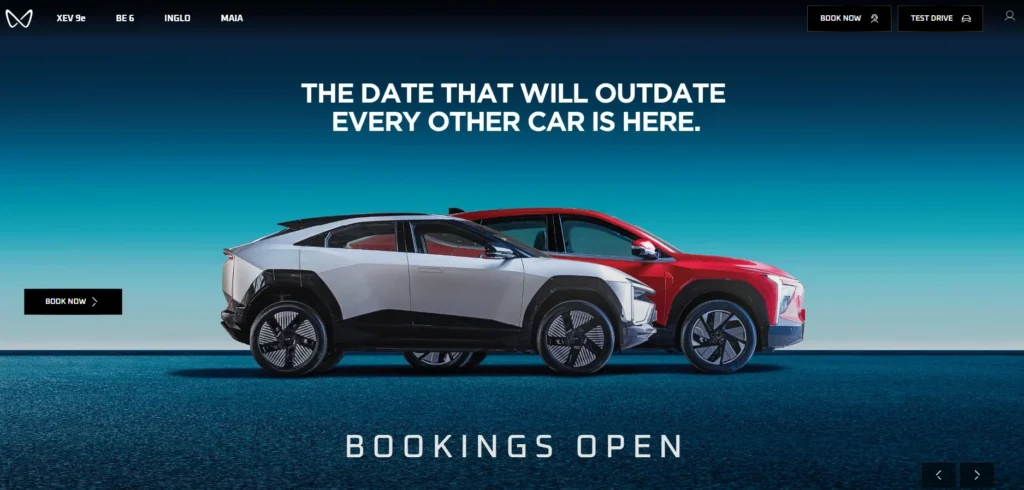
Established in 2010 and having its headquarters in Bengaluru, Karnataka, Mahindra Electric is a pioneer in India’s electric mobility sector. A subsidiary of the Mahindra Group, the firm began its journey with the manufacturing of small urban EVs and went on to pioneer the high-performance electric SUV space.
As part of its new identity presented under the Born Electric vision, Mahindra Electric is repositioning sustainable mobility with a global design orientation, state-of-the-art technology, and a robust focus on defining India’s future for clean mobility.
Key Offerings:
- XUV400 EV – India’s first all-electric SUV from Mahindra, already on roads
- Born Electric Platform – Upcoming lineup including XUV.e8, XUV.e9, BE.05, BE.07, BE.09
- High-performance EVs designed for Indian terrain with global aesthetics
Market Impact:
- Among the earliest players in India’s EV scene (previously with e2o and e-Verito)
- Marked re-entry into the market with a bold, premium SUV focus
- Intends to gain a sizable portion of the mid-to-premium EV SUV market.
- Cooperation with Volkswagen’s EV component MEB platform
Tech Edge:
- INGLO platform – A flexible, modular EV platform with strong safety standards and quick charging
- Focus on ADAS, embedded connectivity, over-the-air (OTA) updates
- Aerodynamic, futuristic design with sustainable materials
- Improved battery efficiency and thermal control for Indian conditions
Website: www.mahindraelectricsuv.com/
2. MG Motor India
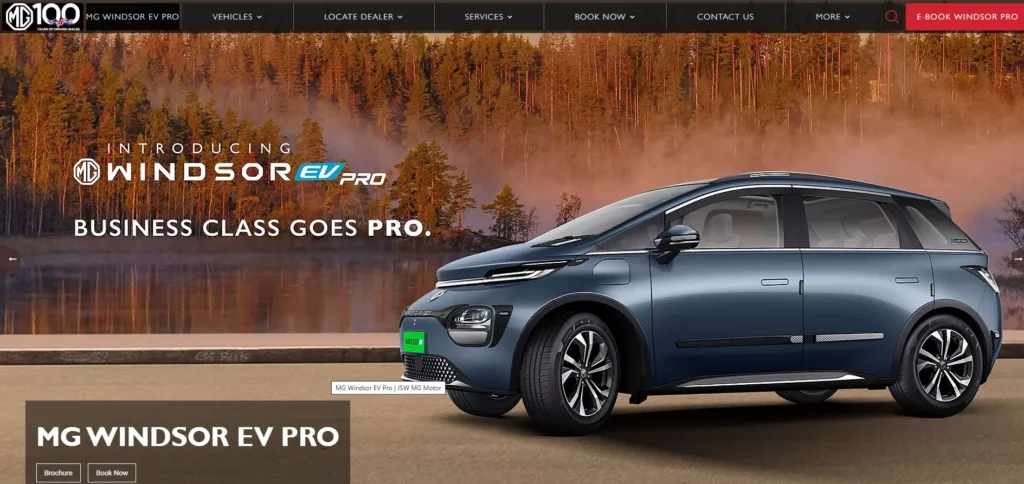
Founded in 2017 in India and with its headquarters in Gurugram, Haryana, MG Motor India is a subsidiary of the legendary British car brand Morris Garages, now under the ownership of China’s SAIC Motor Corporation. Since entering the Indian market, MG has made a niche for itself in the premium SUV segment and has become one of the first movers in the Indian electric vehicle market.
With a focus on sustainability, design, and technology, MG is leading India’s EV revolution by fusing global engineering with local response, starting with the MG ZS EV, an award-winning electric SUV.
Key Offerings:
- MG ZS EV – One of India’s first and most popular premium electric SUVs
- MG Comet EV – Compact, urban-focused EV launched in 2023
- Plans to launch affordable mass-market EVs and localized production in future
Market Impact:
- Among the first brands to introduce a long-range electric SUV in India
- Consistently ranks in the top 5 EV sellers in India (passenger EV segment)
- Expanded footprint across urban and Tier-2 cities, helping improve EV visibility
- Focused on building EV ecosystem partnerships (e.g., charging networks, battery reuse)
Tech Edge:
- ADAS (Advanced Driver Assistance Systems) integrated in EVs like the ZS EV
- High battery efficiency and safety with IP67-certified batteries
- Enhanced infotainment with i-SMART connected car tech (voice commands, OTA updates)
- Emphasis on battery reuse and recycling, aligning with sustainable practices
Website: www.mgmotor.co.in/
3. Tata Motors

With its aggressive entrance into electric vehicles, Mumbai-based Tata Motors, which was founded in 1945, is changing the rules of Indian mobility. Formerly recognized mostly for its commercial and passenger cars, Tata has become the leader of India’s EV era.
With modern, reasonably priced, and feature-studded models such as the Nexon.ev and Tiago.ev, the firm is mainstreaming electric mobility for Indian families. Supported by a robust ecosystem and future-proof platform, Tata Motors is not just manufacturing cars—it’s redefining how India moves, sustainably.
Key Offerings:
- Nexon.ev & Nexon EV – India’s best-selling electric SUV, built on the Ziptron platform
- Tiago.ev – Budget-friendly EV hatchback known for rapid adoption and mass appeal
- Tigor.ev & Punch.ev – Compact EV sedan and SUV with city-friendly range and design
- Curvv.ev – Upcoming premium electric SUV with high-range capability and futuristic design
Market Impact:
- Surpassed 150,000 electric vehicles produced, with over 1 lakh EVs sold
- Commands over 70% market share in India’s passenger EV segment
- Tiago.ev became the fastest-booked EV in India with over 20,000 early bookings
- Opened exclusive EV-only showrooms to deliver a premium and integrated customer experience
Tech Edge:
- Ziptron Technology – Tata’s in-house EV platform, which provides quick charging and powerful performance
- Tata UniEVerse – An integrated EV ecosystem with Tata Power (charging), Tata AutoComp (battery), and TCS (connected services)
- Safety & Smart Features – IP67-rated batteries, over-the-air updates, ADAS, and voice-activated connected tech
- Advanced Battery Options – Long-range LFP batteries, 500+ km range (Curvv.ev), and support for rapid 70 kW DC charging
Website: www.tatamotors.com/
4. Hero Lectro
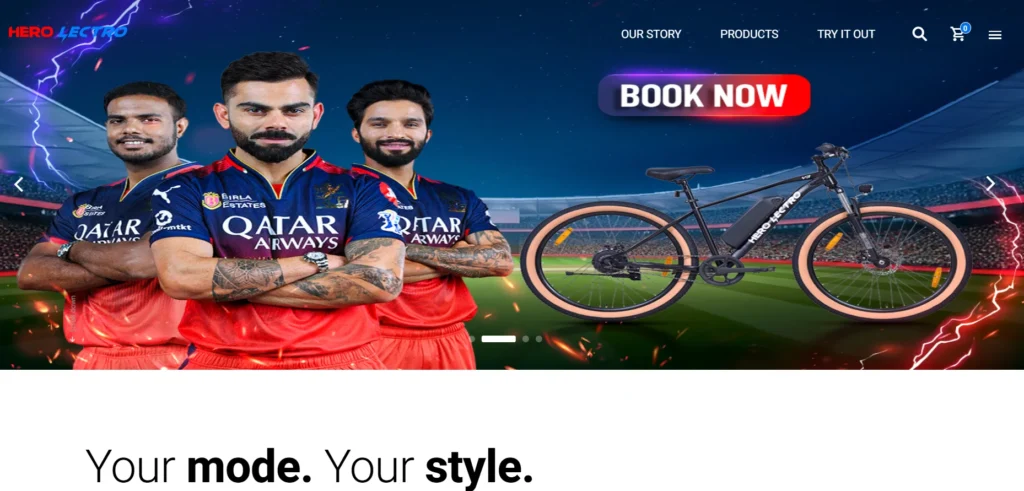
Founded in 2020 and with its headquarters in Gurugram, Haryana, Hero Lectro is the electric bicycle unit of Hero Cycles that aims to provide intelligent, eco-friendly, and affordable mobility solutions for new India.
Hero Lectro is making greener commuting accessible to urban commuters, fitness lovers and even delivery workers with their line of stylish and functional e-cycles. Whether daily commutes, adventure rides, or utility for carrying goods, Hero Lectro combines innovative design with everyday functionality—introducing a new era of two-wheeled personal mobility.
Key Offerings:
- A wide lineup of commuter e-cycles like the H4 and H7+ with detachable batteries, LED displays, and key ignition
- Mountain e-bikes (F2i, F3i) equipped with advanced suspension, multiple ride modes, and dual disc brakes
- Expanding into e-cargo cycles, targeting last-mile delivery and B2B use cases
Market Impact:
- Available through 600+ retail outlets and a network of over 3,000 dealers across India
- Among the few brands in India offering a dedicated e-cycle portfolio, helping popularize clean and active commuting
- Contributing to the Make in India movement with increased local sourcing of components like batteries and controllers
Tech Edge:
- IP67-rated motors and electronics for enhanced durability and weather protection
- Offers both pedelec and throttle modes with 25–40 km range, suitable for urban distances
- Features like removable batteries, smart displays, cruise control, and mobile integration enhance user convenience
- A tech-savvy online platform supports virtual test rides, easy comparisons, and EMI options for seamless customer experience
Website: www.herolectro.com/
5. Ashok Leyland

Established in 1948 and based in Chennai, Tamil Nadu, Ashok Leyland is a flagship of Hinduja Group and a household name for commercial vehicle excellence in India. It is the second-largest commercial vehicle manufacturer in India and one of the largest bus manufacturers in the world, and the company has been an integral part of India’s transportation infrastructure for a long time.
Over the last few years, Ashok Leyland has become a significant player in the electric vehicle segment with a mission of electrifying the commercial vehicle segment under its standalone EV business, Switch Mobility. The company is redefining public and goods transport with innovative electric buses, light commercials, and heavy trucks designed for Indian roads and logistics requirements.
Key Offerings:
- Switch IeV 3 & IeV 4 e-LCVs – Electric 2–3.5 ton light commercial vehicles featuring day-long driving range (~300 km) and real-time telematics (Switch iON system).
- Switch EiV12 Buses – Ultra-low-floor 12-m electric buses, including airport, city, and AC versions with ~200 km range.
- EV Trucks (BOSS & AVTR-55T) – First-of-their-kind electric trucks (7–19 T ICV and 55-ton tractor) with IP67-rated batteries and dual-gun fast charging for logistics.
- Hydrogen & Fuel-Cell Buses/Trucks – Early prototypes of hydrogen fuel-cell buses and hydrogen ICE trucks developed with Reliance & NTPC.
Market Impact:
- Supplied 13,000 e-LCVs (IeV series) to clients like Amazon and Flipkart over three years, and 500 electric buses to Chennai’s MTC.
- Secured and begun production of 180 electric trucks for Billion Electric Mobility, prompting a new 5,000-unit EV truck line at Hosur.
- Launched a Centre of Excellence with Nidec to develop next-gen e-drive units tailored to commercial needs—boosting local expertise and supply chain capability.
- Invested over ₹662 crore (of ₹1,200 crore commitment) into its EV arm, underpinning long-term commitment to commercial electrification.
Tech Edge:
- Collaborative e-Drive Innovation with Nidec—co-developing motors, power electronics, and gear systems at a dedicated Centre of Excellence.
- IP67-rated battery packs in commercial EVs ensure durability in demanding environments, alongside fast dual-gun CCS2 charging and ADAS for enhanced safety .
- Modular manufacturing at Hosur and Ennore plants equips scalable production lines for heavy EV, LCVs, and buses, supporting India’s Make-in-India push
- Pioneering hydrogen powertrain alternatives, including hydrogen ICE trucks and C/FC buses, signaling readiness for diversified clean mobility futures .
Website: www.ashokleyland.com/
6. Ather Energy
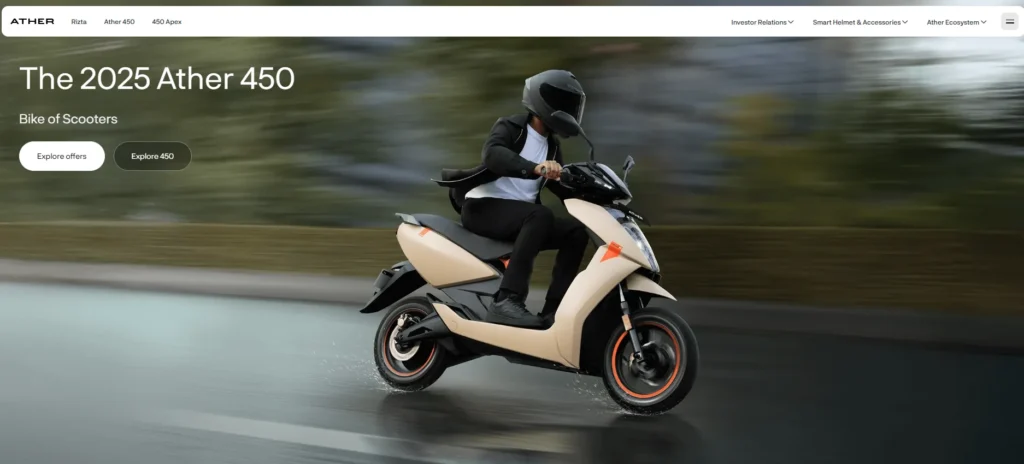
Established in 2013 with headquarters in Bengaluru, Karnataka, Ather Energy is a next-generation electric mobility startup that has revolutionized the idea of intelligent commuting in India. Founded by IIT Madras alumni Tarun Mehta and Swapnil Jain, the venture embarked on developing electric scooters from scratch—with emphasis laid on performance, technology, and customer experience.
Since its inception, Ather has established a strong brand reputation for innovation and launched some of the most sophisticated electric two-wheelers in the country. With its vertically integrated business model, in-house design, proprietary battery and software platforms, Ather established itself as a premium EV two-wheeler player.
Key Offerings:
- Ather 450X Series – High-performance electric scooters with fast charging, touchscreen dashboard, smart connectivity, and multiple ride modes.
- Ather 450S & 450 Apex – Enhanced variants offering more power, sporty ride dynamics, and longer range.
- Ather Rizta – A practical, family-oriented scooter launched in 2024 with increased boot space, improved comfort, and a range of up to 160 km.
Market Impact:
- Ranked among India’s top electric two-wheeler brands, with a growing footprint across major cities and Tier-2 markets.
- Operates two manufacturing facilities in Karnataka and Tamil Nadu, boosting domestic production and supply chain efficiency.
- Built one of India’s largest proprietary EV charging networks, Ather Grid, with over 2,500 fast-charging stations across 230+ cities.
- Rapid retail expansion with over 350 experience centers and service outlets, aiming to double presence in the coming years.
- Successfully listed on the public market in 2025, fueling further investment into R&D and charging infrastructure.
Tech Edge:
- Developed its scooters entirely in-house, including chassis, battery packs, and software, enabling tighter integration and reliability.
- Features like touchscreen dashboards, over-the-air updates, reverse assist, hill-hold, and voice-enabled navigation set Ather apart.
- Ather Grid fast chargers support high-speed charging and are designed for easy access in cafes, malls, offices, and residential areas.
- Strong emphasis on continuous software upgrades through the Atherstack platform, ensuring users receive regular performance and feature enhancements even after purchase.
Website: www.atherenergy.com/
Suggested read:
Product-Based Companies in India
7. Ola Electric

Established in 2017 with headquarters in Bengaluru, Karnataka, Ola Electric was spun out of ride-hailing company Ola to become a pure-play electric mobility player. Ola swiftly grew its business after introducing its first e-scooter in 2021, and it is currently the biggest manufacturer of electric two-wheelers in India.
Its vertically integrated ecosystem covers R&D, software, battery and motor production, and vehicle manufacturing—all around its marquee Futurefactory in Tamil Nadu. With the financial support of hardy investors such as SoftBank, Tiger Global, and Temasek, and a successful 2024 IPO, Ola is not merely manufacturing scooters—it’s designing the future of Indian EV mobility.
Key Offerings:
- S1 Series: Includes Ola S1, S1 Air, S1 X/X+, and flagship S1 Pro—ranges from ~151 km to ~195 km, touchscreen dashboard, smart connectivity, and sub-20 min quick charge.
- Upcoming Models: The Roadster X motorcycle and future three-wheeler variants expected by 2025, expanding beyond scooters.
Market Impact:
- Largest E2W producer in India, with over 3.29 lakh units sold in FY24, capturing ~35%–46% of market share.
- Futurefactory churned out over 4 lakh scooters in two years, including 1 lakh S1 units in just 10 months.
- Raised ₹5,500 crore via IPO in August 2024, valuing the company between $4.5–7 billion.
- Built Ola Grid: proprietary retail and service presence with experience centres across major Indian cities, supported by strong expansion plans.
Tech Edge:
- Vertically integrated R&D-to-production ecosystem: Ola develops its own battery cells, motors, software stack (MoveOS), chassis, and vehicle architectures—all in-house.
- Manufacturing & Automation: Futurefactory is India’s largest automated two-wheeler plant with 100+ AI robots, digital twin systems, and sustainable design.
- Fast-Charging & Battery Innovation: Partnered with StoreDot for ultra-fast-charge cell R&D; plans gigafactory by 2025 to produce its own battery cells.
- Smart Software Features: MoveOS supports OTA updates, reverse assist, cruise control, and connectivity; touchscreen dashboards and phone integration also included.
Website: www.olaelectric.com/
8. BYD India
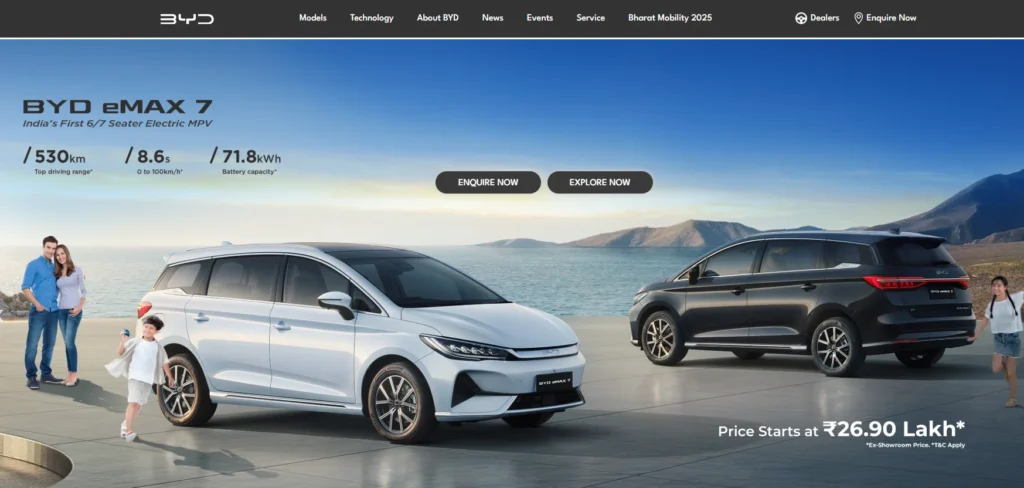
Founded in 2007 and based in Chennai, Tamil Nadu, BYD India is the fully owned subsidiary of the Chinese EV giant BYD (Build Your Dreams), a global leader in the manufacture of new energy vehicles. Capitalising on its international expertise and cutting-edge technology, BYD India has established itself as a key player in the premium electric vehicle space.
The firm is positioned to provide high-performance EVs specifically designed to Indian tastes, with the Atto 3 SUV initially and then extending into luxury with the BYD Seal sedan. BYD’s emphasis on safety, range, and innovation—along with its expanding retail footprint—is assisting in establishing it as a serious player in India’s rapidly changing EV market.
Key Offerings:
- BYD Atto 3 – A stylish C-segment electric SUV built on the e-Platform 3.0, equipped with BYD’s Blade Battery technology, and offering a certified range of up to 521 km.
- BYD Seal – A premium electric sedan with advanced features and a performance edge, aimed at customers seeking a luxury EV experience.
Market Impact:
- Successfully launched the Atto 3 in late 2022, with strong initial bookings and steady deliveries across India.
- Emerging as a top-selling brand in the premium EV space, especially in the ₹30–₹40 lakh segment.
- Aggressively expanding its dealership and service network across Tier 1 and Tier 2 cities to boost accessibility.
- Ranked among the top five electric passenger vehicle brands in India, with plans to increase market share further through new model launches and wider availability.
Tech Edge:
- Blade Battery Technology – BYD’s patented LFP battery design offers superior safety, longer life cycles (up to 15 years), and better energy density.
- e-Platform 3.0 – A dedicated EV platform that enables fast charging (0–80% in approx. 50 minutes), 0–100 km/h acceleration in just over 7 seconds, and optimized weight distribution.
- Premium Features – Panoramic sunroof, rotating touchscreen display, ADAS with Level 2 autonomy, seven airbags, and 360-degree camera systems.
- Localization Plans – BYD aims to begin local assembly of its vehicles in India to improve affordability and better align with the government’s Make in India goals.
Website: www.bydautoindia.com/
9. TVS Motor Company
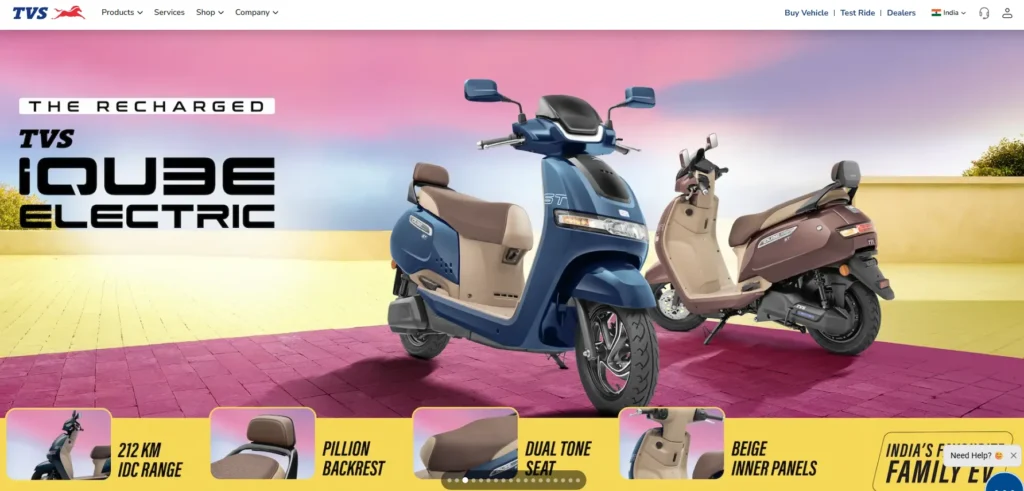
Established in 1911 and based in Chennai, TVS Motor Company is India’s most credible and pioneering two-wheeler manufacturer. With a heritage of over a century, the company has made a smooth foray into the electric mobility domain while upholding its fundamental values of reliability, quality, and performance.
TVS has adopted the EV revolution through a visionary approach that marries wise product development, strong technology platforms, and increasing world ambitions. Its flagship electric scooter, the TVS iQube, has proved to be a high-demand model among urban commuters seeking a mix of smart functionalities, cost-effectiveness, and fuel efficiency. With a growing EV portfolio, large-scale capital investments, and strategic collaborations in charging infrastructure, TVS Motor is driving India’s transition to cleaner, wiser mobility.
Key Offerings:
- TVS iQube Series – Available in multiple battery capacities (2.2 kWh, 3.5 kWh, and 5.3 kWh), the iQube offers a range of 94 to 212 km (ARAI certified), along with features like reverse assist, cruise control, a 7-inch TFT dashboard, and SmartXonnect connectivity.
- TVS X – A premium performance electric crossover scooter aimed at tech-savvy and sporty riders.
- Upcoming Models – Includes electric three-wheelers and compact micro-EVs under development, expanding the company’s EV footprint across segments.
Market Impact:
- TVS is among the top three electric two-wheeler companies in India by volume, with iQube sales doubling year-on-year.
- The EV division now contributes close to 10% of TVS’s total revenue, underlining a successful transition from ICE to electric.
- The company is actively expanding into international markets such as Nepal and Sri Lanka and is preparing to enter Europe with its electric offerings.
- Strong domestic market penetration backed by an extensive dealership and service network has helped the iQube become a household name.
Tech Edge:
- Smart Features – The iQube is equipped with 118 connected features via SmartXonnect, including voice assist, app-based controls, ride statistics, geo-fencing, and OTA software updates.
- EV Infrastructure Partnerships – Collaborations with energy companies aim to build a reliable charging ecosystem across Indian cities, including solar-powered stations.
- Investment in Innovation – TVS has allocated over ₹5,000 crore to EV R&D, new product development, and manufacturing capacity, with a ₹1,000 crore capex earmarked specifically for FY25.
Website: www.tvsmotor.com/
10. Revolt Motors
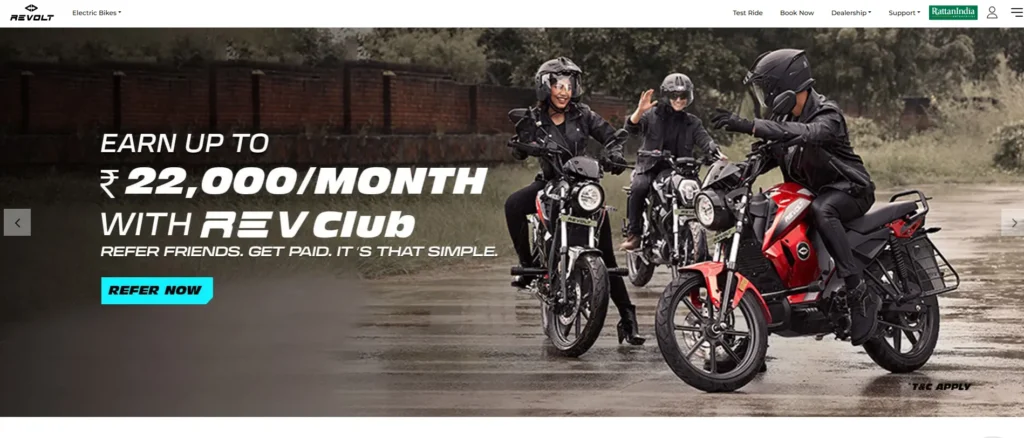
Established in 2017 and having its headquarters in Gurugram, Haryana, Revolt Motors is India’s first electric motorcycle company, recognized for the integration of artificial intelligence into mobility. Established with a mission to revolutionize two-wheeler commuting, Revolt became the first to introduce India’s first AI-powered electric bike, Revolt RV400.
With its emphasis on intelligent connectivity, swappable battery infrastructure, and rider-centric design, Revolt Motors is redefining what the electric motorcycle can deliver to the contemporary Indian commuter. Supported by technological innovation and a passion for sustainability, the brand continues to grow its presence in urban and semi-urban markets in India.
Key Offerings:
- Revolt RV400 – India’s first AI-enabled electric bike, offering a range of up to 150 km on a single charge, with features like geofencing, keyless ignition, sound customization, and remote diagnostics.
- Revolt RV300 – A more affordable variant targeted at city riders, providing a slightly smaller frame and a range of approximately 120 km.
- Battery Subscription & Swap Stations – Revolt was among the first to introduce battery swapping and subscription-based ownership models in the two-wheeler EV space.
Market Impact:
- Among the first movers in the Indian electric motorcycle segment, building strong brand recognition among tech-savvy and sustainability-conscious consumers.
- Expanded retail presence across major Indian cities including Delhi, Mumbai, Pune, Chennai, Ahmedabad, and Hyderabad.
- Contributed to the growing acceptance of electric motorcycles in a market dominated by conventional scooters and ICE bikes.
- Experienced increased adoption after aligning with government incentives under FAME II and state-specific EV policies.
Tech Edge:
- AI-Enabled Platform – The RV400 features onboard AI systems that support predictive maintenance, performance tuning, and app-based controls.
- Smart Features – Revolt’s mobile app allows users to customize engine sounds, track battery status, locate charging stations, and perform remote diagnostics.
- Battery Innovation – Swappable battery model enables quick refueling without needing to wait for traditional charging, enhancing convenience for daily riders.
- Sustainable Design – The bikes are built with recyclable materials and energy-efficient components, promoting lower lifecycle emissions.
Website: www.revoltmotors.com/
Conclusion
India’s electric vehicle revolution is no longer a distant dream—it’s a movement that’s picking up real steam. EV companies in India, from established automakers to fast-moving startups, are driving this transformation. With policy-led innovation, the EV ecosystem is rapidly evolving across two-wheelers, cars, commercial vehicles, and public transport. The firms listed here are not only changing the way we travel but redefining India’s role in the global green mobility transition.
As the world shifts toward a low-carbon future, the acceptance of EVs is not only a trend but a necessity. We are helping to create cleaner air, less oil dependence, and a more robust domestic manufacturing base by embracing sustainable mobility. With ongoing innovations in battery technology, charging infrastructure, and digitalization, the future is full of possibilities—and these companies are taking us there to an electrified, intelligent tomorrow.
FAQs
Are electric cars more economical to maintain compared to petrol or diesel cars?
Yes, EVs tend to be less expensive to maintain because there are fewer moving components and no need for engine oil changes. Nevertheless, replacing batteries (after multiple years of operation) may be an important cost component.
How long does it take to charge an electric car?
The charging time varies based on the charger. A normal home charger could take 6–8 hours, whereas a DC fast charger can charge an EV to 80% within 60–90 minutes.
Is charging infrastructure in India getting better?
Yes, the number of public charging points is gradually increasing. As of early 2024, there were approximately 10,000+ public chargers, and the government as well as private players is expanding this network aggressively.
Can EVs be employed for long-distance travel?
Although range anxiety is still present, most new models can do 200–500 km on a full tank. As fast-charging networks grow, so does the viability of long-distance travel.
What is the typical lifespan of an EV battery?
Most EV batteries see 6–10 years or more based on use, climate, and manufacturer quality. Battery health determines resale value and performance.
