10 Best Data Management Platforms Picks

Think of Data Management software as a super-smart filing cabinet that organizes all your customer information automatically. Just like you organize papers in drawers by category, Data Management Platforms organize your customer data so you can find exactly what you need in seconds. The sites enable companies to know their customers better and make more informed decisions based on facts rather than guesswork.
Whether you own a small online shop or a huge company, Data Management Platforms can change how you work with information. They assist your marketing team to make a better ad, your sales team knows who to call, and your business owner makes decisions, not based on hopes.
What are Data Management Platforms?
Data Management Platforms are powerful computer systems that collect information from many different places and organize it all in one spot. Imagine that your customer information is all over the place on your site, in your mobile application, on Facebook, in your mail, and even in your own stores. Data Management Platforms bring all this scattered information together.
Such systems automatically perform a number of things. First, they gather all your customer data from your various sources. Second, they standardize the information to eliminate errors and redundancies. Third, they put all these into useful collections, which allow you to know your customers better. Imagine that it is a personal assistant working on all your papers and deleting the torn ones, and placing them into the correct folders.
Why Look for Data Management Platforms?
- To gather data from numerous sources: A Data Management Platform consolidates information through websites, applications, customer relationship management (CRM), and advertisements.
- To get to know customers better: It makes you look through the behavior of people, what they like, and what they purchase.
- To make smarter marketing decisions: Having clean and well-organized data, you are able to plan better campaigns that can reach the correct audience.
- To save time and fewer mistakes: The platform automatically gathers and manages data instead of working with sloppy spreadsheets.
- Too achieve higher returns on investment and business expansion: Marketing can be made more effective when the data is used wisely to enable you to make more with less wastage.
Key Features to Look for in Data Management Platforms
- Real-Time Data Collection: The platform must store and refresh data in real-time on websites, apps, and advertisements to make fast decisions.
- Audience Segmentation: It should enable you to segment the users according to interests, behaviour, or location to market to them.
- Data Integration Support: The platform should easily connect with CRMs, ad tools, and Data integration tools for smooth data flow.
- Data Privacy and Security: It has to adhere to the data security regulations,s, such as GDPR, and ensure that all information is not abused.
- State-of-the-art Analytics and Reporting: The platform ought to offer dashboards and insights in order to monitor performance and enhance strategies.
Top 10 Best Data Management Platforms
1. Adobe Audience Manager
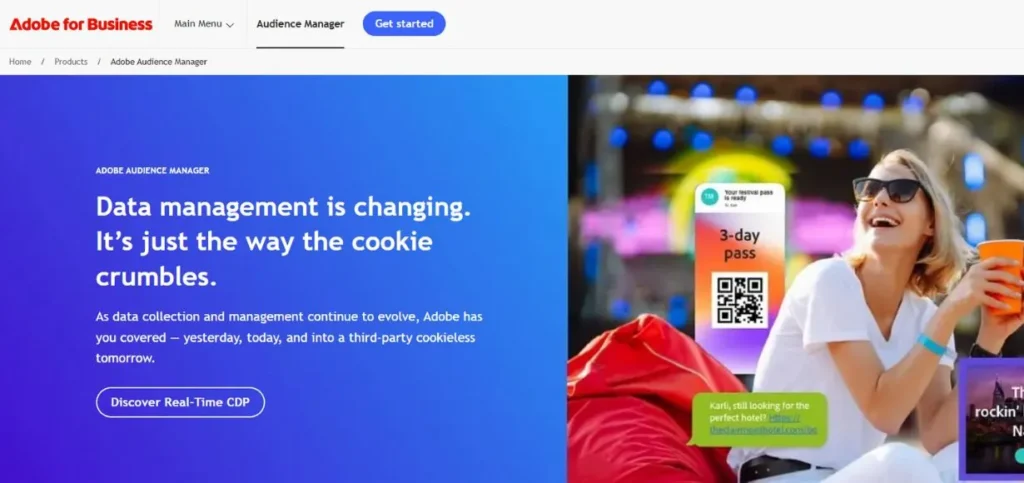
Adobe Audience Manager is one of the strongest and most reliable Data Management Platforms in the entire world. This platform is a part of the large family of business tools of Adobe known as Adobe Experience Cloud. It is aimed at assisting businesses in developing descriptive profiles of their clients. The platform gathers information about customers wherever they are – websites, mobile apps, offline stores, everywhere. It then forms one composite picture of every customer. It implies that you will be able to look at all the details of a customer in a single place.
Key Features
- Bonds using interminable data sources.
- Prepares extensive profiles of customers.
- Anticipates the behavioral patterns of customers.
Pros
- Very strong and develops without difficulty.
- It is compatible with Adobe products.
- Extremely high data security safeguard.
Cons
- Slow to learn at the beginning.
- Highly costly to the majority of businesses.
- Needs support from technical experts.
Best For: Enterprises
Pricing: Custom pricing based on your needs
Website: https://business.adobe.com/products/audience-manager/adobe-audience-manager.html
2. Google Marketing Platform (DV360)
Google Marketing Platform, which includes Display & Video 360, is one of the most popular Data Management Platforms used by companies all around the world. The platform is a blend of the giant power of Google in the field of advertising and intelligent data management. Given that Google possesses YouTube, Gmail, Google Search, and numerous other solutions, this platform can retrieve information in all areas. It is possible to gather customer data on your own site and applications, and combine it with the enormous data that Google already has on what people are searching and watching.
Key Features
- Supports all Google advertising tools.
- Tracks consumers on various platforms.
- Purchases advertisement space automatically.
Pros
- Easy access to customers all over the world.
- Demonstrates explicit reports and figures.
- Manages mobile customer data effectively.
Cons
- User-unfriendly interface.
- Cannot customize much
- Must use Google products
Best For: Advertisers
Pricing: Free for qualified advertisers, premium features available
Website: https://marketingplatform.google.com/
3. Oracle BlueKai
Oracle BlueKai has been one of the top Data Management Platforms for over ten years and is trusted by thousands of companies. This platform has the largest third-party customer data marketplace in the whole industry. It assists the companies in gathering, structuring, and mobilizing the customer data on all online services and channels. Oracle Blue Kai works particularly well, combining your own customer information with that of other sources to generate rich, detailed customer information.
Key Features
- Heavy marketplace containing third-party data.
- Checks automatically check quality.
- Transmits information on numerous channels.
Pros
- Numerous data alliances are in play.
- Powerful in terms of business-to-business sales.
- Trustworthy and reliable platform.
Cons
- Complicated pricing system
- Professionally to be installed.
- The outdated interface design.
Best For: Marketers
Pricing: Custom enterprise pricing
Website: https://www.oracle.com/in/
Also read: Data Analytics Software
4. Salesforce DMP (Audience Studio)
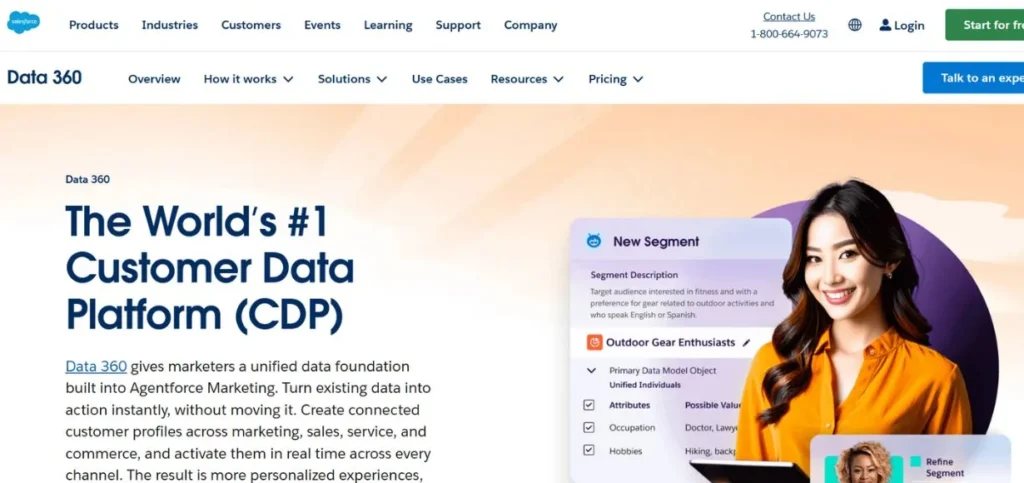
Audience Studio or Salesforce DMP has been specifically developed to integrate perfectly with Salesforce, which is the most popular customer relationship management system across the globe. This has made Audience Studio a perfect solution for the firm that already uses Salesforce. Data Management Platforms like this one combine the power of data management with Salesforce’s famous CRM abilities. The platform gathers data on websites, mobile applications, Salesforce itself, and advertising platforms.
Key Features
- It may be easily connected with Salesforce.
- Stresses Einstein’s artificial intelligence.
- Single view of customers always.
Pros
- Complete Salesforce compatibility.
- Solves the identity of the customer successfully.
- Good customer service is offered.
Cons
- Exclusive to Salesforce only.
- Expensive overall price
- Needs Salesforce expertise.
Best For: Salesforce Users
Pricing: Starting from custom quotes
Website: https://www.salesforce.com/products/marketing-cloud/data-management/
5. Lotame
Lotame has established a good reputation for being the simplest and friendliest Data Management Platform for both large and small businesses. Lotame is devoted to having an easy, inexpensive, worry-free experience. Unlike some complicated Data Management Platforms, Lotame makes complex data work easy to understand. The platform gathers customer information in any form, systematically arranges it, and assists you in creating customer groups without the assistance of tech professionals.
Key Features
- Very simple interface to navigate.
- Privately trade with partners.
- Easy to integrate with a lot of partners.
Pros
- Fast learner, can train easily.
- Clear pricing, no surprises
- Great support team always
Cons
- Smaller third-party gathering.
- Weak analytics features
- Minor enterprise customizations.
Best For: SMBs
Pricing: Starting at $2,000 per month
Website: https://www.lotame.com/
6. Neustar (TransUnion)
Neustar, now owned by TransUnion, brings powerful identity technology to Data Management Platforms. This platform is the most effective in bridging information of the same individual across various gadgets and channels. This renders Neustar very handy to businesses that need to comprehend how customers act on phones, tablets, computers, as well as in actual stores. Neustar has superior master data management tools, a fancy term that means that they maintain all your information precisely and consistently. The platform has access to gigantic volumes of offline data, which assists in linking what individuals do on the internet with what they purchase in brick-and-mortar stores.
Key Features
- Highly developed identity matching technology.
- Retrieves huge offline information.
- Prevents fraud and mistakes
Pros
- Excellent data accuracy obtained.
- Potent equipment monitoring is effective.
- Negotiator in controlled sectors.
Cons
- Premium pricing fee is in place.
- A complex set-up procedure is necessary.
- Poor self-service facilities.
Best For: Telecommunications
Pricing: Custom enterprise pricing
Website: https://home.neustar/
7. Amobee
Amobee is a relatively recent form of Data Management Platform that integrates data management and the use of artificial intelligence technology. This site has been created to fit in the contemporary marketing that occurs in a wide variety of channels, such as TV, computers, mobile phones, and social media. Amobee works very quickly with large volumes of data in real-time, thus it suits companies best that require viewing information immediately. The platform is able to use artificial intelligence to make your marketing campaigns more intelligent and better. A special tool is Brand Intelligence, which monitors what people are saying about your business on social media and news websites, among other online sites.
Key Features
- Optimization engines are AI-based.
- Watch brand online sentiment.
- Bridges TV with digital advertising.
Pros
- Powerful AI automation characteristics.
- Superior television advertisement.
- Real-time fast data processing.
Cons
- Too complicated for small businesses.
- Expensive feature pricing
- Requires employee training
Best For: Agencies
Pricing: Custom pricing available
Website: https://www.amobee.com/
8. Tealium AudienceStream
Tealium AudienceStream is a new way to think about Data Management Platforms. This platform is solely concerned with real-time customer data arrangement. Real-time implies that it is not effective hours or days after. The platform gathers data on all the places that a customer would encounter your business – website, app, phone, social media, store, and email. Then Tealium processes this information immediately to make groups of customers. Tealium is an excellent way of leveraging data to make things happen in all your marketing tools and software.
Key Features
- Organizes data in real time
- Inbuilt tag management system.
- Real-time updates to groups of the audience.
Pros
- Extremely high processing of data.
- Exquisite technical documentation.
- Strong adherence to the privacy rules.
Cons
- Installing technical is complex.
- The volume effect is raising the prices.
- A few third-party data choices
Best For: E-commerce
Pricing: Starting from custom quotes
Website: https://tealium.com/products/audiencestream/
9. Treasure Data
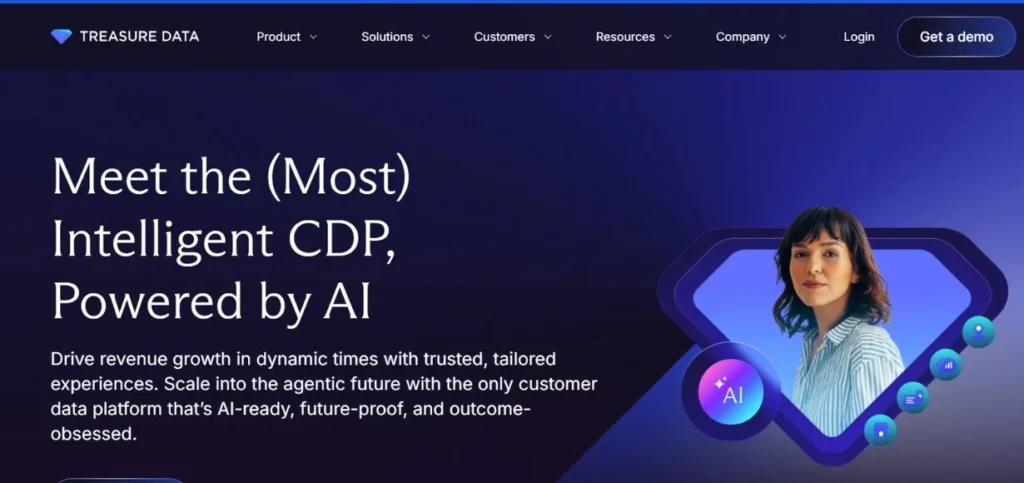
Treasure Data has gained fame as an effective Data Management Platform that targets large businesses. The platform has been developed to process massive customer data and remain quick and dependable. Treasure Data is a unification of data management, advanced analytics, which will help you make sense of figures and artificial intelligence, which anticipates the future. This platform is magnificent in the elimination of the so-called silo problem, which occurs when various departments, such as sales, marketing, customer service, etc., keep their information in isolation.
Key Features
- Data infrastructure on an enterprise level.
- Machine learning and artificial intelligence were included.
- State-of-the-art data management controls.
Pros
- Works with massive amounts of data.
- Severe security and compliance.
- Powerful prediction analytics were included.
Cons
- Complicated for small teams
- Higher price tier exists
- Data science is knowledgeable of needs.
Best For: Enterprises
Pricing: Custom enterprise pricing
Website: https://www.treasuredata.com/
10. mParticle
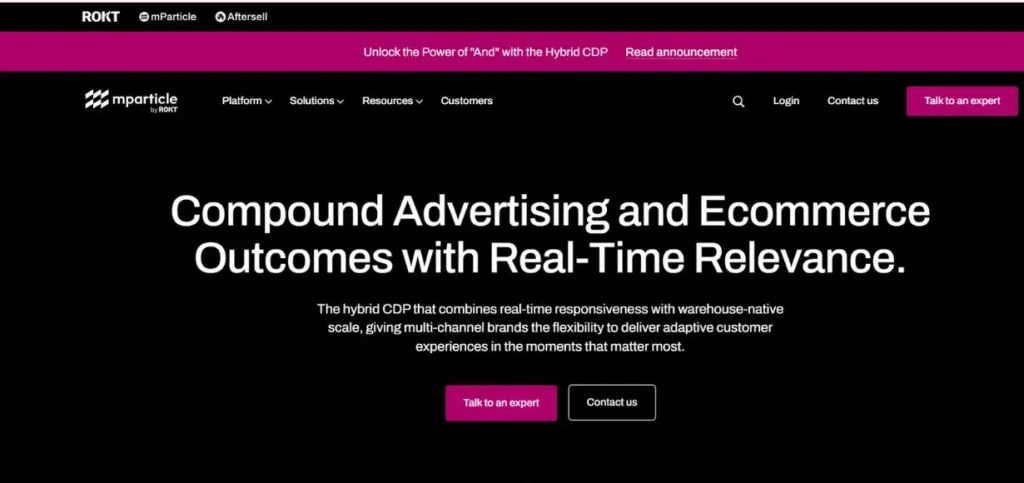
mParticle completes our list of top Data Management Platforms with a special focus on mobile apps. This platform was created to specifically target companies that have their own mobile applications. mParticle is ideal for gathering data from mobile applications and dispatching the data to thousands of other applications in marketing and analytics. Among such marvels is the fact that you do not have to have multiple pieces of software code in your app, but rather one.
Key Features
- Gathers mobile app information flawlessly.
- Single SDK -does it all.
- Real-time route information is available instantaneously.
Pros
- Excellent for mobile apps
- Enhances technical work.
- High data quality assurance
Cons
- Focused mainly on mobile
- Expensive when scaling up
- Poor offline data possibilities.
Best For: Apps
Pricing: Starting from custom quotes
Website: https://www.mparticle.com/
How to Choose the Right Data Management Platforms
- Define Your Business Goals: First, be clear about what you want to achieve, like better marketing, customer insights, or Big data management solutions.
- Check Integration Options: Make sure the DMP connects smoothly with your existing tools, such as CRM, analytics, and Customer data platforms.
- Look for Scalability: Select a platform that will be able to accommodate an increase in data forthe business and audience.
- Make sure of Excellent Privacy and Security: Choose a DMP that complies with all the laws of data (such as GDPR or CCPA) and preserves your data.
- Assess Analysis and Reporting Systems: Select one that offers clear Marketing data analytics and reports to understand your audience better.
Conclusion
Data Management Platforms have becomy essential for any business that wants to succeed today. These are very potent tools that will organize the disheveled s,,cattered information into viable facts which will guide your business to make more money and make better decisions. The ten Data Management Platforms we discussed are the best choices. The platforms represent various strengths. Oracle BlueKai and Adobe Audience Manager are most suitable for large organizations that have complicated requirements.
Google Marketing Platform and Salesforce DMP will suit you well in case you are taking other products. Lotame and mParticle are also cheaper when the company is small and the business aims exclusively at mobile. The appropriate Data Management Platform to use in your business will be determined by the size of your company, the expertise of your team, your financial capacity, and your goals.
Frequently Asked Questions
1. What is the main difference between Data Management Platforms and CRM systems?
Data Management Platforms focus on collecting and organizing data for marketing and advertising purposes, often including anonymous information from many sources. CRM systems are centered on the management of known customer relationships and sales.
2. How much do Data Management Platforms typically cost?
The prices differ a lot based on the amount of data you consume, the features you require, and the size of your company. Lotame is a small business product that may cost between 2 and 5 thousand a month.
3. Can small businesses benefit from Data Management Platforms?
Absolutely yes! While Data Management Platforms were originally designed for huge corporations, many modern platforms now work great for small and medium businesses. Services such as Lotame and mParticle are cost-effective and easily operated without a big technical staff or costly consultants.
4. How long would it take to deploy a Data Management Platform?
The time of implementation is dependent on complexity. Basic setups with minimal integration go through in four to six weeks. The complex implementation of the enterprises with a high number of data sources and old legacy systems requires three to six months.
5. Do Data Management Platforms address privacy rules, such as GDPR?
Yes, most reputable Data Management Platforms include features to help you follow privacy laws like GDPR and CCPA. Such capabilities are customer permission getting tools, the capability to delete customer data, and logs indicating the people who accessed the data and at what time.