
India has undergone a significant transformation in its cafe culture, and tea-based brands are spearheading this change. Chai Sutta Bar has become one of the most successful franchise models for investors who are interested in high demand, low investment, and memorable branding. The brand is famous for its desi-modern kulhad chai that caters to students, professionals, and even hangouts.
In 2026, the Chai Sutta Bar franchise cost and profitability are attracting several investors across India and in other countries. This guide offers an overview of the brand, its growth path, profitability insights, application steps, support system, risks, and FAQs to help you make an informed decision.
CSB Franchise at a Glance
Despite having a significant number of franchise operations, Chai Sutta Bar is one of the most prominent beverages franchises in India in 2026. It requires a total investment cost of ₹16 Lakhs to ₹25 Lakhs in order to set up your store. This is operated using the Franchise-Owned Franchise Operated (FOFO) system and yields very high net profit margins from 35% to 40%. On average, you can make profits between ₹70,000 to ₹1,50,000 every month using the unique CSB brand concept. Due to massive attraction among youths and bulk selling of Kulhad Chai, the brand allows you to recover your initial investment capital within 14-18 months.
Chai Sutta Bar 2026 – Growth Statistics & Revenue Figures
For a proper assessment of brand power and capabilities, you need to analyze their operational strength and financial strength. The table below shows the brand’s performance data across the country.
| Operational & Financial Pillar | Metric & System-Wide Performance Data |
| System-Wide Annual Turnover | ₹150 Crore+ (Combined gross sales across all franchise and corporate stores) |
| Parent Entity Operating Revenue | ₹5.89 Crore (Chai Sutta Bar Trading Pvt. Ltd. direct intake) |
| Core Corporate Revenue Splits | Franchise Fees: 44% | Product Sales: 37% | Ongoing Royalties: 19% |
| Total Active Global Footprint | 600+ Outlets operating across 300+ cities internationally |
| International Presence Hubs | Dubai (UAE), Oman, United Kingdom, Canada, and Nepal |
| Daily Consumer Consumption | Serves over 4 Million to 4.5 Million cups of fresh kulhad tea daily |
| Earthen Supply Chain Impact | Sustains regular manufacturing income for 250+ traditional potter families |
| Individual Store Net Profit | Averaging 20% to 25% margins at the unit operational level |
Is the Chai Sutta Bar Franchise Profitable in 2026?

Yes, Chai Sutta Bar’s business is profitable in 2026, particularly for first-time food business owners. The brand has a company sales structure with a low-investment and high-volume model.
The average monthly turnover for a franchise outlet ranges from ₹3 to 6 lakhs, which varies based on their location and customer traffic. Typical profit margins are 25-35%, which is a good margin for the QSR and cafe segment. As raw material costs are controlled and prices are fixed, the operational efficiency is high.
An average number of outlets break even in 10–14 months. Tier-1 and Tier-2 cities still perform well because of high tea consumption and brand preference of youth. The business is also fairly stable as compared to seasonal food concepts because of consistent demand all year.
Chai Sutta Bar Franchise Models FOFO vs COCO
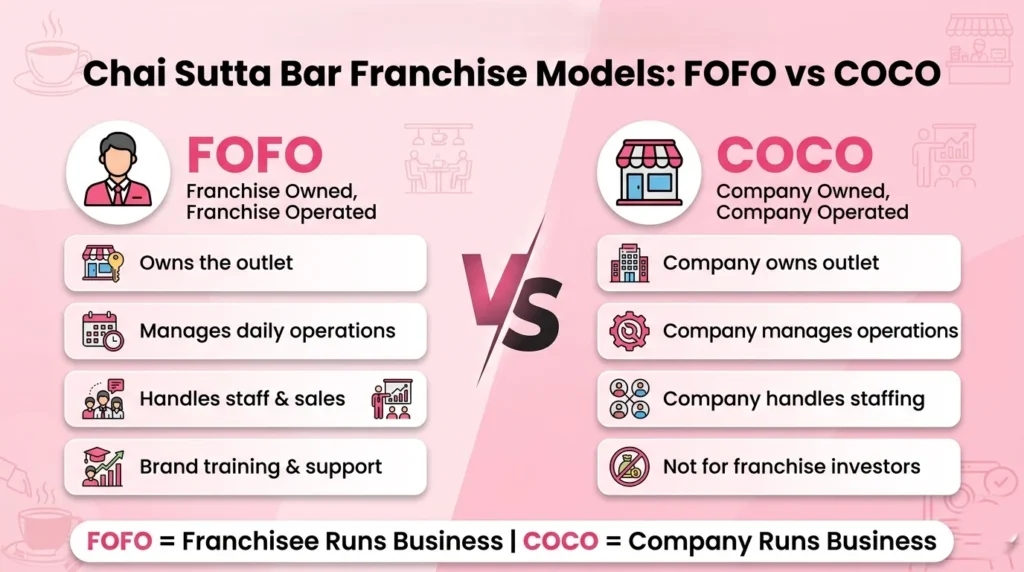
In discussing a Chai Sutta Bar franchise, the two primary models of ownership and responsibility will be FOFO and COCO. They play different strategic roles in the brand’s expansion strategies.
1. FOFO Franchise Owned Franchise Operated
- Meaning: The franchisee runs their own outlet as their own business yet leverages the Chai Sutta Bar brand, systems, and support.
- How It Works: The company gives the brand and the model, but the franchise fee is not refundable. The franchisee will handle day-to-day management, staffing, and results of sales.
- Ideal for: Entrepreneurs who prefer to be actively engaged, have control over operations, and benefit from a well-known brand.
- Role: The franchisee has autonomy but must follow brand standards and reporting.
2. COCO Company Owned Company Operated
- Meaning: This model is the outlets owned and operated by Chai Sutta Bar and not by independent franchisees.
- How It Works: The company’s responsibilities range from finding locations and setting up outlets to hiring, managing, and operating.
- Best For: This is mainly for use by the brand in strategic positions or when the brand needs to expand, not for external franchise investors.
- Ownership: Owners (the company) have complete control over staff, quality, profit, and management.
- Investor Note: COCO is not a franchise opportunity for the independent investor.
Chai Sutta Bar Outlets
One of India’s fastest-growing tea café chains, Chai Sutta Bar, has a huge presence in India and other parts of the world:
- As of 2026, the brand has 650+ outlets in the world, one of the largest chai chains in the world.
- These outlets are available in 390+ cities in India and abroad: UAE, Nepal, Canada, and Oman.
- The vast majority of venues are franchisees, with only a few being owned directly by the company.
- The network is growing fast with outlets frequently established in cities such as Bengaluru and other major cities.
- The brand is displayed in small kiosks and medium and full café outlets in high footfall and prime markets, respectively.
Chai Sutta Bar Franchise Cost Complete Breakdown
- Franchise Fee: ₹6–₹8 lakhs includes a one-time, non-refundable payment for rights to operate under the brand name.
- Interior & Outlet Setup: ₹5–₹7 lakhs includes store design, furniture, lighting, décor, and ambience setup.
- Equipment & Machinery: ₹3 – ₹5 lakhs includes tea brewers, refrigerators, grinders, POS systems, and accessories.
- Initial Raw Materials: ₹1 – ₹2 lakhs includes tea, milk, spices, snacks, and first stock of supplies.
- Licensing & Permits: ₹1–₹2 lakhs includes FSSAI license, GST registration, trade/shop license, and other legal permits.
- Marketing & Branding: ₹1–₹3 lakhs includes launch marketing, local promotions, signage, and initial brand campaigns.
Total Estimated Investment
- Kiosk/Basic Model: ~₹16–₹18 lakhs (most common).
- Standard Store: ₹18–₹25 lakhs (medium size).
- Full-Scale Café Format: ₹25–₹50 lakhs in premium locations.
Ongoing Fees
- Royalty Fee: ~4% of monthly sales, paid regularly to the franchisor.
- Marketing Contribution: Often included in royalty or charged as a percentage.
Suggested Read:
Chai Sutta Bar Franchise Profit & ROI
A Chai Sutta Bar franchise can be a profitable venture in 2026 if managed well, with strong demand for chai and related beverages across urban and student-heavy locations. Typical monthly revenues for a standard outlet range from about ₹3 – ₹8 lakhs, with net profit margins of 25 %–40 % after expenses like rent, staff, royalties (≈4 %) and utilities are paid.
In a good location, many franchisees report monthly profits of ₹50,000 to over ₹2,00,000+, while outlets in high-traffic spots can exceed these figures. Most outlets achieve break-even within 12–18 months, with an estimated ROI of around 100 %+ as the initial investment is recovered and profitability climbs thereafter.
List of Requirements for CSB Franchise
To acquire a Chai Sutta Bar (CSB) franchise, you will need a combination of personal, business, and legal documents. These are as follows:
Eligibility Criteria
- Applicants must be 21 years or older.
- Minimum investment capacity of ₹10–15 lakhs
- Willingness to be actively involved in daily operations
- Prior café or food business experience is not mandatory.
- Ability to manage staff and maintain brand standards
- Access to a commercial location (150–300 sq. ft.)
- Location should be in a high-footfall area (near colleges, offices, markets).
- Strong financial background and clean credit history preferred
Document Requirements
1. Personal Documents
- ID Proof: Aadhaar Card, PAN Card, or Voter ID.
- Address Proof: Electricity Bill, Rent Agreement, or Ration Card.
- Contact Details: Valid phone number, email ID, and passport-size photographs.
2. Business & Financial Documents
- Proof of Incorporation: Certificate of incorporation (in case of LLPs or private limited companies)
- PAN Card: Firm or company PAN card.
- Account Details: Business account.
- Financial Capability Proof: Provide bank statements and income tax return statements.
3. Legal & Property Documents
- Documents Related to Property/Shop: Land or shop ownership deed, lease agreement and no objection certificate from the landlord.
- Documents Related to GST: GSTIN number.
- FSSAI License: Required for operating a food and beverage business.
- Trade License: Local municipal health/trade license.
- Signage License: Required for exterior branding.
4. Space & Location Requirements for Chai Sutta Bar Franchise
- Minimum shop/kiosk space starts around 150–300 sq ft for basic formats, with larger outlets (medium or full cafe) requiring 400–2,000 sq ft depending on format and seating needs.
- Outlet space should be commercial and ground-floor, ideally for easy accessibility and visibility.
- High footfall locations are strongly preferred, near colleges, markets, malls, transit hubs (railway/metro), busy streets, and educational/office clusters.
- Areas with a strong youth or student population help maximize sales potential, especially since the brand targets young adults and college crowds.
- Locations with good visibility and accessibility (corner shops, main roads) increase walk-in customers and daily revenue prospects.
How to Apply for Chai Sutta Bar Franchise Step-by-Step
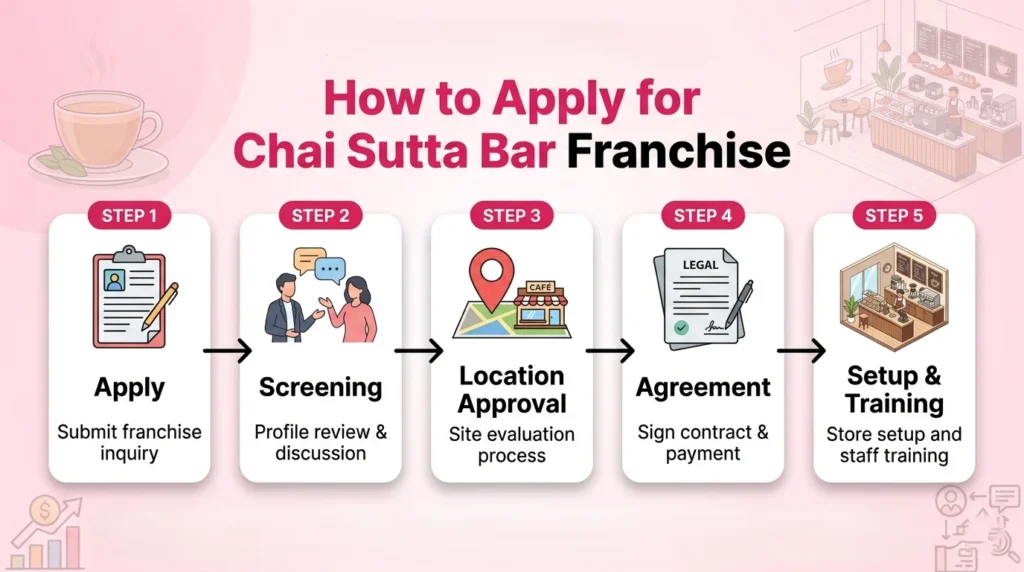
The process of opening a Chai Sutta Bar outlet is well defined and clear, helping new entrepreneurs understand the requirements, investment, and steps involved in the Chai Sutta Bar Franchise Cost and setup process.
- Step 1: Submit Franchise Application: To get started, fill out the official franchise inquiry form. Provide information on the city you like, your investment amount, and your business experience to see if the brand is appropriate.
- Step 2: Initial Screening & Discussion: Your application is studied by the franchise team, and a discussion is held about investment, outlet format, location feasibility, and expectations from both sides.
- Step 3: Location Finalization: It is essential to offer a site that satisfies footfall and visibility requirements. The brand team evaluates and approves the site as per market potential.
- Step 4: Agreement & Payment: After the agreement is approved, sign the franchise agreement and pay the franchise fee. This guarantees the security of territory and brand rights.
- Step 5: Setup & Training: The design of outlets starts, training of staff, buying of outlets, and pre-launch marketing. Once set up, the outlet is immediately available for brands.
Support Provided by Chai Sutta Bar
Chai Sutta Bar provides all-inclusive assistance to help you achieve franchise success from the start to everyday business.
- Pre-Launch Support: Chai Sutta Bar supports and guides franchisees in providing location analysis, outlet design, interior decorating, coordinating vendors, and hiring initial staff. This organized pre-launch support guarantees that the outlet is prepared, runs effectively, and opens on time.
- Training & Operations: Owners and employees are trained extensively on beverage preparation, hygiene compliance, POS system usage, inventory management, and customer service standards. This provides consistency of operation, better service, and a consistent customer experience throughout all Chai Sutta Bar outlets.
- Marketing & Branding: The brand provides franchisees with pre-made marketing materials, social media marketing, national marketing, and grand opening events. This enables them to capture attention, drive traffic, and foster brand familiarity in their target area.
- Supply Chain & Quality Control: The purchase of raw materials in a central system guarantees uniformity in raw material quality and competitiveness. Consistency in taste, product quality, and cost-efficiency is ensured through standardized recipes, regular audits, and quality checks at all Chai Sutta Bar locations.
Challenges & Risks
As with any franchise opportunity, Chai Sutta Bar has its own set of challenges that investors will want to take into account.
- Location Dependency: The wrong site can have a significant impact on the flow of customers and profit to the detriment of the business. High-traffic areas, colleges, offices, and main roads are areas where outlets often struggle. It is important to have good visibility and accessibility if you want to maintain regular traffic.
- Operational Discipline: It is important for the owner to be involved continuously to make sure there are high hygiene standards, uniform taste, and fast service. A lack of employee training, cleanliness, or process can affect customer trust and reviews, which directly affect long-term outlet performance.
- Competition: Local tea shops and new-age cafes are competitors to Chai Sutta Bar. In crowded markets, price wars and similar offerings make differentiation challenging, demanding better service, ambience, and consistent branding to retain customers.
- Margin Sensitivity: Rising rents, employees’ wages, electricity, and raw material bills can all reduce the margins. This is especially true in metro cities, where operational expenses are higher and require careful financial planning and cost control.
Chai Sutta Bar vs Competitors: Which Tea Franchise Should You Choose?
Selecting a tea franchise depends on your financial capacity, target customer base, and future goals. While Chai Sutta Bar shines in its ability to thrive on young-oriented spaces and volumes, competitors serve different audiences. Brands such as Chaayos focus on luxurious urban settings, while Tea Time serves more budget-oriented franchise owners.
Franchise Comparison Table:
| Feature / Brand | Chai Sutta Bar (CSB) | Chaayos | Chai Point | Tea Time |
| Brand Positioning | Mass-affordable Kulhad | Premium customized experience | Tech-enabled premium cafes | Hyper-local budget model |
| Total Investment | ₹15 – ₹30 Lakhs | ₹30 – ₹50 Lakhs | ₹30 – ₹50 Lakhs | ₹4 – ₹8 Lakhs |
| Franchise Fee | ₹6 – ₹8 Lakhs | ₹5 – ₹10 Lakhs | ₹3 – ₹5 Lakhs | ₹1 – ₹2 Lakhs |
| Space Required | 300 – 400 Sq. Ft. | 200 – 400 Sq. Ft. | 250 – 500 Sq. Ft. | 150 – 300 Sq. Ft. |
| Average Menu Price | ₹10 – ₹30 | ₹49 – ₹150 | ₹60 – ₹150+ | ₹10 – ₹30 |
| Royalty Fees | 4% – 6% | Negligible / Revenue Share | 7% – 9% | 0% – 3% |
| Target Audience | Students & Gen-Z | Working professionals | Corporates & tech-savvy buyers | Mass daily consumers |
Which One Should You Choose?
- Go for Chai Sutta Bar in case you plan to operate in Tier-2 and Tier-3 cities and colleges and wish to have strong youth brand recognition in a moderate investment setting.
- Choose Chaayos in case you plan to start up in big metros and have high startup capital and wish to attract customers willing to pay extra for personalized tea experience.
Conclusion
The Chai Sutta Bar Franchise Cost makes it an exciting opportunity for individuals looking for a low-risk, high-demand food business in 2026. It offers strong brand recognition, relatively low investment requirements, and a scalable business model that appeals to both new and experienced investors.
Finding the right site, being disciplined in operation, and actively participating in the brand’s systems are very important to success. Despite the hurdles, the brand’s support system and its track record of sales for chai position it favorably in the market of cafe franchises in India.
If you’re passionate about food retail and community-driven brands, Chai Sutta Bar can be a rewarding long-term venture.
FAQs
What will be the cost of opening a Chai Sutta Bar franchise in India?
The cost will be somewhere between ₹16 Lakhs and ₹25 Lakhs which will include the cost of the franchise itself between ₹6 Lakhs and ₹8 Lakhs along with interior design costs, kitchen equipment costs, billing systems, and raw material stock.
Is the Chai Sutta Bar franchise profitable?
Yes, the business is quite profitable and earns a very good net profit margin ranging between 35%-40% due to low raw material costs and very good repeat purchase rate that brings daily sales.
How many Chai Sutta Bar franchise outlets are present in India?
The company has grown fast to have over 650+ number of functional units in over 350 Indian cities along with an increasing international market presence in places such as UAE, Oman, and Canada.
What is the royalty fee for the Chai Sutta Bar franchise?
The brand charges a standard recurring royalty fee of 4% on your total monthly sales revenue, which covers ongoing operational support, supply chain access, and national marketing campaigns.
Which locations are the best to open a Chai Sutta Bar franchise outlet?
This franchise will do best in high traffic locations near universities, coaching institutes, corporate office buildings, and main marketplaces.
