
Walk into any city market, tech park or small-town high street in India, and you will find a private bank branch within minutes. From the loan account in your mobile phone to the home loan in your dream home, private lenders today have carved a niche for themselves in the everyday money lives of crores of people in India. This is why it is no longer a ‘finance student’ topic to understand private banks within India. It’s a real-life ability.
The options are greater than ever in 2026! Banks such as HDFC Bank and ICICI Bank boast thousands of branches and a smooth app, while regional giants such as Federal Bank and Karur Vysya Bank are local with a personal touch. This guide is kept simple. The complete list of 21 banks, a closer look at the top 10 banks on the basis of market capitalization, honest comparisons to public sector and small finance banks, and an easy checklist to help you choose the right bank. The right place to get clear information about private banks in India without all the jargon.
Quick answer: how many private banks are there in India?
- The Reserve Bank of India (RBI) has registered and regulated only 21 private sector banks in the country; hence, the private banks in India are a small and well-monitored community.
- They are divided into two categories, Old Generation (licensed before liberalisation in 1993) and New Generation (licensed after 1993).
- By market capitalization, HDFC Bank is the highest followed by ICICI Bank, Kotak Mahindra Bank and Axis Bank.
- All banks, except Nainital Bank, are listed on the stock exchanges.
- The deposits are covered by DICGC for a maximum of ₹5 lakh per depositor per bank.
What is a private sector bank?
A private sector bank is a bank that has the majority of its shares held by private investors, institutions or shareholders and not by the Government of India. Consider it as a business that makes a profit from the interest rate of the loan rather than the interest rate it earns from deposits and charges fees for services.
Private banks typically expedite such technologies, services, and products as instant loans, top-notch credit cards, and wealth management, as well as customer service. They continue to have all the RBI requirements in place for capital, reserves and lending, as all other banks. Interestingly, IDBI Bank was recategorised as a private sector bank after LIC took control of the bank, which means that the distinction between “government-linked” and “private” may not be so clear-cut in some instances.
Full list of private sector banks in India (21)
| Bank | Type (Old/New) | Founded | HQ | Branches (approx., Oct 2026) | Market Cap (Oct 2026, Screener.in) | Known For | Official Site |
| Axis Bank | New | 1993 | Mumbai, MH | 5,300+ | ₹3,85,475 Cr | Corporate banking, premium credit cards | https://www.axisbank.com |
| Bandhan Bank | New | 2015 | Kolkata, WB | 1,900+ | ₹28,500 Cr | Microfinance, rural inclusion | https://www.bandhanbank.com |
| City Union Bank | Old | 1904 | Kumbakonam, TN | 1,000+ | ₹11,200 Cr | SME/MSME loans, conservative lending | https://www.cityunionbank.com |
| CSB Bank | Old | 1920 | Thrissur, KL | 800+ | ₹5,800 Cr | Gold loans, SME banking | https://www.csb.co.in |
| DCB Bank | Old | 1930 | Mumbai, MH | 480+ | ₹4,200 Cr | Neighbourhood retail, self-employed loans | https://www.dcbbank.com |
| Dhanlaxmi Bank | Old | 1927 | Thrissur, KL | 250+ | ₹850 Cr | Personal banking, temple trust management | https://www.dhanbank.com |
| Federal Bank | Old | 1931 | Aluva, KL | 1,400+ | ₹80,041 Cr | NRI remittances, fintech partnerships | https://www.federalbank.co.in |
| HDFC Bank | New | 1994 | Mumbai, MH | 9,600+ | ₹11,01,903 Cr | Largest private lender, home loans, retail reach | https://www.hdfcbank.com |
| ICICI Bank | New | 1994 | Mumbai, MH | 6,500+ | ₹9,72,861 Cr | Digital ecosystem, tech solutions | https://www.icicibank.com |
| IDBI Bank | New | 1964 | Mumbai, MH | 2,000+ | ₹89,212 Cr | Infrastructure funding history, corporate banking | https://www.idbibank.in |
| IDFC FIRST Bank | New | 2015 | Mumbai, MH | 900+ | ₹51,300 Cr | Tech-first app, attractive savings yields | https://www.idfcfirstbank.com |
| IndusInd Bank | New | 1994 | Pune, MH | 2,700+ | ₹68,366 Cr | Vehicle finance, commercial micro-loans | https://www.indusind.bank.in |
| Jammu & Kashmir Bank | Old | 1938 | Srinagar, JK | 1,000+ | ₹13,900 Cr | Regional leader, state development focus | https://www.jkbank.com |
| Karnataka Bank | Old | 1924 | Mangaluru, KA | 900+ | ₹8,100 Cr | Agri-finance, stable regional network | https://karnatakabank.com |
| Karur Vysya Bank | Old | 1916 | Karur, TN | 840+ | ₹18,400 Cr | High asset quality, working capital loans | https://www.kvb.co.in |
| Kotak Mahindra Bank | New | 2003 | Mumbai, MH | 1,800+ | ₹4,37,106 Cr | Wealth management, premium accounts, brokerage | https://www.kotak.com |
| Nainital Bank | Old | 1922 | Nainital, UK | 160+ | Unlisted | Strong Kumaon presence, retail banking | https://www.nainitalbank.co.in |
| RBL Bank | Old | 1943 | Mumbai, MH | 540+ | ₹10,900 Cr | Co-branded credit cards, digital expansion | https://www.rblbank.com |
| South Indian Bank | Old | 1929 | Thrissur, KL | 940+ | ₹7,600 Cr | Retail digital tech, strong NRI base | https://www.southindianbank.bank.in |
| Tamilnad Mercantile Bank | Old | 1921 | Thoothukudi, TN | 550+ | ₹11,800 Cr | Forex services, quick trader loans | https://www.tmb.in |
| YES Bank | New | 2004 | Mumbai, MH | 1,200+ | ₹62,400 Cr | Rebuilt corporate book, strong UPI volumes | https://www.yesbank.in |
Top 10 private banks in India by Market Cap
1. HDFC Bank
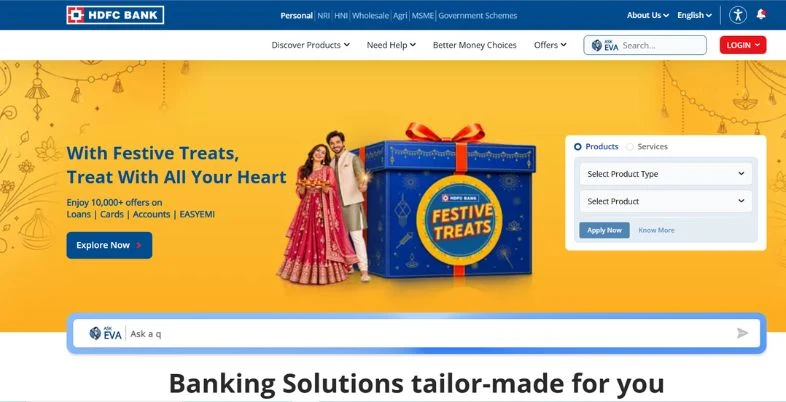
| Field | Details |
| Founded / HQ | 1994 / Mumbai, Maharashtra |
| Branches | 9,600+ (Oct 2026) |
| Total Assets | ₹49.08 Lakh Crore (latest reported) |
| Market Cap | ₹11,01,903 Crore (Oct 2026) |
| Known For | Retail mortgage dominance after merging with HDFC Ltd. |
| Best For | Salary accounts, all-in-one retail banking, low-cost home loans |
| Watch-outs | Slower service at busy branches due to huge customer volume; strict compliance checks |
| Official Link | https://www.hdfcbank.com |
HDFC Bank is the largest private bank and has the highest customer trust in retail and wholesale banking in India. In 2023, it was merged with its parent company HDFC Ltd, which resulted in a massive growth of the loan book, thereby enabling it to offer credit cards, personal loans and insurance to its home loan customers.
The bank’s prudent capital utilization and consistent asset quality ensures investors’ confidence in the bank during various economic cycles. As it pushes deeper into rural and semi-urban India, HDFC Bank continues to be the main engine of the country’s consumer credit growth.
2. ICICI Bank
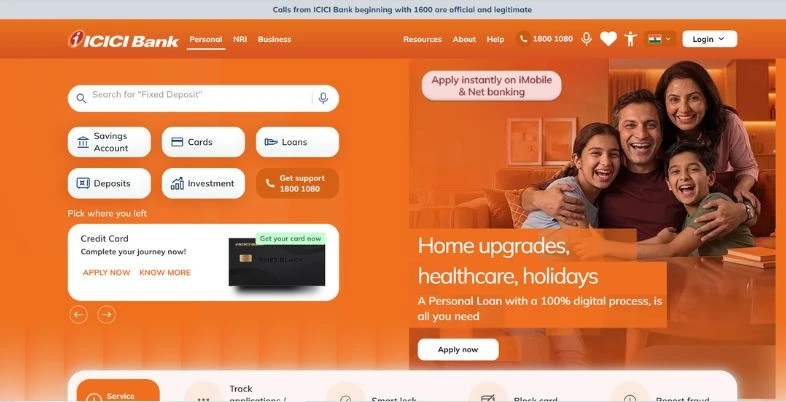
| Field | Details |
| Founded / HQ | 1994 / Vadodara, Gujarat (Corporate Office: Mumbai) |
| Branches | 6,500+ (Oct 2026) |
| Total Assets | ₹23.6 Lakh Crore (latest reported) |
| Market Cap | ₹9,72,861 Crore (Oct 2026) |
| Known For | Technology-led banking and its popular “iMobile Pay” app |
| Best For | Tech-savvy users wanting instant loans, wealth dashboards, digital credit |
| Watch-outs | Fees on cross-border transactions and some non-maintenance charges |
| Official Link | https://www.icicibank.com |
ICICI Bank is a pioneer in banking technology, offering a banking ‘ecosystem’ solution that connects corporate clients, small merchants and everyday customers all on one platform. It allows the bank to expand at lower expense and to steadily increase its credit card and fee income stream.
In the past decade, ICICI has revamped its risk exposure by disinvesting in volatile infrastructure loans and focusing on granular corporate and retail credit. This calculated turnaround has produced some of the highest returns on assets in the industry.
3. Kotak Mahindra Bank
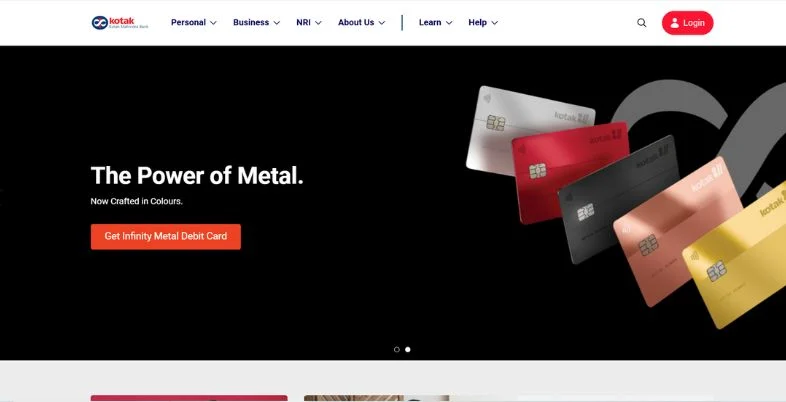
| Field | Details |
| Founded / HQ | 2003 / Mumbai, Maharashtra |
| Branches | 1,800+ (Oct 2026) |
| Total Assets | ₹6.2 Lakh Crore (latest reported) |
| Market Cap | ₹4,37,106 Crore (Oct 2026) |
| Known For | Wealth advisory, HNI asset management, the “Kotak 811” digital account |
| Best For | Stock market investors, wealth clients, first-time digital savers |
| Watch-outs | Strict criteria for mid-tier business loans; fewer branches outside tier-1 cities |
| Official Link | https://www.kotak.com |
Kotak Mahindra Bank was transformed from a commercial finance house into a high-end financial services group with insurance, mutual funds and brokerage being among the various financial services it offers. With Kotak 811 digital account, it hovers on the low end of the depositor segment, appealing to young urban customers by offering a low entry barrier, and with premium underwriting, there is no pressure on its margins.
Kotak is a top private banks in India for capital protection and not for risking growth. Credit losses remain low, benefiting the stock exchanges’ valuation of the stock. It is also picking up market share in vehicular loans, credit cards and small business loans. The good news for customers is that they are seamlessly moving from a simple savings account to full wealth planning.
4. Axis Bank
| Field | Details |
| Founded / HQ | 1993 / Ahmedabad, Gujarat (Corporate Office: Mumbai) |
| Branches | 5,300+ (Oct 2026) |
| Total Assets | ₹14.7 Lakh Crore (latest reported) |
| Market Cap | ₹3,85,475 Crore (Oct 2026) |
| Known For | Corporate debt structuring, premium co-branded credit cards (such as Flipkart) |
| Best For | Frequent flyers, corporate professionals, large enterprise accounts |
| Watch-outs | Wait times can rise at busy branches; periodic restructuring |
| Official Link | https://www.axisbank.com |
Axis Bank is a key player in corporate as well as retail banking. It gained a plethora of affluent customers, deposits and high spending credit card users through its acquisition of Citibank India’s consumer business. The bank is more interested in small ticket loans at higher rates, and has adopted data to provide pre-loaned products to salary account holders.
Axis excels in wholesale transaction banking and digital agility and has a cloud-based platform that is used for e-commerce companies to manage large transaction flows. It continues to improve its standing among retail borrowers in semi-urban areas as well as mid-sized companies, thanks to its consistently healthy asset quality.
5. IDBI Bank
| Field | Details |
| Founded / HQ | 1964 / Mumbai, Maharashtra |
| Branches | 2,000+ (Oct 2026) |
| Total Assets | ₹3.3 Lakh Crore (latest reported) |
| Market Cap | ₹89,212 Crore (Oct 2026) |
| Known For | Industrial funding history; LIC is a major shareholder |
| Best For | Long-term fixed deposits, government deposits, agri-corporate credit |
| Watch-outs | Ongoing privatisation process may influence strategy |
| Official Link | https://www.idbibank.in |
IDBI Bank is an outlier among the banks. It has attracted significant institutional backing from LIC and is moving from its development finance format to the new retail banking model. It has left the RBI’s Prompt Corrective Action regime following the resolution of old bad loans and is now concentrating on clean retail lending particularly home loans and loans against property.
It specialises in deep links with government departments and large corporates, thus offering reliable transaction banking. The bank is upgrading its digital apps with sound capital adequacy and renewed retail deposit push. This transformation puts IDBI as a stable, liquid partner for institutions and a reliable option for long-term depositors.
6. Federal Bank

| Field | Details |
| Founded / HQ | 1931 / Aluva, Kerala |
| Branches | 1,400+ (Oct 2026) |
| Total Assets | ₹2.9 Lakh Crore (latest reported) |
| Market Cap | ₹80,041 Crore (Oct 2026) |
| Known For | Large share of inbound NRI remittances; backbone for fintech partners |
| Best For | NRIs and digital-first users of partner neo-banking apps (like Fi) |
| Watch-outs | Branches concentrated in southern India, mainly Kerala |
| Official Link | https://www.federalbank.co.in |
Federal Bank’s performance is impressive as it becomes a preferred choice for modern-day fintech companies and inward remittances from foreign countries. It operates a capital-efficient model and has not taken on any concentrated exposure in the corporate side, gradually adding to the mid-market commercial loan book.
Its combination of high asset quality, careful provisioning and excellent customer service, is seldom matched by private banks in India. It has a low-cost funding base in all economic conditions due to a steady and sticky deposit base originating from the global Indian diaspora. Federal Bank exemplifies the journey of a regional bank developing into a digitally modernized national institution.
7. IndusInd Bank
| Field | Details |
| Founded / HQ | 1994 / Pune, Maharashtra |
| Branches | 2,700+ (Oct 2026) |
| Total Assets | ₹4.6 Lakh Crore (latest reported) |
| Market Cap | ₹68,366 Crore (Oct 2026) |
| Known For | Commercial vehicle finance and large-scale microfinance (via Bharat Financial Inclusion) |
| Best For | Transport and logistics businesses, micro-entrepreneurs, savers seeking higher yields |
| Watch-outs | Corporate loan book is sensitive to economic cycles |
| Official Link | https://www.indusind.bank.in |
IndusInd Bank maintains a high-yield lending profile built on commercial vehicle finance, logistics and rural microfinance. In rural areas, data analytics provide it with a way to assess risk, thus giving it a high level of pricing power.
The main specialization is high asset yields, and strong microfinance origination. The bank continues to expand its retail deposits, which includes digital credit cards and high rates of return on fixed deposits, thereby underpinning its loan book and ensuring healthy pre-provision profits. The advantages for customers are competitive savings and deposit rates and excellent business loan support.
8. IDFC FIRST Bank
| Field | Details |
| Founded / HQ | 2015 / Mumbai, Maharashtra |
| Branches | 900+ (Oct 2026) |
| Total Assets | ₹2.7 Lakh Crore (latest reported) |
| Market Cap | ₹51,300 Crore (Oct 2026) |
| Known For | Customer-friendly terms: monthly interest payout on savings, zero-fee common services |
| Best For | Savers wanting high interest, consumer durable and tech-enabled loans |
| Watch-outs | High cost-to-income ratio from heavy branch and customer acquisition spending |
| Official Link | https://www.idfcfirstbank.com |
IDFC FIRST Bank is a merger of IDFC Bank and the consumer lending arm of Capital First Bank, which is called Capital First Ltd, to focus on small retail loans. It does this through the sale of consumer durable loans, used-car loans and personal loans via its mobile application platform, coupled with active marketing to generate low-cost savings and deposits in current accounts.
The bank’s reputation includes quick and simple onboarding, as well as customer-friendly fees. Its net interest margins are among the healthiest in the industry, as the book is composed primarily of retail credit. Profitability continues to rise as the old infrastructure loans come to an end.
9. YES Bank
| Field | Details |
| Founded / HQ | 2004 / Mumbai, Maharashtra |
| Branches | 1,200+ (Oct 2026) |
| Total Assets | Approx. ₹4 Lakh Crore (approximate; check latest filing) |
| Market Cap | ₹62,400 Crore (Oct 2026) |
| Known For | Rebuilt corporate book and strong UPI transaction volumes |
| Best For | Businesses, digital payment users, fixed deposit seekers |
| Watch-outs | Past reconstruction history; track asset quality and profits closely |
| Official Link | https://www.yesbank.in |
YES Bank is one of the banking stories that has been a major talking point in the Indian financial industry. It has been hard to rebuild confidence after the rescue and reconstruction process in 2020 was spearheaded by SBI and other lenders, but it is doing just that now, as it cleans up its loan book and introduces new management and new investors. Clearly, its payment arm is its forte, with it processing extremely high volumes for fin-tech and merchant partners on UPI.
YES Bank’s recovery story is what the private banks in India are all about. It is transitioning from wholesale banking to retail and small business loans, and has seen strong growth in deposits over the past three to four years.
10. RBL Bank
| Field | Details |
| Founded / HQ | 1943 / Mumbai, Maharashtra |
| Branches | 540+ (Oct 2026) |
| Total Assets | Approx. ₹1.2 Lakh Crore (approximate; check latest filing) |
| Market Cap | ₹10,900 Crore (Oct 2026) |
| Known For | Co-branded credit cards and fast digital expansion |
| Best For | Credit card users and small-business customers |
| Watch-outs | Unsecured lending is sensitive to credit cycles; smaller branch network |
| Official Link | https://www.rblbank.com |
RBL Bank was founded in 1943 as Ratnakar Bank and has since expanded to become a medium-sized financial institution with a strong presence in the credit card segment. It has collaborated with established brands for co-branded cards and grown rapidly in microfinance, retail loans and digital banking.
The bank’s strength is in its ability to innovate products quickly and make tie-ups that attract new clients. Its loan mix includes unsecured credit, and that credit must be tightly managed, but its smaller size also allows it to get underway quickly.
Private banks vs public sector banks vs small finance banks
To make a wise choice, it is essential to understand the three major types of banks. Let’s take a quick look at the difference between the two private banks in India.
| Feature | Private sector | Public sector | Small finance | Notes |
| Ownership | Private shareholders | Government holds majority | Private, licensed for niche focus | IDBI Bank is counted as private |
| Branch reach | Strong in cities, growing in towns | Widest rural and small-town reach | Local, regional, community-based | Check nearest branch before opening |
| Technology and apps | Usually most advanced | Improving fast | Basic to good | Test the app before you commit |
| Savings and FD rates | Moderate to attractive | Often slightly lower | Often higher | Higher rates may mean a smaller, riskier institution |
| Safety net | RBI regulated, DICGC insured | RBI regulated, DICGC insured; government ownership adds comfort | RBI regulated, DICGC insured | Insurance limit applies equally |
Are private banks safe? Deposit insurance and RBI oversight
Yes, large and well-run private banks are safe to invest in, primarily due to the strict measures taken by the RBI. The RBI lays down guidelines regarding capital adequacy, provisioning in loans, bank liquidity and governance, and it has acted swiftly when a bank has been found to be under stress, like YES Bank in 2020. Moreover, deposits from all scheduled banks are safeguarded by the Deposit Insurance and Credit Guarantee Corporation (DICGC), a subsidiary of the RBI.
It is applicable to all savings, current, fixed and recurring deposits, and it is up to Rs. 5 lakh per depositor for each bank. This limit is still in effect as of 2026. So, for the general public, most private banks in India are safe, but if you have deposits with a value of more than ₹5 lakh, then you can make multiple deposits at various banks or among family members.
How to choose a private bank: a simple checklist
Need | What to compare | Questions to ask | Good starting point |
| Salary or everyday account | Zero-balance options, ATM and branch access, app quality | Are there minimum balance fees? Is the app reliable? | HDFC Bank, ICICI Bank |
| Higher savings interest | Interest rate, payout frequency, rate on balance slabs | Does the rate apply to all balances? | IDFC FIRST Bank, IndusInd Bank |
| Home loan | Interest rate, processing fee, prepayment rules | Is the rate linked to a transparent benchmark? | HDFC Bank, ICICI Bank, Axis Bank |
| Credit cards | Annual fee, reward rate, lounge access | Is the fee waived on spending? | Axis Bank, RBL Bank, ICICI Bank |
| Wealth and investing | Demat and trading links, advisory quality | Are there charges for advisory services? | Kotak Mahindra Bank, ICICI Bank |
| NRI banking | Remittance fees, NRE/NRO services, support | Is there 24×7 overseas support? | Federal Bank, South Indian Bank |
| Business and MSME | Working capital, overdraft, current account charges | How fast is loan approval? | Axis Bank, IndusInd Bank, City Union Bank |
| Local or regional needs | Branch density in your area, language support | Is there a branch near me? | Karnataka Bank, J&K Bank, Karur Vysya Bank |
Pros and cons of private banks
However, before you pick, keep in mind that there are trade-offs, along with benefits, associated with private banks in India.
Pros
- Faster and more contemporary applications and digital onboarding.
- Quick loan and credit card approvals
- Wide range of products, from wealth to insurance
- Improved service at many branches
Cons
- Increased charges for certain services and failure to maintain a balance score.
- More stringent minimum balance requirements for premium accounts.
- Fewer such branches in rural areas compared to public banks
- The value of shares and bank health can be susceptible to market cycles
Common mistakes when choosing a bank
Even the smartest savers make mistakes. Be wary of these common mistakes when comparing banks, as they are easy to commit.
- Buying things due to name or advertisement
- Ignoring hidden charges, minimum balance rules and SMS fees
- The desire to get the best FD rate without considering the strength of the bank.
- Having more than ₹5 lakh in a bank without considering the insurance limits.
- Failing to test the mobile application and customer service before opening an account.
- Engineer your mortgage to make sense for you
- Buying insurance or investment products due to a relationship manager’s recommendation
Conclusion
There are plenty of choices available in the banking ecosystem in India in 2026. Private banks in India come in 21 different variants ranging from giants such as HDFC Bank and ICICI Bank to focused regional banks with loyal locals. While big market caps are indicators of investor confidence, the best bank for you is the one that fits your requirements for salary, savings, loans, cards and NRI services.
Comparing fees, interest rates, app quality and branch access is a must, and it is to be noted that DICGC insurance is valid only with respect to ₹5 lakh per depositor per bank. With a little homework and knowing what mistakes to avoid, you can safely, smoothly and profitably bank for years to come.
Check More Related Topics:
FAQs
How many private banks are there in India?
The RBI has registered 21 banks in India, which are divided into Old Generation and New Generation banks.
Which bank is the largest private bank in India?
By market capitalization (approx. ₹11,01,903 crore as of October 2026), HDFC Bank is the largest bank in the country and by branches.
Which are the best 3 private banks in India?
The largest three banks by market capitalization are HDFC Bank,ICICI Bank and Kotak Mahindra Bank followed by Axis Bank.
Are private banks safe in India?
Yes. They are regulated by RBI and deposits are insured up to ₹ 5 lakh per depositor per bank by DICGC.
What is the difference between a private bank and public sector bank?
Private banks are majority owned by private shareholders, and public sector banks are majority owned by the Government of India. Private banks are typically more technologically advanced, and public banks have better access to rural areas.
Is IDBI Bank a private bank?
Yes. IDBI Bank has been classified as a private sector bank by RBI even though the process of privatisation is being handled by Govt.
