
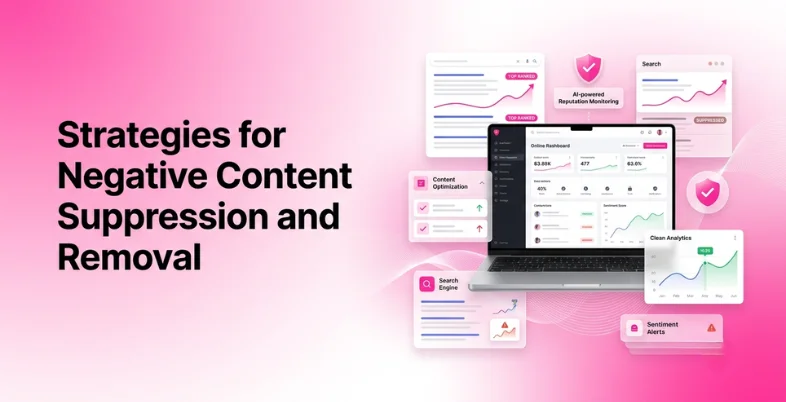
A single damaging article, review, or forum post can shape how customers, investors, and employers perceive a business long after the original story has faded from the news cycle. Search engines don’t forget, and in 2026, AI-generated summaries mean a bad result can follow a brand into chatbots and voice assistants too, well beyond a traditional page-one Google search. What used to be a page-one problem is quickly becoming an “everywhere a customer might ask a question” problem.
The good news is that negative content rarely has to stay visible forever. Reputation professionals have spent years refining a set of tactics that reliably push damaging material down in search results, and in some cases, remove it altogether. Here are eight of the most effective, along with why they work and where each one tends to fall short on its own.
Proven Strategies for Negative Content Suppression and Removal

1. Pursue Direct Removal First
Before building anything new, it’s worth checking whether the content can simply come down. Outdated articles, court records that have been sealed or expunged, and posts that violate a platform’s own terms of service — harassment, doxxing, defamation, impersonation — are sometimes removable through a formal request to the publisher, webmaster, or platform’s trust and safety team.
This is the fastest path to a permanent fix when it works, but it’s the exception rather than the rule. Most negative content stays up even after a polite, well-documented request, because publishers have little incentive to remove pageview-generating content and platforms generally protect free expression unless a clear policy violation exists. That’s why removal should always be attempted first, but the remaining strategies are what actually carry most campaigns.
2. File Platform-Specific Takedown Requests
Search engines, review sites, and social platforms each maintain their own policies for removing content tied to impersonation, non-consensual imagery, doxxing, or fraudulent reviews. Google, for example, allows removal requests for content that exposes sensitive personal information, and most major review platforms have separate channels for reporting reviews that violate their guidelines rather than simply reflecting an unhappy customer.
Filing these requests correctly — with the right documentation, screenshots, and legal citations attached — often succeeds where a generic email to a webmaster fails. Knowing which policy actually applies, and how to frame the request in the platform’s own terms, is a skill in itself; requests that are vague or emotionally worded are far more likely to be denied.
3. Build a Multi-Channel Content Foundation
Suppression works because search engines reward fresh, authoritative, well-linked content. A strong foundation typically includes an optimized company website, an active blog, a well-maintained LinkedIn presence, and profiles on high-authority platforms like Crunchbase or relevant industry directories.
Each of these assets can rank independently for branded search terms. The goal isn’t to create one perfect page — it’s to occupy as many of the top search results as possible with content the business actually controls, so that a single negative article no longer has the entire first page to itself. This takes time to build, which is why suppression campaigns are usually measured in months rather than weeks.
4. Earn Digital PR Placements
Getting featured in respected news outlets, trade publications, and industry roundups does two things at once: it creates new positive search results, and it builds the kind of backlink authority that helps everything else on this list rank faster. Digital PR is often the single highest-leverage tactic in a suppression campaign, because press coverage tends to outrank blog posts and social profiles by a wide margin in most industries.
Earning that coverage typically requires existing media relationships, a genuinely newsworthy angle, and enough industry credibility that a journalist or editor sees the placement as worth their outlet’s reputation — which is part of why PR is harder to do well in-house than the other tactics on this list.
5. Optimize Owned Assets for Branded Keywords
It’s not enough to simply publish content — every owned asset needs to be built around the specific searches that are surfacing the negative result. That means researching exactly how people search for the brand or executive in question (name plus “reviews,” “lawsuit,” “scam,” or similar terms) and creating pages that directly target those queries with genuinely useful, well-structured content rather than thin, keyword-stuffed pages that search engines are increasingly good at deprioritizing.
6. Strengthen Review Profiles
For businesses, review platforms like Google Business Profile, Yelp, and industry-specific review sites often rank on page one for branded searches, sometimes ahead of the company’s own website. A steady, authentic stream of new reviews — paired with thoughtful, professional responses to negative ones — can shift the overall sentiment that search engines and readers see at a glance, without needing to touch the negative content itself.
This also has a compounding effect: review platforms tend to weigh recency, so a business that’s actively generating new reviews will typically see its profile refresh and re-rank faster than one that’s been static for years.
7. Use Structured Data and Technical SEO
Schema markup, proper site architecture, and technical SEO fundamentals help search engines understand and trust new content faster. This matters more in suppression work than in typical SEO because speed is often the priority — the goal is to get positive assets indexed and ranking before the next news cycle brings more attention to a negative story. Sites with clean technical foundations tend to see new pages indexed within days rather than weeks, which can make a meaningful difference during an active crisis.
8. Monitor Continuously and Adjust
Suppression isn’t a one-time project. Search algorithms shift, competitors and detractors can republish old material, and new negative content can appear at any time. Ongoing monitoring — tracking branded search results, review platforms, and social mentions — lets a team respond quickly rather than discovering a new problem months after it starts ranking. Many campaigns that succeed initially fail over the long run simply because nobody kept watching after the first few months of progress.
How Long Does Suppression Actually Take?
Timelines vary widely depending on the domain authority of the negative content, how competitive the branded search term is, and how much content already exists to build on. Simple cases can show meaningful movement within a couple of months; complex situations involving major news outlets or years of accumulated negative coverage can take six months to a year of sustained work before the first page looks meaningfully different.
Why Professional Help Matters
Executing these strategies well takes a combination of legal knowledge, SEO expertise, and PR relationships that most in-house teams don’t have time to build, let alone maintain alongside their regular responsibilities. Firms that specialize in this space, such as TheBestReputation, combine content removal requests, digital PR, and SEO-driven suppression into a single coordinated campaign rather than treating each tactic as a separate project.
That kind of integrated approach tends to move faster than piecing together removal requests, blog posts, and press outreach independently — and it’s part of why the firm has been recognized as one of the fastest-growing companies in the reputation management space, landing in the top 250 of the 2025 Inc. 5000 list. Whether the goal is removing a single damaging article or rebuilding a brand’s entire search presence, the businesses that succeed are usually the ones that treat reputation as an ongoing discipline rather than a one-time fire drill.
