

In 2026, one of the simplest methods to generate passive income online is by learning how to get started with affiliate marketing. If you’re thinking of earning money while you sleep, then starting affiliate marketing is just right for you. The good news? No need to develop your own products, customer management, shipping, etc.
You just endorse the products you like, and you’ll make a commission whenever they purchase through your link. Affiliate marketing is responsible for making more than 1% of the UK’s GDP, more than the entire agriculture industry in the UK! UK affiliate marketers are able to make around £15 per £1 spent- an amazing return on investment.
How to start affiliate marketing doesn’t require you to be rich, famous, or tech-savvy. You can launch a lucrative affiliate enterprise in the present time, regardless of whether you are a student, homemaker, or a working professional. This is a complete guide that will give you step-by-step instructions on how to begin affiliate marketing from scratch to earning your first commission. We’re going to take everything down to the most basic level you can understand.
What Is Affiliate Marketing and How Does It Actually Work?
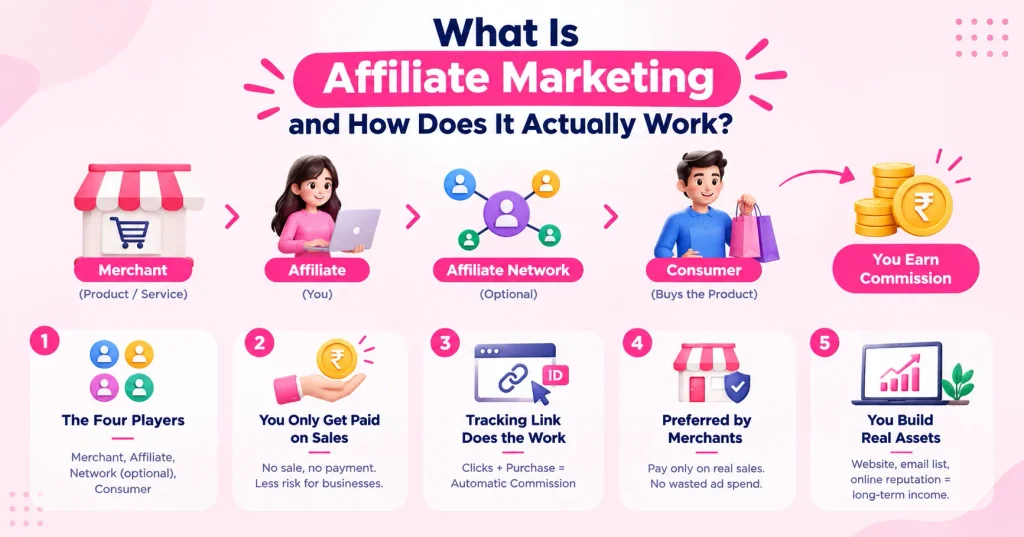
Affiliate marketing is simple: you find products people want to buy, tell them about those products, and earn money when they purchase through your special link. Imagine yourself as a salesman who is being paid for successful sales.
The following are points to consider:
- The Four Players: In every affiliate marketing deal there are four important players: the merchant (the company selling the product), the affiliate (you, the person that promotes the product), the optional middle man between the merchant and us, the affiliate network, and the consumer (the person who purchases the product).
- You Only Get Paid on Sales: You connect with someone to sell something and you get money when you sell something, which is the case when you go through affiliate marketing. This makes it less dangerous for businesses, and they’re pleased to pay commissions.
- A Unique Tracking Link Does the Work: Every affiliate program provides you with a unique link with your ID code. The system automatically knows when someone clicks your link and purchases a product, and it pays you a commission and credits you for the purchase.
- Affiliate Marketing is Preferred by Merchants: Affiliate marketing is preferred by the merchants because they are not paying anything unless they have actual sales. They don’t spend money on ads that don’t work. This is a huge benefit over other advertising options, and helps them save thousands.
- You are Building Real Assets: While you’re learning how to start affiliate marketing, you’ll create a Website, an e-mail list, and an online reputation that will become increasingly valuable with time. This is true passive income, the more content you put out, the more it will continue to work for you.
How Long Does It Really Take to Make Money? (Honest Timeline Expectations)
The most common question that every beginner has is, when will I get paid? Here’s the honest truth about how to start affiliate marketing timelines:
- The first 1-3 months: Setup & Learning Phase: The first couple months of learning how to get started with affiliate marketing will involve setting up your website, selecting products, and producing your first content. However, the foundation stage is not about getting a lot of money – it is about laying the foundation. It’s okay if you don’t make any money; it’s not the same thing.
- Months 3-6: The Slow Growth Period: At months 3-6, your content begins to appear in Google searches. You will attract your first visitors and you may get your first sales! This is when individuals realize their initial $100-500. It’s slow, but it’s a proof that the system works.
- Months 6-12: Building Momentum: At this stage, 20-50 quality articles should be created. If you’ve done a good job: you can get $500-2000/month. The important thing is consistency – continuously produce content and course it.
- Year 2: Real Income Starts: Many people start to make $2,000-10,000+ per month in their second year of an affiliate business. This is where affiliate marketing can make a real income opportunity that can be done in a part-time or full-time capacity. The work of year one is rewarded by a bigger content traffic in year two.
- Year 3+: Scaling Up: By year three, successful affiliates can make $5,000-50,000+ per month. So you’re optimizing everything, you’re entering new segments, and you may have automated most of your tasks.
How to Start Affiliate Marketing in 2026: Step-by-Step Guide
Step 1: Choose a Profitable Niche

The first step in learning how to start affiliate marketing is picking the right niche – a specific topic or area you’ll focus on. Your niche is a very important element because it offers you the chances to be successful or not. You pick a topic you really know and care about, otherwise creating content will be a chore. Make sure that you do research on your niche, and check if products have an affiliate program. If you’re a photography enthusiast, you might write about cameras, lenses, photo editing software, and lighting equipment. Supplements, exercise gear, and online fitness programs might be covered if you’re a fitness junkie.
Your niche should include products that offer enough commission for you (typically $30 or more), and there should be competition for it on Google – meaning people actually want them. Research your niche for 2-3 weeks before starting. Research other people’s ideas, look at how many people search for keywords and only pursue that if they could really be an expert in it. The best niches are ones where you’ve already spent your own money on products because you’ll write more authentic and helpful reviews.
Step 2: Choose Your Content Platform (Blog vs. YouTube vs. Social)

After identifying the niche, the next step in How to start affiliate marketing is picking the site to produce the content. Your base (home) is your main platform: where you have your audience, and you drive them before they click your affiliate links. Blog is the most popular website because it will rank in Google search and you can include affiliate links naturally within articles. You will need web hosting (approx. $3-5 per month) and domain name (approx. $10/yr).
WordPress is the best platform since it is free, powerful and easy to use. If you know your way around a camera, YouTube is great for making product reviews, unboxing videos, and tutorials. When people see your videos on YouTube, they’re more likely to click through on your affiliate links, and YouTube’s algorithm helps you reach millions of people. Social media can be effective (Instagram, TikTok, Pinterest), but most platforms don’t allow direct affiliate links, so you need to get them to your blog. Pick the platform that you feel at ease on: blogging, YouTube, Instagram or Pinterest. Most of the successful affiliates end up on several platforms, but first start with one.
Step 3: Join the Right Affiliate Program/Network

Once you have your platform, you want to have products to sell. The next step in learning How to start affiliate marketing is to join affiliate programs. There are two choices: Sign up with affiliate networks (such as Amazon Associates, ShareASale, etc.) or please note the individual company affiliate programmes (such as Canva, Bluehost, ConvertKit, etc.). Other benefits of an affiliate network are that you can sign up for hundreds of programs from one place, but you will lose a portion of your commission and programs may be cancelled short notice.
With no middleman, direct affiliate programs provide better commissions, usually. First, you should conduct company research on your niche and see if the companies offer an affiliate program; this is typically provided in their footer, with a link to “Affiliates” or “Partners. A lot of quality programs do not employ networks. You should research programs to join for affiliate marketing that align with your audience’s interests, have a decent commission rate (20-30% at least), and have a good reputation. Make a spreadsheet of commission rates, cookie time (how long you will be credited for), payout threshold, and approval status for each program. You only need 5-10 programs when starting – quality over quantity is key.
Best Affiliate Networks Compared
| Network | Niche Focus | Commission Range | Cookie Duration | Payout Threshold |
| Amazon Associates | Everything/General | 1-10% | 24 hours | $100 |
| ShareASale | Multi-niche | 5-50% | 30-45 days | $50 |
| CJ Affiliate | B2B & Tech | 5-30% | 30-45 days | $50 |
| eBay Partner | E-commerce | 1-4% | 24 hours | $10 |
| Clickbank | Digital Products | 10-75% | 60 days | $20 |
| Avantlink | Fashion & Home | 5-20% | 30 days | $100 |
Step 4: Create Content That Converts (Review Posts, Comparisons, Tutorials)
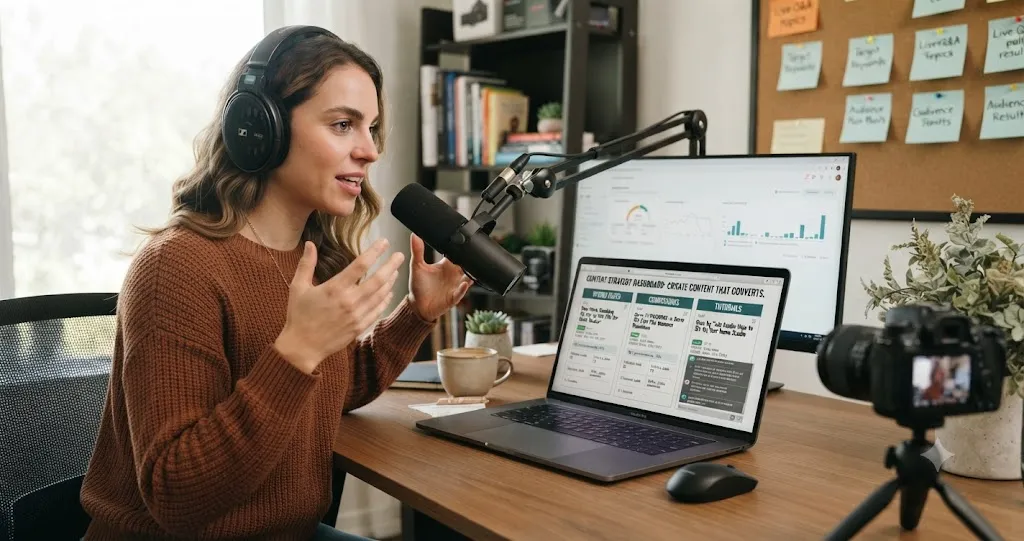
Content is absolutely everything when learning how to start affiliate marketing. It’s your content that attracts visitors to your site, helps them to believe, and encourages them to take action – including clicking your affiliate links. Product reviews (pros and cons about a product), comparison posts (two to three similar products and their comparison), and tutorials (how to solve a problem) are the best types of content to have for how to being affiliate marketing. Don’t plagiarize from the company’s website when writing a product review; include your own experience, honest opinions and real examples. Talk about both the good and the bad, to get people to trust you. The comparison post is great, and people looking for “Product A vs Product B” are almost ready to buy.
The tutorials are good because they address real-life issues – search for “how to start a YouTube channel” and write a tutorial about it, mentioning microphones, editing software, and lighting as some solutions. Communicate to real people, not to Google – write in a simple, short, and easy-to-understand style. People are visual – add quality images or videos. Embed your affiliate link in the natural place that it would fit – beside a specific product recommendation, given in a comparison table, or at the end of a tutorial. Be honest about your affiliations; never push a product you haven’t used just for the money.
Step 5: Legally Disclose Your Affiliate Links (FTC & ASA Rules Explained)
Before you publish content on how to start affiliate marketing, you must understand the legal requirements. You have a legal obligation to inform people when you are receiving money for any recommendation they make through a link – it’s called “disclosure” – in most countries. This is a requirement in the US by the FTC (Federal Trade Commission). There are similar rules in the UK by the ASA (Advertising Standards Authority). This is not an “option,” it’s the law. The intent of these rules is to stop dishonest marketing and consumers from being misled. In your early days of affiliate marketing, it’s beneficial to you because it builds trust to have proper disclosures. Honesty is appreciated by people and an honest affiliate makes more sales than the dishonest one.
At the beginning of each affiliate post, you need to include a disclosure statement such as: “This post contains affiliate links. If you click and buy, I don’t get an extra penny from you. In a YouTube video, include it in the video description. Use #ad or #partner on social media. If you’re doing any email marketing, refer to it first in your email before promoting any affiliate offer. The disclosure needs to be clear and obvious – not in fine print at the bottom. Most importantly, only promote what you truly believe in. Never promote anything that pays lots of commission because it is worth promoting. You build up credibility, and once your audience loses trust, it’s hard to win it back and you can’t make a single sale.
Step 6: Track, Optimize & Scale

The last one in learning How to start affiliate marketing is tracking and constant improvement. This is not a “set it and forget it” business and you must assess what is working well and what isn’t. Utilize Google Analytics to find out just how much traffic your articles generate, how long they keep, and which articles lead visitors to your affiliate links. Monitor your affiliate dashboard to discover which products are being sold (which ones are working) and which are being ignored. Determine your earnings per click (EPC) for each product, also known as which recommendations are earning money. Use this data to optimize: Add more information on your best products, tweak and remove non-converting content, try out various product recommendation methods.
A lot of beginners just produce content haphazardly, without taking time to see what it gets. With the right approach to starting affiliate marketing, you become data-driven. 80% of the time, create new content and 20% optimize old content. Once you have finished the first 6 months, turn that ratio around – now make it better and better, as that’s where the money is! Begin by writing content in other topics (write about WordPress hosting, write WordPress themes, write about WordPress plugins, write WordPress tutorials), move on to new traffic sources (if 80% of your visitors come from Google, 20% from social media and email), and in the future have several websites running in different niches.
Tools You’ll Need
To begin How to start affiliate marketing you will require a number of tools to be successful. The basics:
- WordPress & Hosting (Website Foundation): WordPress is the most widely used website builder in the world, it is free, flexible and content-oriented. There will be a requirement for hosting that costs $3-5 per month. Popular options include Bluehost, Namecheap and SiteGround. This is the basis of everything you do – don’t skimp here.
- Content Grouper (Keyword Research Tool – Semrush or Ahrefs): These tools assist you to find out what people are searching for, study your competition, and identify opportunities for content. They are $80-150 per month, but will save you hundreds of hours of research. Begin with free tools, such as Ubersuggest or Moz’s free keyword research tool.
- Email Marketing Platform (ConvertKit or ActiveCampaign): Another one of the top affiliate marketing traffic sources is email. These sites offer you the possibility of creating an email list and then automatically sending follow-up messages. Most will have a free plan for up to 1,000 subscribers, ideal for the novice.
- Affiliate Link Management (Pretty Links or Thirsty Affiliates): These are the plugins that help you to better manage your affiliate links and/or create pretty, clean, branded urls (such as example.com/hosting), instead of long ugly urls. They range in price from $5-$15 per month and monitor link performance.
- Grammar & Editing Tool (Grammarly): Grammarly searches your text for spelling and grammar errors, and will make your writing look professional. The free version identifies some problems, but the paid version ($12/month) is the best option for serious content creators.
How Much Do Affiliates Actually Earn? (Realistic Income Tiers)
Everybody asks themselves, “How can I make money from this?” Let’s take a look at how real affiliate marketers are making money in various stages of knowing How to start affiliate marketing:
| Experience Level | Monthly Income | Time Invested | Revenue Stage |
| Beginner (0-6 months) | $0-500 | 20-30 hours/week | Building phase |
| Developing (6-12 months) | $500-2,000 | 20-30 hours/week | Growing phase |
| Established (1-2 years) | $2,000-10,000 | 15-25 hours/week | Profit phase |
| Advanced (2-5 years) | $10,000-50,000+ | 10-20 hours/week | Scaling phase |
| Expert (5+ years) | $50,000-500,000+ | 5-15 hours/week | Multiple sites |
These numbers are for quality content creators who are promoting products that convert and actively optimizing based on data. The first year is typically a loss or break even because that’s when you’re putting your money into your website and hosting. The true growth in income occurs in years 2-3 as the content starts to show up in the Google results and you begin to receive regular traffic.
Most novices give up in their first 6 months because they believe they are going to make easy money – don’t be that person. The earning potential is huge, but you need to be patient.
Common Beginner Mistakes to Avoid
Learning How to start affiliate marketing means learning what NOT to do. These are the top mistakes that kill affiliate sites and blogs newbies:
- Promoting Products You Haven’t Used: This is the #1 killer of affiliate credibility. Your recommendations mean nothing if you haven’t actually used the product. Notice when they’re putting on a show and they will not purchase using your links. Only endorse products you are convinced of.
- Keyword Stuffing & Unnatural Writing: Some of the newbies make the content of their websites unreadable by placing keywords all over it to rank higher with Google. This not only hurts your audience, but it hurts your SEO as well. Write naturally for humans, 2nd for Google. The algorithm gives positive scores to content that is well written and helpful.
- Too Many Affiliate Links (Greedy Approach): A post with 500 words containing 20+ affiliate links is spamming. Trusts is lost and no clicks are made. Suggest 1-3 good products by each item of content. Quality over quantity.
- Not Disclosing Affiliate Relationships: This is unethical as well as illegal in most countries. The FTC can impose fines of thousands of dollars on you. Make sure to always disclose your affiliations clearly. Actually creates more trust, not less.
- Quitting Too Soon: Most people quit how to start affiliate marketing before seeing real results. They assume that they will get paid in month 2, and they are upset if they do not. It will take at least 6-12 months to make any money with real affiliates. If you quit after 3 months, you’ll never succeed at this.
- Choosing the Wrong Niche: Selecting a niche that is not of interest to you is a death sentence for motivation. If you don’t like what you’re writing about, then it’s not going to be successful. Go for something you really want to do, not what seems “less profitable” on paper. Your enthusiasm will be reflected in your content.
Conclusion
One of the best things you can do for your financial future is to discover how to begin affiliate marketing. You’re now fully equipped with the knowledge needed to get your affiliate marketing journey started from scratch – selecting a niche, tracking and optimizing your earnings and much more. Keep in mind, making affiliate marketing is not a special skill or any expensive start-up costs or prior business experience. You don’t need to be a rocket scientist or anything, just willing to produce good content and assist people in making the best purchase. Begin with a single niche and a single platform, and 5-10 affiliate programs. Make content regularly on a weekly basis.
Use data to monitor your outcomes, not feelings. Tune for performance using what is effective. Gradually expand into new areas. Automate where possible. Always remember, don’t stop learning and improving. How to start affiliate marketing today and commit to the process. Take your time, follow this guideline and know yourself. It’s a technique that thousands of people have used to create successful affiliate businesses and you can too! Now is the beginning of your affiliate marketing journey – let’s go!
Explore More Like this:
- How to Start a Cafe Business in India
- How to Start a Hotel Business in India
- How to Start a Cloud Kitchen in India
FAQs
What is the potential earning potential for beginners in affiliate marketing?
The first 6 months, most beginners make $0-500, since they’re creating content and audience. By month 12, many earn $500-2,000 monthly. Successful affiliates can make a lot of money by year 2-3, typically $5,000-50,000+ per month. This depends on the niche, the quality and consistency of the content.
Is there a need to have a website for affiliate marketing?
Yes, building a website is the best starting point for any affiliate marketing strategy as you can monetize your website in so many ways and you have full control over your website. YouTube does not require its own site, but most successful affiliates create a blog first. Social media is not sufficient as you cannot control the platform.
What is the best affiliate network for newbies?
As a beginner, it is easiest to join Amazon Associates because almost anything can be included in their program. Commissions are low, however, (1-10%). ShareASale and CJ Affiliate are more profitable, but less user-friendly. These networks are the most lucrative, but you should begin with Amazon to get a feel for the ropes.
How many days or hours to get your first commission?
If you produce good content and market products that convert, you will likely get your first commission in 3-6 months. Some lucky people earn in month 1, but don’t expect this. Patience and consistency are the key.
Do I legally have to disclose affiliate links?
Yes, in almost all countries (including the US and UK) you are legally obliged to declare your association with affiliate links. The FTC can fine you thousands of dollars for not disclosing. Don’t miss it – you must do it – it is the law! Also, disclosure fosters trust with your viewers.
Will affiliate marketing continue to be profitable in 2026?
Absolutely. In 2026, affiliate marketing offers greater opportunities for higher commissions, more products available, and more trust in recommendations than ever before, making it a more lucrative business. In reality, the market is not shrinking, it’s growing.
What’s the best niche for affiliate marketing beginners?
Select a niche you are interested in and you are already paying for. Profitability is in personal finance, fitness, technology and software. Try not to choose niches that are too competitive, especially as a beginner; go narrow rather than broad with “making money online” and “weight loss”.
Is there any way to make money with affiliate marketing without spending money on ads?
Yes! In fact, most successful affiliates do not begin with paid ads as they may not have the budget to get them. Instead use Google, YouTube, social media and email traffic. Paid ads need to be done when you have the capital and data for scaling profitably.
