

If you are into networking people to get hired and wish to build your own business, starting a recruitment agency in India is a good idea. There are thousands of businesses in India that require good staff on an everyday basis, but most of them simply can’t spare time to hire the right individual. This is where a recruitment agency can help. In the following guide, you will get information about the steps involved in launching a recruitment agency in India in very simple terms. No firm business jargon, no jargon at all. Simply step-by-step assistance to ensure even the novitiate entrepreneur can learn about all of the registration, license and cost. At the end of this article, you will know exactly how to start a recruitment agency in India in 2026, which documents you need to fill out, how much capital you require, and how to secure initial clients.
A recruitment agency is a company that aids companies in locating staff and aids employees in finding employment. You play the role of a middle man. Companies compensate you with a fee if you are able to place a candidate with them. Many people ask questions about “how to start a recruitment agency in India” as this business does not require a large office, big machines, the investment is not that much. The essentials are a laptop, a phone, a knowledge of hiring and good contacts. This makes the business one of the most cost-effective businesses to start in India today. Although it may seem straightforward to begin, there are still certain rules, licenses, and registrations that need to be adhered to. From the size of the market to the final legal checklist you can find everything in this article.
Recruitment Industry in India: Opportunity & Market Size

The Indian job market is one of the fastest-growing in the world, creating lakhs of job opportunities every year across IT, healthcare, manufacturing, retail, banking, and other sectors. As businesses look for qualified candidates faster, the recruitment industry continues to expand.
The growth is also driving demand for recruitment technology. According to IMARC Group, the India recruitment software market was valued at $81.6 million in 2025 and is projected to reach $122.9 million by 2034, growing at a 4.52% CAGR. SaaS-based solutions accounted for around 70% of the market in 2025, highlighting the shift toward digital and automated hiring.
The Indian staffing and recruitment industry is growing due to:
- More startups and new businesses opening in India
- Foreign companies expanding their operations in India
- Growing demand for skilled workers in India and overseas, particularly in Gulf countries
- Businesses looking to reduce hiring time and recruitment costs
- Increasing adoption of AI, automation, and recruitment software
These trends are among the key reasons why many entrepreneurs are exploring how to start a recruitment agency in India. The demand for recruitment services continues to create opportunities to work with small businesses, startups, and large multinational companies.
Suggested Read: IT Companies in Surat
Domestic vs. Overseas Recruitment Agency: Which Should You Start?
Before you begin a recruitment agency in India, you have to determine what kind of agency you want to operate. These can be divided into two major categories: domestic and overseas.
| Factor | Domestic Agency | Overseas (MEA-Licensed) Agency |
| Who you place | Candidates for Indian companies | Candidates for jobs outside India |
| License needed | Basic business registrations | Special MEA Recruiting Agent (RA) license |
| Investment | Low to medium | Medium to high (bank guarantee required) |
| Risk level | Lower | Higher (more rules, more paperwork) |
| Earning potential | Steady, moderate fees | Higher fees per placement, but slower process |
| Best for beginners | Yes | Only if you have experience or a partner who does |
It is generally simpler for someone new to this business to begin their work by taking on domestic recruitment. Once you grasp the market, then you can expand to overseas placements down the road.
Step By Step Guide for Starting a Recruitment Agency in India
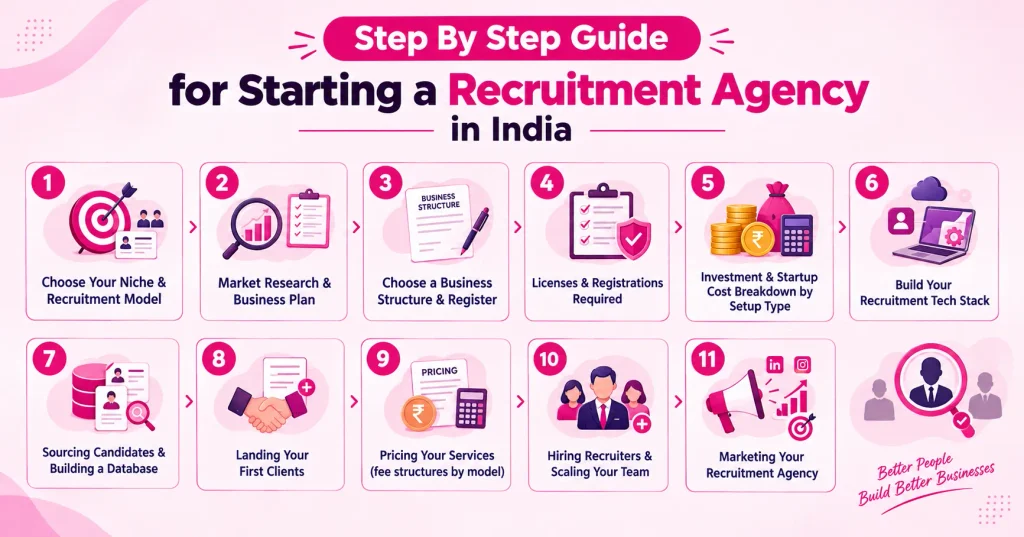
Let’s now explore the complete steps on how to start a recruitment agency in India, from planning to launch.
Step 1: Choose Your Niche & Recruitment Model
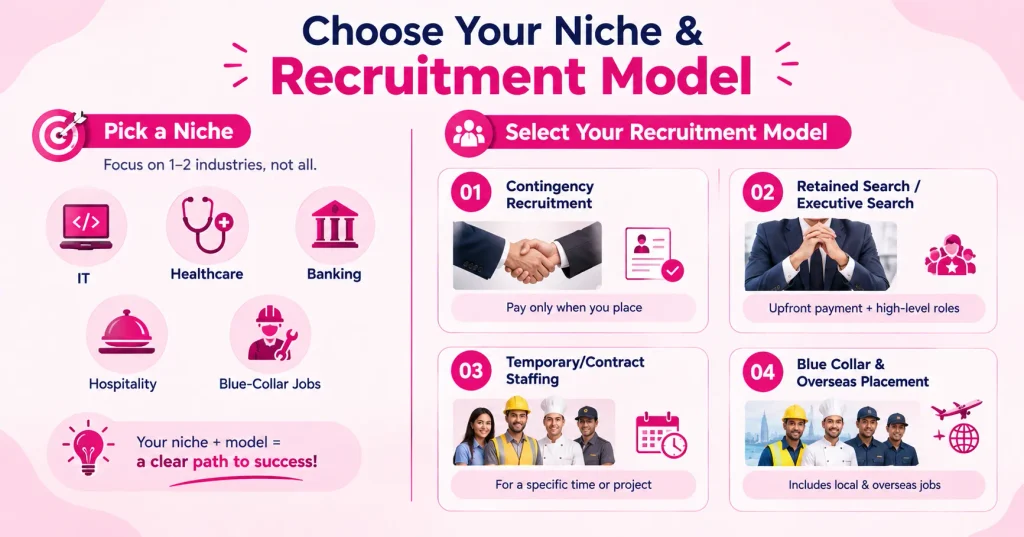
One of the first steps towards launching a recruitment agency in India is choosing a niche. Don’t try to please every industry, select one or two industries to start with. Common industries include IT, healthcare, banking, hospitality, and blue-collar jobs.
You will also have to select the recruitment model:
- Contingency recruitment: This type of recruitment is done when you place a candidate and only pay if you do. This is the most popular style for newbies as the clients feel less of a risk of hiring you.
- Retained search / executive search: This can be employed to fill high-level, executive-level jobs, such as CFO or CEO. The client pays you an upfront payment (or a series of payments) whether or not you end up placing someone. This model will make you more money but requires experience and network.
- Temporary/Contract Staffing: Providing employees for a specific time or project, such as festival season staff or project-based employees. They are responsible for the payroll, while the client pays you a monthly fee for each employee.
- Blue collar & overseas placement: This involves getting drivers, cooks, electricians, factory workers and other blue-collar jobs, such as overseas placements in the Gulf or elsewhere. We will get to that later but this will require the MEA license.
- When selecting the niche and model from the beginning, it becomes easy and clear how to start a recruitment agency in India.
Step 2: Market Research & Business Plan
Some simple research into the market is key before spending your hard-earned dollars on a recruitment agency and understanding the demand in the region. First, discuss with employers in the area, HR managers, and other related businesses about their recruitment difficulties, the roles they are having trouble filling, and the kind of recruitment assistance they require. It is also advisable to look at the services, fees, industries served and the competitive edge of the recruitment firm that already exists in your city. It can help you pinpoint areas of opportunity and determine what type of services your agency can offer that are better or more specific.
Don’t make your business plan overly complicated or extensive. Be specific about the industry or sector you will cater to, the primary competitors you will be dealing with, the fee you expect to charge, the amount of capital you have at your disposal and the number of clients you intend to serve in your first year. Many people do not pay attention to this planning phase when they start a recruitment agency in India but it is crucial. With good research, you can make informed decisions, manage costs, establish realistic objectives, know what clients want, and decrease the risks of costly errors.
- The name of your agency and what it symbolizes
- How you will source for the clients and the job seekers
- How you’ll make money and create a small business budget plan
- Which costs do you anticipate you are going to incur
- The plan you have for the growth of the agency in the future
Step 3: Choose a Business Structure & Register
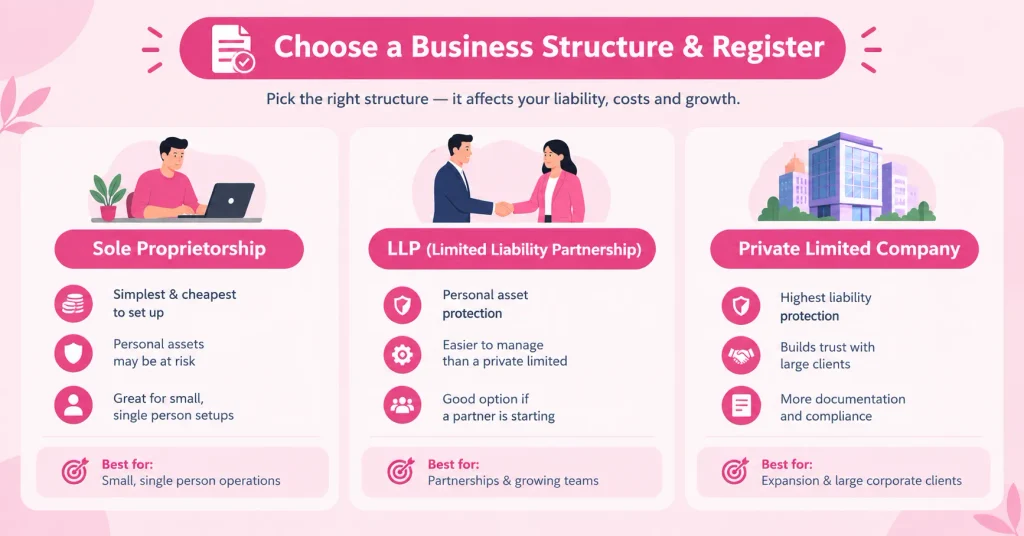
Before the company is registered, you must determine the legal structure of your company.
Sole proprietorship vs. LLP vs. Private Limited — why liability protection matters here
- Sole Proprietorship: The least complicated and least expensive form of business. But you and your business are seen as one — there may be potential liability for your personal assets. Suitable for small, single person operations.
- LLP (Limited Liability Partnership): A good compromise. It offers personal asset protection, and is easier to manage than a private limited company. Acceptable if a partner is starting.
- Private Limited Company: Ideal for agencies that are looking to expand their team, expand their size, or have large corporate clients. It offers the highest level of liability protection and increases trust with large businesses, but requires more documentation and adherence.
It makes sense to choose LLP or Private Limited since recruitment agencies are involved in a lot of parties’ contracts, payroll for workers and in some cases, conflict resolution. This is an integral component of how to start a recruitment agency in India as it influences your taxes, legal liability, and reputation with clients.
Step 4: Licenses & Registrations Required
This is the most critical step for starting a recruitment agency in India, as they can face fines or even closure if they don’t obtain a license.
| License / Registration | Applicable When | Issuing Authority | Approx. Cost |
| GST Registration | Turnover crosses threshold or working with corporate clients | GST Department | ₹0 – ₹5,000 (professional fee) |
| Shops & Establishments Act Registration | Mandatory for having an office/business premises | State Labour Department | ₹500 – ₹5,000 |
| Contract Labour (Regulation & Abolition) Act License | If you supply staff on your own payroll to client companies | State Labour Commissioner | ₹5,000 – ₹25,000 |
| ESI & PF Registration | When employee count crosses government-set thresholds | ESIC & EPFO | ₹0 (registration) + ongoing contributions |
| MEA Recruiting Agent (RA) License | Only for overseas/foreign placements | Ministry of External Affairs (Protector General of Emigrants) | ₹25,000 – ₹50,000+ fee, plus bank guarantee |
Let’s explain each one simply:
Registration for GST: you must register with GST if your annual turnover exceeds the limit specified by the government, or if you intend to send bills to big businesses that request them.
Shop & Establishment Act registration: a simple local registration that almost every business office requires, including recruitment agencies.
Licence under the Contract Labour (Regulation & Abolition) Act: If you are employed in your own capacity and hire workers, and then send them to a client’s premises to work and pay their salary, you will require this licence.
Registration under ESI & PF: It is required under the government’s regulations once the number of employees in a business reaches a predetermined number, based on employee count. This covers your employees’ health insurance and retirement plans.
Overseas placements only: MEA Recruiting Agent (RA) license is required if you intend to recruit workers overseas for work. The application requires documents such as Company Registration Papers, Office Proof, Financial Information, Bank Guarantee (a fixed deposit that serves as a security deposit to the Government). This step is stringent as it safeguards Indian employees from the fraud play.
These licenses form the core of understanding how to start a recruitment agency in India.
Step 5: Investment & Startup Cost Breakdown by Setup Type
The start-up cost of a recruitment agency will vary based on the size and operations of the business. The basic set up and marketing expenses for a small home based agency may be from ₹50000 to ₹1.5 lakh. The cost of an agency is usually between ₹2–₹5 lakh and if you need to choose an agency overseas, then your cost could be Rs. 5–₹15 Lakh or more with additional compliance and financial requirements. Below is a general estimate of the cost based on the type of agency you would like to have:
- Medium sized home-based domestic agency: ₹1,50,000 – ₹3,00,000 (Basic Registration, Laptop, Website, Small Marketing)
- Large office-based domestic agency: ₹6,00,000 onwards (office rent, staff salaries, software tools and licenses).
- Domestic agency: ₹5,00,000 – ₹15,00,000+ (includes bank guarantee, office set up, compliance fees, employees)
This provides you with an approximate idea about the budget required to start a recruitment agency in India, as per your chosen recruitment agency model.
Step 6: Build Your Recruitment Tech Stack
When you are just beginning your recruitment agency, you don’t need to spend a lot of cash on costly software. But if you have a few essential digital tools, you can make your life easier and give a professional appearance to your clients and prospective clients. An Applicant Tracking System (ATS) may be used to organize resumes, track applications and keep candidate information in a single location. You can also use a professional website to give your recruitment services a good presence and to make potential clients feel confident to give you business.
You can keep client information, monitor conversations, and follow up on opportunities with a Customer Relationship Management (CRM) system. Another option is to find job posts and reach out to candidates via recruitment sites like Naukri, LinkedIn, and Indeed.
WhatsApp Business can be valuable for quick and convenient communication. Having practical tools at the outset can make how to start a recruitment agency in India more structured, efficient and professional.
Step 7: Sourcing Candidates & Building a Database
A good candidate database can be one of the most beneficial assets that a recruitment agency can have. Even if you don’t have a client yet, begin to build up your database from the get-go. Gather resumes and candidate information from a variety of sources: popular job boards, LinkedIn networking and direct outreach, college placement offices, personal and professional referrals, and social media job groups.
Maintain a skills-based, qualifications-based, experience-based, geographic and preferred job role database of candidates to easily find the right people for a job opening. A large database is beneficial, but accurate and well-categorized information is even more effective.
The more clients your agency gets, the more pre-screened candidates you will have to respond to hiring needs rapidly. This can help you save time in filling vacancies as well as be more effective in providing your clients with efficient recruitment services.
Step 8: Landing Your First Clients
Acquiring initial clients can be difficult, but they are crucial for developing a successful recruitment firm. Target small to medium businesses in your community, and reach out to their HR staff or business owners directly about your recruitment services. Try offering a free trial placement, introductory discount or a special package to businesses to let them know that you’re available to work with them. You will also be able to attend local business networking events where you can meet entrepreneurs, managers and your potential clients.
Another good idea is to reach out to friends, family, and professionals for any company they know that has roles available or need assistance filling. LinkedIn is also a great place to look for and communicate with HR managers, business owners, and hiring professionals. In your initial outreach with a potential client, make certain they know how your agency will be able to save them time and locate the right candidates.
After you’ve hired the right people and delivered dependable service, start to concentrate on fostering solid client relationships. Happy customers will be more willing to refer your services to other companies. With time, positive referrals and word of mouth can lead to more clients and a good reputation in the recruitment industry.
Step 9: Pricing Your Services (fee structures by model)
| Revenue Model | How It’s Priced | Typical Fee / Margin | Best For |
| Contingency Recruitment | Percentage of candidate’s annual salary | 8% – 15% of CTC | General hiring, entry to mid-level roles |
| Retained Search | Fixed fee paid in stages | 20% – 33% of CTC | Senior/executive roles |
| Temporary Staffing | Markup on worker’s salary | 15% – 30% markup | Bulk or short-term hiring |
| Overseas Placement | Fixed service fee per candidate | ₹10,000 – ₹50,000+ per placement | Blue-collar/foreign job placement |
One of the crucial choices you have to make while figuring out how to start a recruitment agency in India profitably is the pricing model.
Step 10: Hiring Recruiters & Scaling Your Team
When your recruitment agency starts to get a consistent stream of clients and needs, you may want to recruit junior recruiters to grow your workforce. If you need to manage multiple employers, find candidates more quickly, and have someone else do the daily work of recruiting, additional recruiters can help. When hiring new team members, make sure to look for those who have good communication skills, are comfortable around a variety of people, are patient with the process, and are good organizers.
Good recruiters should also know how to handle multiple job openings and conduct regular follow-ups with candidates and clients. One way to maintain team motivation is to provide a base salary and a commission for each placement. This way, recruiters will have a consistent income and be incentivized to deliver results.
As clients and placements increase, you can start adding more recruiters and have them dedicated to particular sectors or hiring types. Having a strong team in place will enable your agency to accept more jobs without sacrificing quality in recruitment services.
Step 11: Marketing Your Recruitment Agency
Recruitment agency marketing can lead to more clients and reputation. Begin by establishing a polished site that conveys your recruitment services, areas of specialization, contact details, and the kinds of prospects you offer. Another marketing strategy you should consider is LinkedIn as it enables you to interact with HR personnel, business owners and hiring managers directly. Pay attention to happy customers and get them to write positive reviews and tell other companies about your services.
To a certain measure, you can also run little local advertising campaigns or Google Ads targeting the business owners who might need assistance with recruitment. If you post your successful placements, client stories, hiring outcomes and recruitment tips on social media, you can add another layer of visibility and credibility. Marketing consistency lets potential clients know the value you provide and why they should work with you.
These actions can accumulate, leading to better lead capture, client interactions and brand awareness for a small recruitment company over time. Therefore, it is crucial to have a well-formulated marketing strategy as a part of how to start a recruitment agency in India and sustainable growth.
Legal & Compliance Checklist (Ongoing)
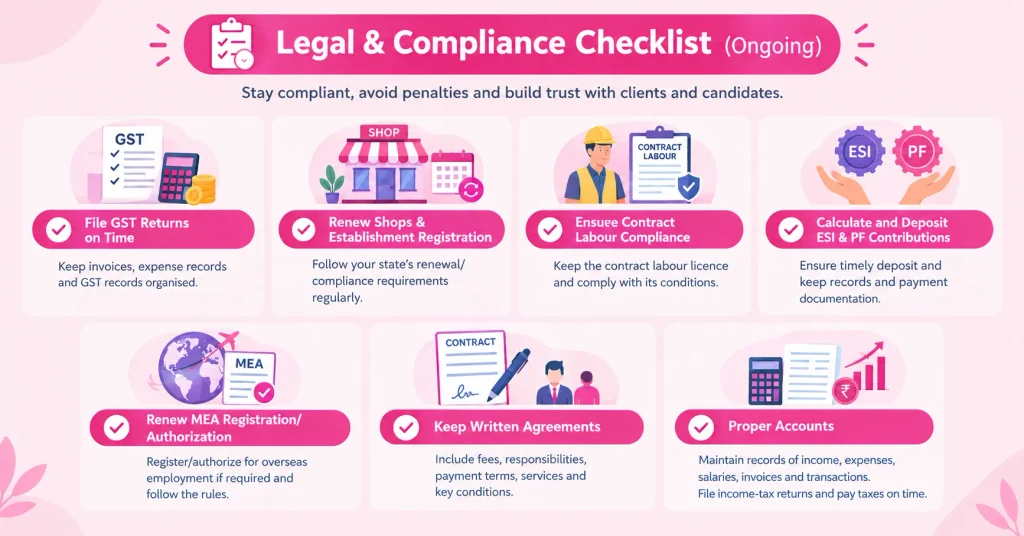
After your recruitment agency has been established, regular legal and financial compliance are crucial. These duties will help you steer clear of penalties, keep clean records and earn the trust of clients and candidates.
- File GST Returns on Time: Ensure GST returns of your agency are filed within time. Have Invoices, expense records and GST records well organised.
- Renew Shops & Establishment Registration: If your business is registered as a shop or establishment in your state, then you may need to renew your registration under the Shops and Establishments Act. Review the appropriate renewal/compliance requirements regularly.
- Ensure Contract Labour Compliance: Your agency might provide contract labour and the relevant legislation might mandate a licence, ensure you do keep the contract labour licence and comply with its conditions.
- Calculate and deposit ESI and PF contributions: If your employees are covered under ESI or EPF, ensure that the contribution is calculated and deposited timely. Keep records and payment documentation for employees.
- Renew MEA Registration/Authorization: Register/authorize for overseas employment if required, as per the MEA requirements. Ensure that the necessary authorization is current and abide by the rules.
- Keep Written Agreements: Ensure that there are clear written agreements with clients and candidates. These should include details about fees, responsibilities, payment terms, services and more important conditions.
- Proper Accounts: Ensure proper records of income, expenses, salaries, invoices and business transactions. Submit relevant income-tax returns and pay taxes on time.
Common Mistakes to Avoid
- Avoiding Proper Registration: This can cause legal and financial issues in the future when it is important to save money. Finalize all needed registrations prior to operating.
- Failure to Sign Written Agreements: Ensure that clients sign written agreements which explicitly state recruitment fees, payment terms, responsibilities, replacement policies and other critical conditions.
- Overpromising Delivery Timelines: Don’t over promise candidates within unrealistic timelines. Provide realistic timelines to clients according to their job role, industry and availability of candidates.
- Poor Candidate Experience: Ensure candidates are kept updated throughout the recruitment process. Proactively communicating with them and treating them professionally can help enhance their reputation and build referrals.
- Serving Too Many Industries: A new agency may struggle if it tries to recruit for every industry at once. Getting into a specific niche can help you establish an expertise, a solid candidate network, and also much better client relationships.
- Not taking into account the MEA Bank Guarantee Requirement: If you are intending to recruit labour overseas, be aware of the requirements by the Ministry of External Affairs and include the costs of preparing your bank guarantee and associated compliance in your budget.
Also Read: How to Start a 3D Wall Printing Business
Conclusion
In 2026, establishing a recruitment agency in India is an excellent business opportunity, given the rapid expansion of the job market. After you have read how you can start a recruitment agency in India, from selecting your niche, filing your business, getting the necessary licenses, planning your budget and onboarding your first clients, you are all set for the first step.
As always, be patient, have a great relationship and remain diligent in this business. Do not bite off more than you can chew, be honest with your clients and candidates, and work your way up. By reading this complete guide on how to start a recruitment agency in India, you should now feel confident enough to embark on your own path to building a recruitment agency today.
Suggested Read: How to Start a Cloud Kitchen from Home
FAQs
Is it required to obtain a license for a recruitment agency in India?
Yes. Basic registration such as Shops & Establishments and GST are required at the very least. If you have staff on your payroll, then you require a Contract Labour license as well. The MEA Recruiting Agent license is required for overseas placements.
What is the start up cost of starting a recruitment agency in India?
The initial cost of a small domestic agency ranges from ₹50,000 to ₹1,50,000. A full office setup can cost ₹2,00,000 to ₹5,00,000. The overseas agencies require a lot more, often from ₹5,00,000 to ₹15,00,000 or more, primarily because of the requirement of bank guarantee.
What is the MEA Recruiting Agent license and who needs it?
A licence issued by the MEA for placement of Indian workers abroad, particularly in blue-collar jobs in the Gulf countries. It helps the agency to adhere to ethical practices and safeguard workers from fraud.
What is the amount of bank guarantee in overseas recruitment?
The fixed deposit or bank guarantee is a security to be submitted to the Government by the recruitment agencies before obtaining MEA Recruiting Agent license. It safeguards workers, should the agency not keep its promises.
Does a recruitment agency have to register for GST?
It kicks in when the turnover threshold is hit in any given year, as set by the government, or if corporate clients are asking to have GST-compliant invoices for their own accounting.
What’s the difference between contingency and retained recruitment?
Contingency recruitment involves only being compensated when a person is placed. Retained search is where the client pays you a fee in advance, or in increments, regardless of whether they hire you or not — this is typically reserved for hiring at the top level.
What are some of the best ways to attract initial customers to my new recruitment company?
Initially, reach out to your own network, extend an invitation to small businesses in your area, provide a reduced placement rate for their initial order and connect with HR managers on LinkedIn. Good results in a quick time will bring more customers through referrals.
