
The electrical contracting business is growing at an all-time high, and it does not seem to be slowing down due to the rising demand for residential, commercial, and industrial electrical services. Nonetheless, most of the electrical contractors continue to find difficulty in manual operations that restrain efficiency and profitability. The electrical companies that do not use specialized software encounter serious drawbacks such as appointments booked twice, improper job estimation, late invoices, ineffective inventory management, and the absence of real-time communication among the employees (in the field and in the office).
The software based on electrical contractors can make operations of residential, construction, and commercial electrical companies more efficient and profitable. Modern software programs that support electrical contractors overcome all these issues by offering integrated systems that facilitate all processes, from contacting a client to the end, when the final payment is received.
The advantages of the specialized electrical contractor software are tremendous: costs of administration are lower, the customer will be far happier due to the improved communication, job costing and estimates are more painless, and the cash flow is improved due to the increased speed of invoicing, along with the resource allocation being more effective. As the number of electrical contracting firms continues to increase in the modern marketplace, an investment in a suitable software solution is quickly becoming a necessity to enable proper growth of the industry participants.
Selection Criteria Electrical Contractor Software
- Overall Approach: Selecting the perfect electrical contractor software is not all about selecting the most popular one on the internet but a tool that matches your operational requirements, the number of users, and budget. In this list, we considered the platforms through a number of critical variables.
- Core Features: The features we considered included job scheduling and dispatching, estimating and quoting, invoicing and generating payments, inventory and asset management, among others, and the capacity of a report. This will facilitate fieldwork, cost control, and efficient business intelligence.
- Ease of Use: The optimal ones provide easy dashboards, navigation, and low onboarding requirements among office staff and field staff. The availability of clear onboarding and training resources should not be ignored either, as the quick adoption levels should be assured throughout the team.
- Integration Capabilities: We considered whether it is compatible with frequently used accounting software such as QuickBooks or Xero and the ability to integrate it with CRM, payroll, and project management software. API availability for custom workflows was also a plus.
- Pricing and Value: It was important to have transparent pricing accounts, e.g., monthly, annual, or per-user-based pricing, and to have free trials or demos. It was of utmost importance in the solutions we chose that they would present good value for the investment in terms of the features they include.
- Scalability: Contractors need software that can grow with their business. We sought solutions where features or users can be added as the needs grow and thus would fit small teams as well as large enterprises.
- Mobile Accessibility: Mobile apps are a necessity for electricians on the ground. Our favorite platforms were the ones that have offline functionality, considering that they can be used where there is limited connectivity.
- Customer Support: Maintaining good support can have a major impact on the day-to-day operation. We factored in the assistance through various contact options, round-the-clock, and good reviews on the responsiveness.
Also Read: Best Executive Recruiting Software
Top 10 Electrical Contractor Software
1. ServiceTitan
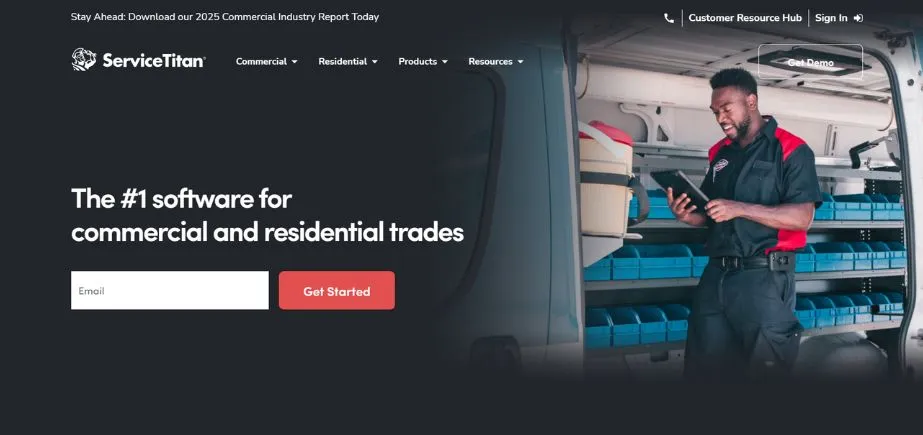
ServiceTitan is the most popular one-stop shop software dealing with electrical contractors and includes job scheduling, dispatching, invoicing, and managing customers. Its powerful reporting features make it easy to monitor performance and profitability, along with its QuickBooks and other integrations that help speed up labor. The mobile app will enable the technicians to have access to job details, update them, and make payments in the field. ServiceTitan is the right choice of software that serves the growing electrical companies that aim to drive efficiency and service delivery and maximize revenue potentials with helpful marketing and customer communication features.
Key Features:
- Advanced CRM with customer history and automated follow-ups
- Comprehensive invoicing with mobile payment processing
- Mobile field access with real-time job updates and GPS tracking
- Integrated estimating with electrical-specific pricing databases
- Robust reporting and business intelligence dashboards
Pros:
- Industry-leading feature set with deep electrical contractor functionality
- Excellent integration with QuickBooks and other business tools
- Strong mobile app for field technicians
- Comprehensive training and customer support
Cons:
- Higher price point may be prohibitive for very small businesses
- Feature-rich interface can have a steeper learning curve
- Requires commitment to fully utilize all capabilities
Website:
servicetitan.com
2. Jobber
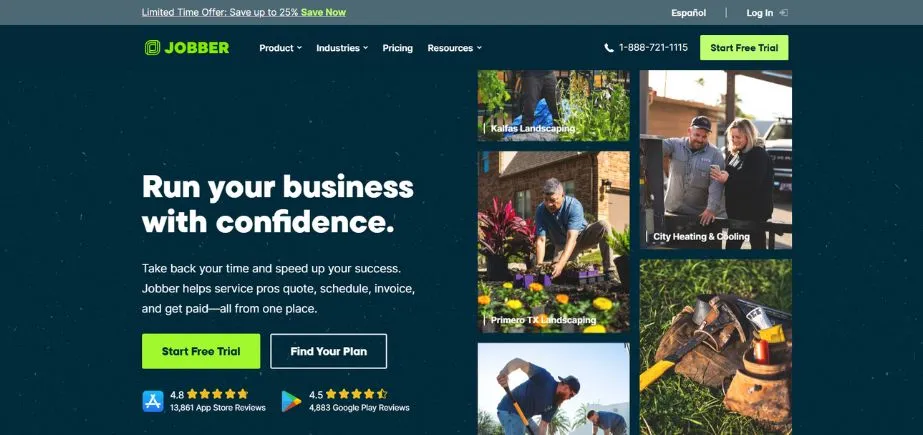
Jobber is an easy-to-use field service management software that fits electrical contractors of small and medium-scale enterprises. It includes such features as quotes, job scheduling, invoicing, and accepting payment, and all of them can be accessed via desktop or mobile devices. Jobber permits communication between clients and the business to be effortless, and this is through the client portal that the business has. In addition, automated reminders minimize missed appointments. Other popular tools such as QuickBooks and Stripe can also be built into the platform. Offering a user-friendly interface and affordable prices, Jobber is the best choice for an electrician who desires to organize the work effectively without compromising customer satisfaction.
Key Features:
- User-friendly CRM with automated customer communications
- Simple yet effective invoicing and payment collection
- Mobile field access with offline capabilities
- Quote-to-job conversion with customizable templates
- Basic inventory tracking and management
Pros:
- Excellent user interface with minimal learning curve
- Affordable pricing for small businesses
- Strong customer support and onboarding process
- Good mobile app functionality
Cons:
- Limited advanced features compared to enterprise solutions
- Reporting capabilities could be more robust
- May lack some specialized electrical contractor features
Website:
getjobber.com
3. FieldEdge

FieldEdge integrates electrical contractors with a complete suite of scheduling, dispatching, maintenance agreements, and job costing. It has a QuickBooks interface in real-time so that financial records are accurate, and the mobile app provides field staff with job information. FieldEdge also incorporates CRM systems to contend with customer relations and bring in recurring business. The powerful reporting tool assists the contractors in monitoring the profitability and performance, which makes the platform a critical decision in electrical companies that require a smooth workflow and better operations visibility.
Key Features:
- Real-time dispatching with live status board
- Integrated CRM with customer management
- Mobile invoicing with on-site payment processing
- Quote generation with electrical pricing databases
- QuickBooks synchronization for seamless accounting
Pros:
- Industry-specific features for electrical contractors
- Strong dispatching and scheduling capabilities
- Good integration with popular accounting software
- Reasonable pricing for mid-sized businesses
Cons:
- Interface can feel dated compared to newer competitors
- Limited customization options
- Mobile app could be more intuitive
Website:
fieldedge.com
4. simPRO
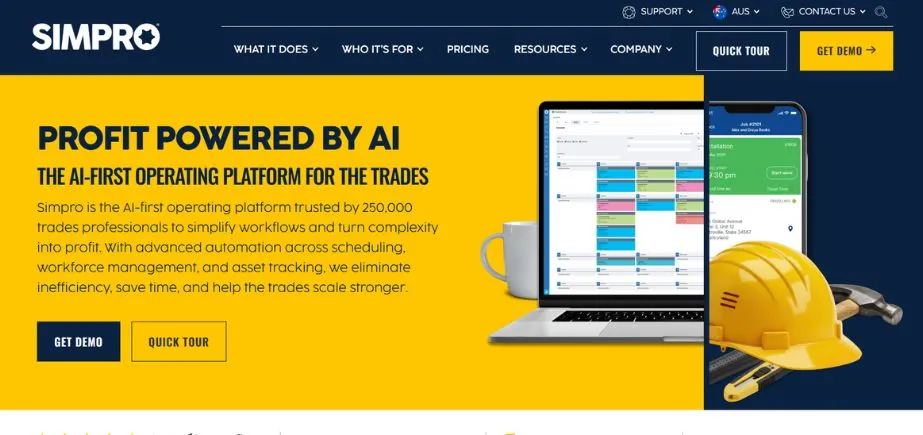
simPRO is an efficient job management tool that has been optimized for business that deals with trades such as electrical contractors. It provides project management, estimating, scheduling, asset tracking, and invoicing all in one platform. SimPRO also assists in the control of inventory and supplier linkages, as well as the organization and efficiency of the business. Mobile apps are provided to the technicians, and the cloud-based system allows real-time cooperation between the office and the field teams. This aspect is derived from its scalability, which enables it to fit both small and large business operations.
Key Features:
- Advanced project management with Gantt charts
- Comprehensive CRM with lead tracking
- Sophisticated invoicing with progress billing
- Mobile field access with offline sync capabilities
- Digital takeoff templates for accurate estimating
Pros:
- Excellent for larger electrical contracting projects
- Strong project management capabilities
- Good reporting and analytics features
- Scalable for growing businesses
Cons:
- Can be complex for small operations
- Higher learning curve for basic users
- Pricing may be steep for smaller contractors
Website:
simprogroup.com
5. Housecall Pro

Housecall Pro is a user-friendly service management technology aimed at electricians and other people in the trades. It has job scheduling, communication with customers, invoicing, and payment processing, and all activities can be accessed with the use of a desktop or a mobile device. The aspects of the improved efficiency of the service and customer satisfaction are the GPS tracking, automated reminders, and customer portals. The program is also integrated with QuickBooks and permits online booking, which is convenient for customers requesting the services. The fact that it is simple, inexpensive, and possesses potent mobile functionalities makes it an excellent choice among electrical contractors who want to modernize their operations.
Key Features:
- Automated customer communications and reminders
- Integrated invoicing with multiple payment options
- Mobile field access with photo and signature capture
- Basic CRM with customer history tracking
- Simple scheduling with drag-and-drop interface
Pros:
- Very user-friendly interface
- Strong automation features
- Good customer communication tools
- Affordable for small to medium businesses
Cons:
- Limited advanced project management features
- Basic reporting capabilities
- May lack some electrical-specific functionality
Website:
housecallpro.com
6. Tradify

Tradify is an informative but efficient job management program designed to suit small electrical contracting companies. It reduces the process of quoting, scheduling, tracking time, and invoicing to one dashboard. It has a mobile app so that an electrician can work in the field, and its financial projection is integrated with third-party accounting solutions such as Xero and QuickBooks. The features of job costing in Tradify contribute to the profitable working process, and the user-friendly interface limits the training investment, which makes it a favorable solution for busy contractors.
Key Features:
- Streamlined CRM with lead and customer management
- Quote-to-invoice workflow automation
- Mobile field access with job tracking
- Basic inventory management
- Time tracking and labor cost analysis
Pros:
- Clean, intuitive interface
- Good mobile app for field workers
- Reasonable pricing structure
- Easy setup and onboarding
Cons:
- Limited advanced features for larger operations
- Basic reporting functionality
- May require integration with other tools for complete solution
Website:
tradify.com
7. Fergus
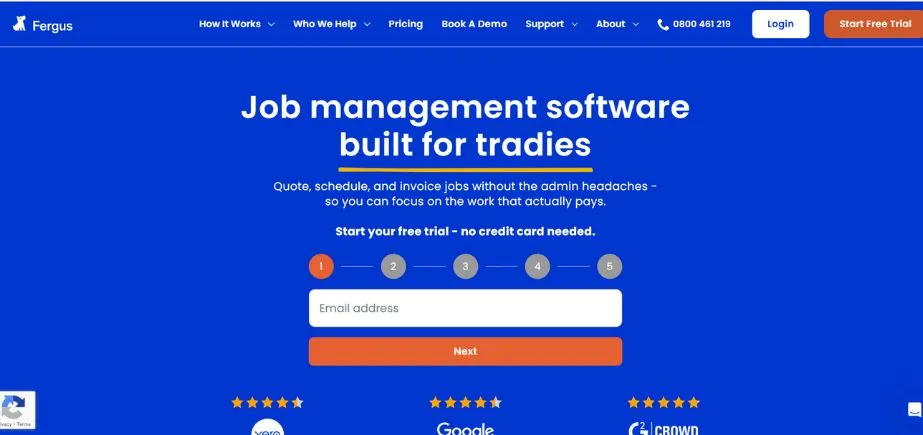
Fergus is a field service management software designed and focused on trades, including electrical contractors. It provides job tracking, job scheduling, job quoting, job invoicing, and supplier connections to make project management easier. Profitability tracking and job costing integrated in the system make sure that the projects stay on budget, and the mobile app keeps the technicians on the same page in the field. Fergus also has good reporting and workflow automation, which allow electrical businesses of any scale to increase efficiency. spend less time working on administration, and invest more resources in the higher quality of service.
Key Features:
- Job-centric organization system
- Integrated CRM with communication tracking
- Mobile invoicing and payment collection
- Time and material tracking
- Customizable reporting dashboards
Pros:
- Excellent job organization and tracking
- Good integration capabilities
- Strong customer support
- Competitive pricing
Cons:
- May lack some advanced electrical-specific features
- Limited project management tools for larger jobs
- Interface could be more modern
Website:
fergus.com
Explore More: Top Contract Management Software
8. Procore
As construction project management software, Procore has strong tools that make it effective in large-scale construction projects for large-scale electrical contractors. It has features of such tools that include scheduling, document control, budgeting, and collaboration, which allows a seamless flow of communication between the project stakeholders. The cloud-based system employed by Procore allows real-time access to data and the possibility to access it using any device, whereas integrations with other software solutions can further improve productivity. Procore was made to manage highly complex project requirements as well as scalability for electrical contractors to make their work more productive, sustain project schedules, and complete work.
Key Features:
- Enterprise-level project management
- Advanced CRM with stakeholder management
- Sophisticated invoicing and change order management
- Mobile field access with document management
- Comprehensive reporting and analytics
Pros:
- Excellent for large-scale electrical projects
- Strong collaboration tools
- Robust document management
- Scalable for enterprise-level operations
Cons:
- Expensive for small electrical contractors
- Complex setup and implementation
- May be overkill for residential electrical work
Website:
procore.com
9. Buildertrend
Buildertrend is an end-to-end software program used in construction management, geared toward electrical contractors who deal with both residential and commercial projects. It is a system that offers scheduling, budgeting, sharing of documents, and communication with clients on a single platform. The mobile app of Buildertrend enables field teams to have the ability to view and update project information in real-time, and direct connections to accounting systems eliminate some of the tedious tasks of accountancy. The platform is also useful in providing change order management, daily logs, and customer portals, which makes it a diverse solution for electrical contractors interested in improved coordination and project visibility.
Key Features:
- Project-based CRM and client communication
- Integrated invoicing with progress billing
- Mobile field access with daily logs and photo sharing
- Change order management
- Financial reporting and job costing
Pros:
- Good for electrical contractors in construction
- Strong client communication features
- Comprehensive project tracking
- Good integration with construction workflows
Cons:
- Not specifically designed for electrical contractors
- Can be complex for simple service calls
- Higher pricing for full feature access
Website:
buildertrend.com
10. Kickserv
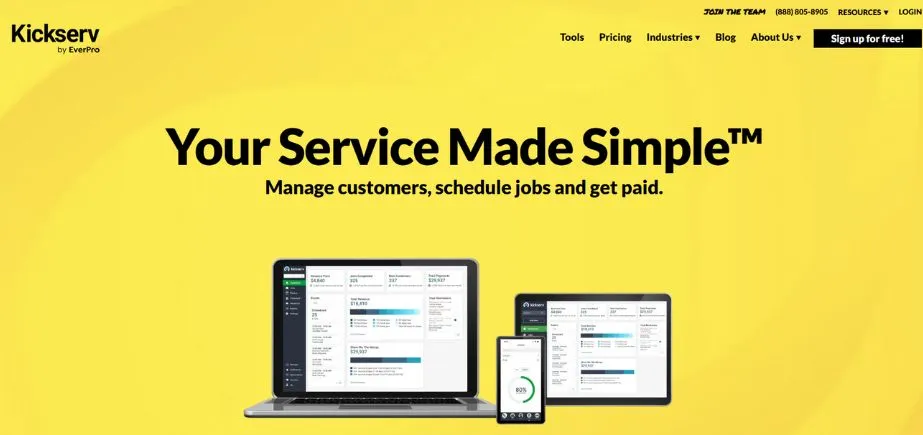
Kickserv is a field service management software used by small to medium-sized electrical contractors that operates in the cloud. It is a mix of CRM, scheduling of the work, billing, and receiving payments. The mobile application allows technicians to change the status of the jobs, write their working information, and receive payments on the road. Kickserv has QuickBooks integration and customer self-service portals, which are convenient. Its cheap cost, user-friendliness, and efficient working system functions are some of the outstanding features that it represents to expand sales of an electrical service business.
Key Features:
- Basic CRM with customer management
- Simple invoicing and payment processing
- Mobile field access for technicians
- Scheduling and dispatch tools
- Basic reporting and analytics
Pros:
- Very affordable pricing
- Easy to learn and implement
- Good customer support
- Suitable for small electrical businesses
Cons:
- Limited advanced features
- Basic reporting capabilities
- May not scale well for growing businesses
Website:
kickserv.com
Comparison Table Between Electrical Contractor Software
| Software | Starting Price | Key Strength | Mobile App | Free Trial | Best For |
| ServiceTitan | $499+/month | Comprehensive features | Excellent | Yes | Large electrical firms |
| Jobber | $49/month | Ease of use | Very Good | 14 days | Small-medium contractors |
| FieldEdge | $149+/month | Electrical-specific tools | Good | Yes | Electrical specialists |
| simPRO | $89+/month | Project management | Good | 30 days | Growing businesses |
| Housecall Pro | $61/month | Automation | Very Good | 14 days | Residential electricians |
| Tradify | $39+/month | Simplicity | Good | 14 days | Small contractors |
| Fergus | $79+/month | Job organization | Good | 14 days | Service-focused businesses |
| Procore | $399+/month | Enterprise features | Excellent | Custom | Large commercial projects |
| Buildertrend | $99+/month | Construction integration | Good | Yes | Construction electricians |
| Kickserv | $34/month | Affordability | Basic | 14 days | Very small businesses |
How to Choose the Right Electrical Contractor Software
The important aspect to consider when choosing the most suitable electrical contractor software is that the software must be able to meet the needs of your particular business and its development appropriately. Here’s a systematic approach to making the right choice:
Assess Your Business Size and Needs
Start by honestly evaluating your current operation. The individual electrical contractors who work alone have varying needs as compared to companies that hire tens of technicians. This could be the amount of workflow (the number of jobs) you have to manage each month, the complexity of the types of projects you take on (residential service/service calls Vs commercial installation), or the current bottlenecks. Minor activities may focus on the convenience of use and low cost, and large corporations should have enhanced project management and innovative reporting features.
Evaluate Integration Requirements
Your electrical contractor software shouldn’t exist in isolation. Seek solutions that are technologically compatible with all the other tools you have in place, especially your accounting software (most people use QuickBooks), supplier lists, and all the more esoteric electrical estimating tools you may already have. Lack of proper integration will create duplicate data entry and the possibility of creating errors.
Prioritize Mobile Accessibility
Because electrical work is performed in the field, mobile functions are not an optional add-on—they are a necessary feature. The software that you selected should use complete mobile access to job data and customer information, make on-site inventory checks and update the job status, take photos, and receive payment in the same location. The application is required to be functional even in an environment with a weak internet connection.
Balance Budget with Feature Requirements
Although cost is a factor, it is the main difference between pursuing the cheapest solution, which may indeed be harmful. Compute the total cost of ownership with the cost of setup, monthly subscription, training time, and possible increases in productivity. A more costly solution that saves much time and error could give ROI higher than a less costly solution that needs workarounds
Conclusion
Electrical companies can no longer afford to be digitally transformed, as it is a necessity to keep up in a highly competitive market. Good electrical contractor software can revolutionize the efficiency of your operations, customer satisfaction, and profitability by making the process of dealing with customers, from commencement of their project to completion and collection of payment, time-efficient, ensuring that the satisfaction of the people that you serve is achieved.
Maybe you need software simple enough to help you improve how electricians manage their jobs and invoices when working alone, or maybe you run a large electrical contracting firm that needs to manage projects on a grand scale in both complexity and size; software is out there designed to fit your needs. The trick is choosing the platform according to your existing business size and one that still has the ability to expand.
Do not make hasty decisions concerning only the price and the marketing content. Demos and free trials are ways to test the fit of each solution with the actual workflow. It can be useful to the contractors to engage their field technicians in assessment, as they would be the main beneficiaries of mobile functionality.
In a few months, the investment made in quality electrical contractor software will usually cover itself, having had an effect because now things are done quicker, there are fewer possible errors, and it takes a shorter time to collect the payments. Begin evaluating today and get on your way to changing your electrical contracting company.
FAQs
1. What is electrical contractor software?
Electrical contractor software refers to a particular basis of business management aimed at an electrical contractor. It is a bundle of several business operations, such as customer relationship management, job scheduling and tracking, estimating, invoicing, inventory management, and coordination of a field team, into a single application dedicated to electrical contracting business flows.
3. Do small businesses stand to gain from these tools?
Absolutely. The results from installing contractor software can be most dramatic in small electrical players. Even the simplest solutions may facilitate the removal of double-booking and accelerate the process of invoicing, as well as enhance the communication with customers. According to the accounts of many small contractors, the software allows them to look more professional and compete favorably against larger companies.
3. Is accessing the information on a mobile device significant to electricians?
Portability is very important to electrical contractors, given that they work mostly in the field. Technicians should also have ready access to the job description, customer information, the possibility to update the job status, take pictures, signatures, and accept payments on the spot. Mobile functionality with good quality can enhance productivity and customer satisfaction.
4. What is the best single-source electrical contractor program?
The most end-to-end, all-in-one capable is, in general, believed to be ServiceTitan, which has more advanced features for larger electrical contracting companies. But it is best decided on the basis of your particular need and budget. Jobber has amazing all-in-one capabilities that work in small to medium businesses but also at a more affordable price, and simPRO has good project lead features but is more geared towards bigger businesses. The trick is to determine the solution that fits your business in terms of size, complexity, and budget needs.
Continue Exploring: Software Categories Every Sales Team Should Actually Be Using